
The Human Chain That Reached Across Three Countries
On August 23, 1989, roughly two million people formed the Baltic Way across Estonia, Latvia, and Lithuania. Their peaceful line made freedom visible.
By Ryan Nichols
- 194 total reach
- 0 reading now•0 active 24h
- 0 shares•3 inbound
- 0 comments
By Ryan Nichols
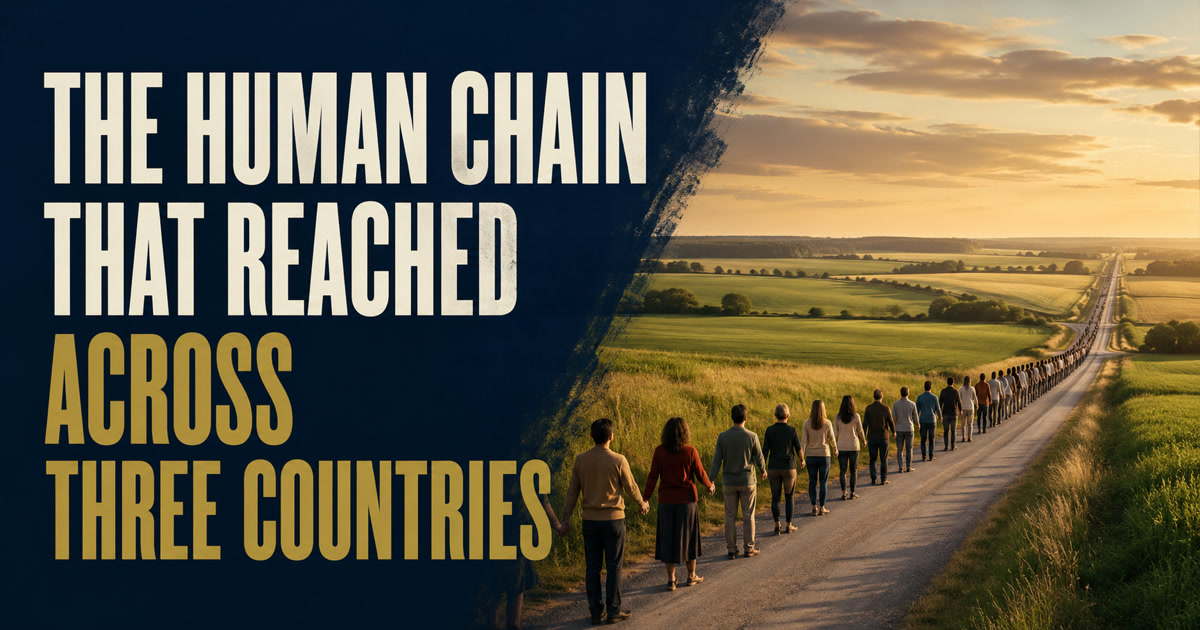
At 7 p.m. on August 23, 1989, people stopped being a crowd and became a line.
The line began in Tallinn, passed through Riga, and reached Vilnius. It crossed cities, villages, highways, fields, and three Baltic countries then controlled by the Soviet Union.
Roughly two million people held hands.
They did it for about fifteen minutes.
There was no weapon that could explain the image. No single speaker could claim the whole moment. The power came from ordinary people agreeing to stand in the same direction at the same time.
The demonstration became known as the Baltic Way.
It made a political demand visible across more than 600 kilometers: Estonia, Latvia, and Lithuania wanted their freedom restored.
Reader poll
What gives peaceful action its strength?
Tap your answer to vote
One tap. Free and anonymous. No signup to vote.
The date carried the argument
The organizers chose August 23 deliberately.
Fifty years earlier, Nazi Germany and the Soviet Union had signed the Molotov-Ribbentrop Pact. A secret protocol divided parts of Eastern Europe into spheres of influence. The Baltic states were later occupied and incorporated into the Soviet Union.
By 1989, national movements in Estonia, Latvia, and Lithuania were demanding recognition of that history and restoration of national independence.
The official Baltic Way history says the Popular Front of Estonia, the Popular Front of Latvia, and Lithuania's Sąjūdis organized the action. People traveled to populated and remote stretches of the route so the chain would not break between the capitals.
That logistical detail matters.
The famous photograph was only possible because people filled the unglamorous miles where no stage, camera, or monument was waiting.
More than 600 kilometers depended on the next pair of hands
Estimates of the route vary by source. UNESCO's Memory of the World record describes a 600-kilometer human chain and calls it a unique peaceful demonstration uniting three countries in their drive for freedom.
Guinness World Records records the chain at 675 kilometers, or about 419 miles, with approximately two million participants.
No one can reconstruct the exact head count across every road and city. Contemporary estimates differ. The scale is not in serious doubt.
Imagine the instruction reaching people before group texts, live location sharing, and smartphone maps.
Be in this place at this time.
Bring other people.
Stand close enough to close the gap.
Hold the line.
Every participant depended on strangers beyond sight. A person near Riga could not see Tallinn or Vilnius. Most could not see more than a small section of road.
They still knew what the line meant.
Reader poll
Where would you have wanted to stand?
Tap your answer to vote
One tap. Free and anonymous. No signup to vote.
A peaceful picture forced the world to look
The Baltic Way did not overthrow the Soviet system in fifteen minutes.
It did something a single speech could not.
It showed that the demand for independence was not an isolated complaint or a small group operating in secret. It had scale, discipline, and public courage across three nations.
The line also made repression harder to explain away. These were not armed units crossing a border. They were families, workers, students, elders, and neighbors holding hands.
Lithuania's official national portal describes the chain reaching more than 600 kilometers and notes that participants stood together for approximately fifteen minutes. Streets and highways became part of the statement.
Within months, the Soviet Congress of People's Deputies condemned the secret protocols attached to the 1939 pact. Lithuania declared the restoration of independence in March 1990. Estonia and Latvia followed as the Soviet Union moved toward collapse.
The human chain was not the only cause of independence. History that large never belongs to one day.
But the Baltic Way gave the movement an image the world could understand without translation.
The line held because people accepted an ordinary assignment
Most participants did not negotiate with Moscow.
They did not design the full route. They did not write the final declaration or know exactly what would happen next.
Their job was smaller.
Get to the assigned place. Reach for the next person. Do not leave a gap.
That is how large acts of service usually work.
The Small Boats That Crossed the Channel at Dunkirk tells a rescue story built from many vessels completing different parts of the same mission. The Berlin Airlift Kept a City Alive One Landing at a Time shows how repeated individual actions can become an international lifeline.
The Baltic Way carried the same lesson without engines or cargo.
The person beside you does not need you to control the entire outcome. That person needs you to keep your part of the line.
Freedom became something people could see
The Baltic Way survives in photographs and archives because the demonstration understood something important about public truth.
An idea can be dismissed as abstract.
A visible human commitment is harder to ignore.
The participants took a claim about history, sovereignty, and freedom and gave it physical shape. The chain crossed boundaries drawn by power and connected people whose nations had been told their independence was finished.
It was peaceful without being passive.
It was disciplined without being controlled by one personality.
It lasted fifteen minutes, but it had been prepared by years of memory, organizing, courage, and refusal.
The Battlefield Memory That Became the First Geneva Convention is about turning a moral truth into a rule that could outlive the witness. The Baltic Way did something parallel. It turned private memory and national longing into a public line too large to hide.
If stories about courage, service, freedom, and the systems behind public change matter to you, join the RealRyanNichols.com email and text list. The next story will meet you there.
What is one line you would be willing to hold even if you could not see where it ended?
Reader poll
What part of the Baltic Way stays with you?
Tap your answer to vote
One tap. Free and anonymous. No signup to vote.
Sharing this is the biggest help. Put it in front of one more person.
Verification note: Historical claims were checked on August 23, 2026 against UNESCO's Memory of the World record, the official Baltic Way history project, Lithuania's national portal, and Guinness World Records. Contemporary route and participation estimates vary, so the article uses approximate figures.
OG artwork disclosure: The social image is an original synthetic historical illustration. It is not archival evidence and does not depict an identifiable participant, an exact location, or a documented photograph from the Baltic Way.
You made it to the end
Most people quit at the headline. You didn’t.
So don’t stop here. Pick one.
Read the book
Fighting Shadows is the whole story in my own words: the road into January 6, the D.C. jail, and the fight to get the record out.See the book
Follow the case
The record is still being written. Get one email when something new drops on it.
Hire Ryan
I built this site. Want one that brings your business real leads? Start with a free 30-minute call.See the services
Tap how this hits you — no signup, everyone sees the count
Share this post — get it back in front of people
Comments
Speak here
Create an account to comment.
This is where people can say what gets buried or cancelled elsewhere. Comments are signed-only, moderated, and tied to a real profile so the record stays usable.
No approved comments yet. Create an account and put the first opinion on the record.