
The Steel Chamber That Brought 33 People Up From the Bottom
When USS Squalus sank in 1939, a new rescue chamber made four descents and brought 33 survivors home. The story shows what preparation makes possible.
By Ryan Nichols
- 252 total reach
- 0 reading now•0 active 24h
- 0 shares•0 inbound
- 0 comments
By Ryan Nichols
Facts last checked: August 10, 2026, 5:00 a.m. Central
The submarine was sitting on the bottom in 243 feet of water.
Thirty-three people were alive inside the forward section. Twenty-six others had already died when the after compartments flooded.
It was May 1939, off Portsmouth, New Hampshire. USS Squalus had gone down during a test dive after a catastrophic problem with its main engine air-induction valve.
The survivors could not simply swim to the surface. Pressure, cold, darkness, distance, and the condition of the boat stood between them and daylight.
Their rescue depended on a steel chamber that had never before saved anyone from a sunken submarine.
It went down four times.
Every survivor came up.
Reader poll
What gives a rescue team the best chance?
Tap your answer to vote
One tap. Free and anonymous. No signup to vote.
The emergency started before the rescue was ready
The Naval History and Heritage Command records that Squalus suffered its valve failure at 7:40 a.m. on May 23, 1939, during a test dive off the Isle of Shoals.
The partially flooded submarine came to rest upright on the seabed. The 32 surviving Navy crew members and one civilian were trapped in the forward compartments.
Above them, rescuers first had to find the boat, establish contact, position a rescue ship, and prepare equipment that had existed mostly as a response to earlier disasters.
The idea for a submarine rescue chamber had been pushed forward after losses in the 1920s. Navy officer Charles “Swede” Momsen had argued for a diving bell that could connect to a submarine's escape hatch. Allan McCann later directed design revisions, and the Navy adopted the device known as the McCann rescue chamber.
It was a blunt-looking machine. It did not need speed, elegance, or a dramatic shape. It needed to travel down a cable, seal against a submarine hatch, equalize pressure, carry survivors, and return to the surface without losing the connection.
Years of work existed inside that simple requirement.
Four trips into the dark
The rescue ship USS Falcon lowered the chamber at 11:30 a.m. on May 24, according to the Navy's official history of the sinking and rescue.
The chamber connected to the submarine's escape hatch. Water in the lower compartment could be forced into ballast tanks, pressure could be equalized, and the hatch could open so the trapped people could enter.
Then the chamber had to rise.
It returned to the bottom again.
And again.
And again.
The U.S. Naval Undersea Museum's submarine rescue chamber history says four trips retrieved all 33 survivors. The Navy completed the operation over roughly thirteen hours.
That number can sound clean now. Four descents. Thirty-three rescued.
It was not clean while it was happening. It was heavy equipment, deep water, cables, pressure, fatigue, and a machine proving itself while lives depended on the proof.
Reader poll
What is hardest during a long emergency?
Tap your answer to vote
One tap. Free and anonymous. No signup to vote.
Courage had a system around it
Rescue stories are often shortened until courage appears to be the only ingredient.
Courage mattered. Navy divers worked under dangerous conditions, and four received the Medal of Honor for their actions in the rescue and salvage effort.
But bravery did not invent the chamber after the submarine sank.
Somebody had studied earlier failures. Somebody had argued for a different capability. Engineers had designed, revised, tested, and stored the equipment. Divers had learned how to work at depth. A rescue ship carried the chamber. A team knew enough to place it over an escape hatch on a submarine they could not see from the surface.
Preparation did not make the operation safe. It made rescue possible.
That is an important difference for every search team, business, family, church, and community organization.
You cannot predict the name, time, or shape of every emergency. You can still decide before it happens:
- who takes command;
- how the team communicates;
- where critical equipment lives;
- who knows how to use it;
- what happens when the first attempt fails; and
- how facts and decisions are recorded under pressure.
The Apollo 13 filter story shows what people can improvise when the original system breaks. The Squalus rescue shows the other side of preparedness. Sometimes the thing that saves people is not invented during the emergency. It is the capability someone refused to stop building before anyone needed it.
The fourth trip matters
The first successful descent proved the chamber could work.
The fourth proved the team would keep working until everybody they could reach was out.
There is a danger in celebrating an early win before the actual mission is complete. A first group arrives safely, a missing person is found, a system comes back online, or the public danger begins to pass. Relief can arrive before the responsibility is finished.
A disciplined team asks:
Who is still down there?
That question is not only for literal rescues.
Who has not received the update? Which customer is still locked out? What family is still waiting for an answer? Which piece of equipment was used and must be restored? What decision still needs a receipt?
Completion is not the moment the team feels better. It is the moment the defined responsibility has been handed off, closed, or honestly declared beyond reach.
If a responsibility is too heavy to carry alone, asking for help before the wheels come off is not weakness. It is part of building the team that can make another trip.
The boat came back too
The story did not end when the survivors reached the surface.
The Navy later raised Squalus after a difficult salvage operation. The submarine was decommissioned, renamed USS Sailfish, recommissioned in 1940, and went on to serve during World War II.
That does not erase the 26 deaths. A recovered machine is not a substitute for the people who did not come home.
It does show that failure can be investigated, rebuilt, and returned to useful service without pretending the loss never happened.
The full record holds both truths: people died, and 33 people lived because preparation met courage at the bottom of the Atlantic.
The invitation
Most days do not feel like rescue days.
That is when readiness is built.
Check the equipment. Write the contact plan. Train the second person. Back up the record. Ask what failed last time. Make the process clear enough to use when nobody has spare attention.
Then, when the day comes, make the first trip.
And if somebody is still down there, make the next one.
Join the RealRyanNichols.com email and text list to follow more stories about service, hard lessons, rebuilding, and the systems people create when the stakes are real.
Reader poll
What readiness step will you take this week?
Tap your answer to vote
One tap. Free and anonymous. No signup to vote.
Sharing this is the biggest help. Put it in front of one more person.
Primary and authoritative sources
- Naval History and Heritage Command, USS Squalus sinking, rescue, and salvage
- Naval History and Heritage Command, The Rescue of USS Squalus
- U.S. Naval Undersea Museum, Submarine Rescue Chamber
- U.S. Naval Undersea Museum, Saving Submariners
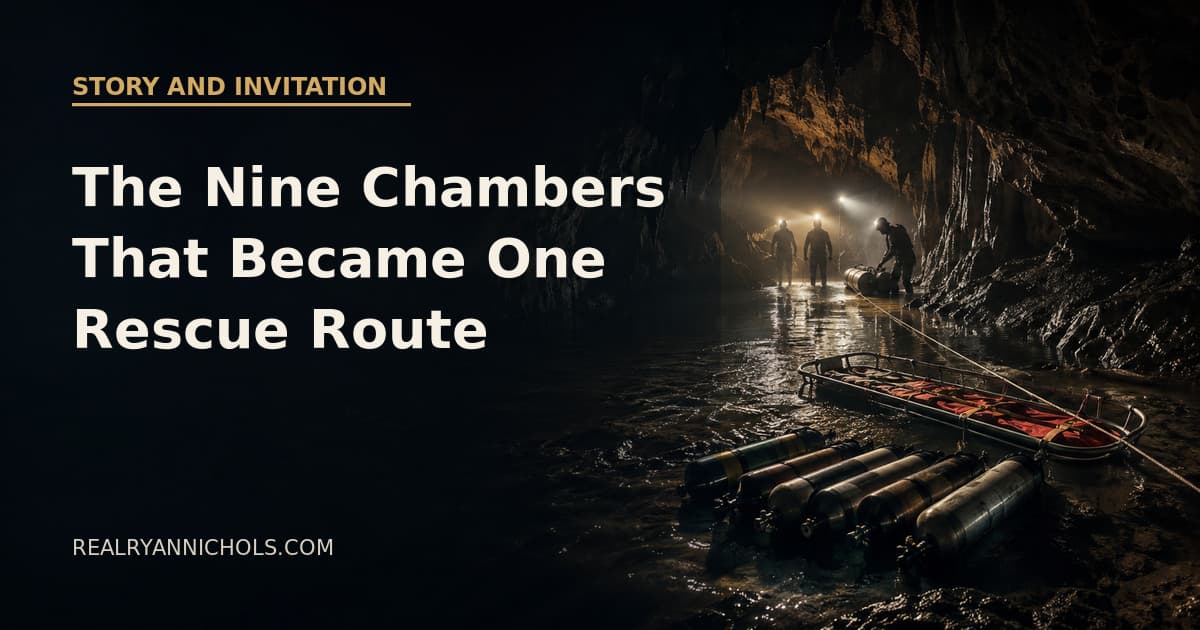
OG artwork disclosure: The social image is an original synthetic historical reconstruction. It is not an authentic photograph of USS Squalus, USS Falcon, the McCann chamber, or the 1939 rescue.
You made it to the end
Most people quit at the headline. You didn’t.
So don’t stop here. Pick one.
Read the book
Fighting Shadows is the whole story in my own words: the road into January 6, the D.C. jail, and the fight to get the record out.See the book
Follow the case
The record is still being written. Get one email when something new drops on it.
Hire Ryan
I built this site. Want one that brings your business real leads? Start with a free 30-minute call.See the services

Tap how this hits you — no signup, everyone sees the count
Share this post — get it back in front of people
Comments
Speak here
Create an account to comment.
This is where people can say what gets buried or cancelled elsewhere. Comments are signed-only, moderated, and tied to a real profile so the record stays usable.
No approved comments yet. Create an account and put the first opinion on the record.