
The 27-Minute Ceremony That Ended World War II
On September 2, 1945, a 27-minute ceremony aboard the USS Missouri formally ended World War II. Eight paragraphs carried the weight of six years.
By Ryan Nichols
- 139 total reach
- 0 reading now•0 active 24h
- 0 shares•0 inbound
- 0 comments
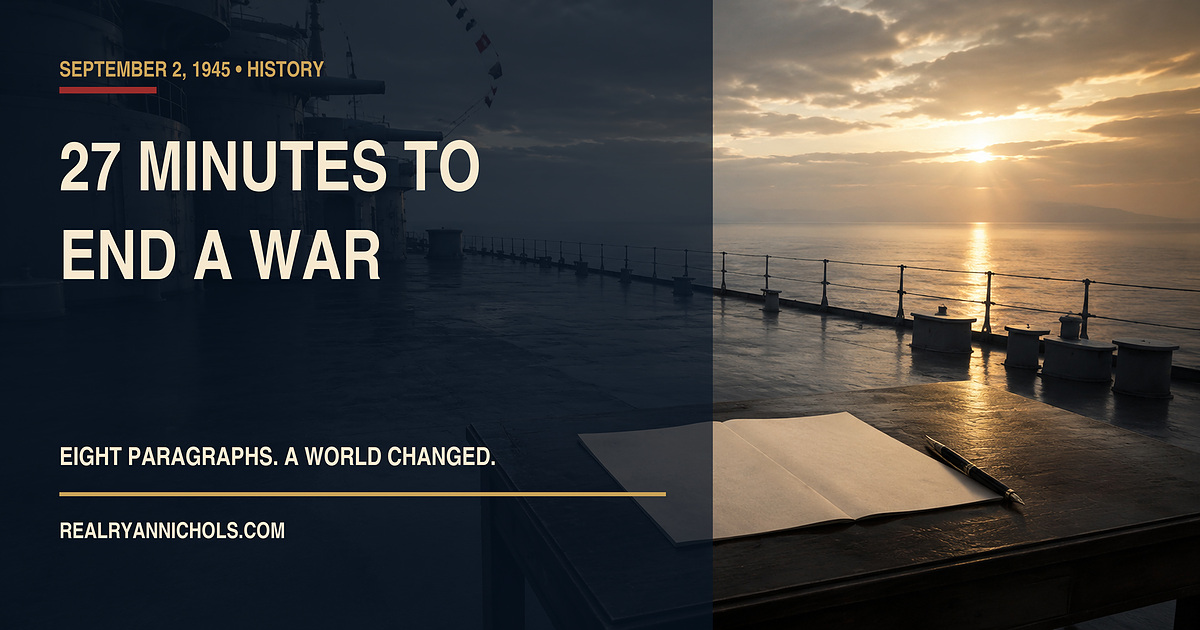
Six years of war ended with eight paragraphs and a line of signatures on a gray battleship.
The ceremony did not need a full morning.
It took 27 minutes.
On September 2, 1945, representatives of Japan and the Allied powers gathered aboard the USS Missouri in Tokyo Bay and signed the Instrument of Surrender. The fighting had already stopped. The announcements had already gone around the world. But this was the formal act that turned the end of combat into a record governments could carry forward.
The page was short because the cost behind it was not.
Eight paragraphs on the deck
The National Archives' milestone-document page preserves the two-page instrument and a transcript.
It began by stating that the Japanese representatives were acting on behalf of the emperor, the Japanese government, and Imperial General Headquarters. The second paragraph proclaimed unconditional surrender of Japanese armed forces and forces under Japanese control.
The document required the armed forces to stop hostilities, preserve military and civil property, and comply with orders from the Supreme Commander for the Allied Powers. It also placed the authority of the emperor and Japanese government under that commander's direction for the purpose of carrying out the surrender.
There was no attempt to make the document literary.
It had one job: end organized resistance and establish who was responsible for carrying out the terms.
Reader poll
What gives a historic document its weight?
Tap your answer to vote
One tap. Free and anonymous. No signup to vote.
The signatures made the order visible
The National Archives' 70th-anniversary account says the document was prepared by the U.S. War Department and approved by President Harry S. Truman. It describes eight short paragraphs and a ceremony that lasted less than thirty minutes.
Japanese Foreign Minister Mamoru Shigemitsu signed for the emperor and government. General Yoshijiro Umezu signed for Imperial General Headquarters.
General Douglas MacArthur signed as Supreme Commander for the Allied Powers. Fleet Admiral Chester Nimitz signed for the United States. Representatives of China, the United Kingdom, the Soviet Union, Australia, Canada, France, the Netherlands, and New Zealand also signed.
Those signatures did not erase what had happened. They established who had accepted the terms and who could be held to the next order.
That is what a serious record does.
It does not carry every story. It creates the fixed point the stories can be measured against.
The ceremony was short. The surrender was not simple.
The formal signing is easy to compress into one clean photograph. History around it was not clean.
The war in Europe had ended months earlier. Fighting in the Pacific continued until Japan announced its acceptance of Allied surrender terms in August. Military units, prisoners of war, occupied territories, ships, aircraft, and commands still had to receive and follow orders.
The instrument's brevity was part of its strength. It did not attempt to settle every political, legal, humanitarian, or moral question left by the war. It identified the surrender, the authority, the immediate duties, and the obligation to obey further orders.
The National Archives' College Park overview says the signing aboard the Missouri formally ended World War II. The original belongs to the records of the U.S. Joint Chiefs of Staff.
That provenance matters.
The document is not a later retelling. It is the instrument governments signed and preserved.
Why the page still matters
The value of the surrender document is not only that it marks an ending.
It shows what an ending requires.
Words alone do not stop a war. Authority alone does not create trust. A public announcement alone does not settle who accepted what.
The record joined the words, authority, duties, and signatures in one place.
That same pattern appears in other turning points. The Battlefield Memory That Became the First Geneva Convention tells how suffering became an organized humanitarian commitment. The Human Chain That Reached Across Three Countries shows how ordinary people made a political demand visible across hundreds of miles.
Different moments. Same lesson.
A turning point becomes durable when people can point to what happened, who stood behind it, and what came next.
Peace still had to be built
The signing ended the war. It did not finish the work after war.
Prisoners had to come home. Occupation policy had to be carried out. Cities and families had to rebuild. Accountability, memory, grief, and international order would occupy generations.
That is why the 27 minutes should not be treated as magic.
The ceremony closed one chapter with unmistakable authority. Human beings still had to live inside the next one.
There is something honest in that.
We often imagine an ending as a moment after which the work disappears. Real endings usually create a new list of duties. The argument ends, then repair begins. The emergency stops, then recovery begins. The agreement is signed, then people have to keep it.
Reader poll
What is hardest after a major ending?
Tap your answer to vote
One tap. Free and anonymous. No signup to vote.
On September 2, 1945, the world received a fixed point: two pages, eight paragraphs, signatures from the parties, and a formal end to the largest war in history.
The paper was brief.
The responsibility after it was not.
Join the RealRyanNichols.com email and text list for more verified stories about the records, systems, and people behind moments that changed what came next.
Sharing this is the biggest help. Put it in front of one more person.
Historical sources and document details were verified September 2, 2026.
Editorial visual disclosure: The header image is an original AI-assisted symbolic historical illustration. It is not archival evidence and does not depict the actual USS Missouri, surrender document, signatories, or ceremony.
You made it to the end
Most people quit at the headline. You didn’t.
So don’t stop here. Pick one.
Read the book
Fighting Shadows is the whole story in my own words: the road into January 6, the D.C. jail, and the fight to get the record out.See the book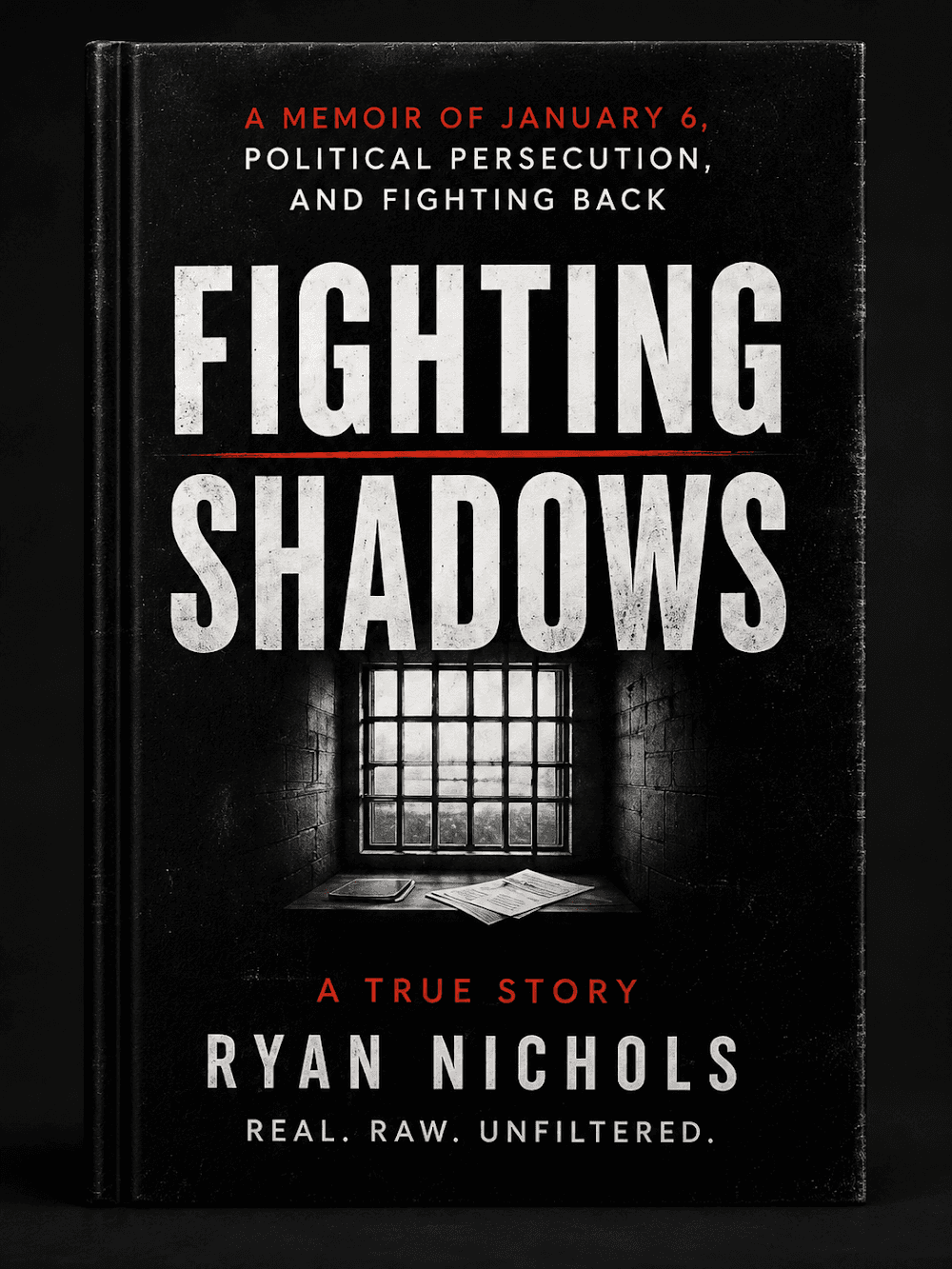
Follow the case
The record is still being written. Get one email when something new drops on it.
Hire Ryan
I built this site. Want one that brings your business real leads? Start with a free 30-minute call.See the services

Tap how this hits you — no signup, everyone sees the count
Share this post — get it back in front of people
Comments
Speak here
Create an account to comment.
This is where people can say what gets buried or cancelled elsewhere. Comments are signed-only, moderated, and tied to a real profile so the record stays usable.
No approved comments yet. Create an account and put the first opinion on the record.