
The Three Digits That Replaced a Wall of Emergency Numbers
Before 911, callers needed separate local police, fire, and ambulance numbers. One shared front door made emergency help easier to reach and route.
By Ryan Nichols
- 444 total reach
- 0 reading now•0 active 24h
- 0 shares•1 inbound
- 0 comments
By Ryan Nichols
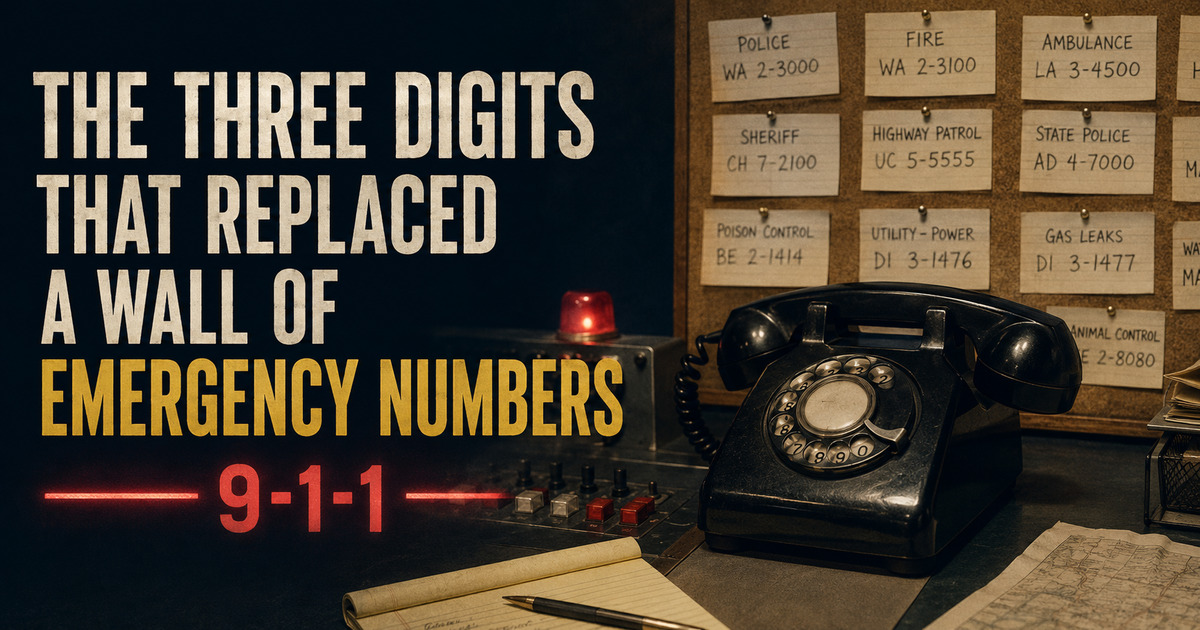
Before 911, an emergency could begin with a search.
Police might have one local number. The fire department had another. Ambulance service might be somewhere else. A traveler could cross a county line and lose the number that had been memorized at home.
The public did not only need responders. It needed a reliable front door.
That problem sounds simple now because three digits solved it so well that most Americans rarely think about the system behind them.
The digits were 9-1-1.
Reader poll
In a crisis, what matters first?
Tap your answer to vote
One tap. Free and anonymous. No signup to vote.
The emergency happened before the routing did
In 1966, the National Academy of Sciences published Accidental Death and Disability: The Neglected Disease of Modern Society. The report described accidental injury, especially from motor vehicle crashes, as a major national public-health problem and called attention to gaps in emergency care.
The communications problem was part of that larger chain.
A person could know exactly what was wrong and still lose time figuring out whom to call. Even after reaching an operator or agency, the call still had to find the correct local responder.
The country did not lack telephone numbers. It had too many of them at the moment when memory and attention were least reliable.
According to the federal National 911 Program, people commonly used local seven-digit police, fire, or emergency numbers before a universal emergency code. AT&T announced 911 as a nationwide emergency number in January 1968. The first 911 call was placed in Haleyville, Alabama, in February of that year. Six days later, another early call was made in Nome, Alaska.
A shared number is a promise about the next handoff
The useful part of 911 was not only that three digits were easy to remember.
The number created a common entrance into thousands of local systems.
The caller did not have to understand the organization chart. The system accepted responsibility for routing the need.
That is a quiet design principle with enormous consequences:
The person in trouble should not have to know your internal structure before your structure can help.
Businesses violate this principle every day.
Press one for sales. Press two for billing. Call another office for service. Fill out a form and wait. Repeat the story when the handoff fails.
An organization may see departments. The person asking for help sees one problem.
The universal number did not merge every police department, fire service, ambulance, or public-safety answering point into one national agency. It gave them a common public doorway.
The first version was not the finished system
Early 911 service did not automatically provide everything people now expect.
Systems had to expand across telephone exchanges and jurisdictions. Enhanced 911 later added capabilities such as caller number and location information. Wireless phones and internet-based calling created new routing and location challenges.
Congress passed the Wireless Communications and Public Safety Act of 1999, and the Federal Communications Commission designated 911 as the universal emergency number for wireline and wireless telephone services. Modern upgrades continue because the public’s devices, networks, and expectations keep changing.
That history matters because good systems are rarely born complete.
They begin by removing the most dangerous confusion. Then they learn from the next failure.
The Black Box Began With a Memo Nobody Wanted tells a related story. Aviation safety improved because investigators could recover a record after disaster. Emergency communications improved because callers received one front door before the response.
One system preserved the facts. The other shortened the path to action.
Reader poll
Where does your work lose the most time?
Tap your answer to vote
One tap. Free and anonymous. No signup to vote.
One front door still needs strong rooms behind it
A memorable number cannot dispatch an ambulance by itself.
Behind 911 are call takers, dispatchers, telecommunications systems, local agencies, mapping and location tools, backup power, policies, training, and people making decisions under pressure.
The front door is only trustworthy when the handoffs behind it work.
That is why one number is not an excuse to hide complexity. It is a commitment to manage complexity on the caller’s behalf.
The same lesson appears in other service systems.
The Nine Chambers That Became One Rescue Route shows how the Tham Luang cave rescue depended on a disciplined chain of handoffs. The Small Boats That Crossed the Channel at Dunkirk shows what happens when many different vessels are organized around one urgent route.
Different tools. Different people. One shared outcome.
The practical test for any service system
Look at the first five minutes after somebody asks your organization for help.
Can the person remember where to begin?
Does the first person who answers know where the need goes next?
Does the context travel with the handoff, or does the caller start over?
Can somebody see whether the request was accepted, assigned, and completed?
What happens when the normal route is unavailable?
The wall of emergency numbers failed the first test. It made the public choose the right internal destination under stress.
911 changed the entrance.
The work after that first call has never stopped, but the central idea remains clean: make the first step obvious, then build the handoffs strong enough to honor it.
If you want the next story about practical systems, service, and rebuilding, join the RealRyanNichols.com email and text list. You will get the next article without having to search for the right door.
What part of your business or community still makes people understand the whole system before they can ask for help?
Reader poll
What should you simplify first?
Tap your answer to vote
One tap. Free and anonymous. No signup to vote.
Sharing this is the biggest help. Put it in front of one more person.
OG artwork disclosure: The social image is an original synthetic historical editorial illustration. It is not archival evidence and does not depict the first 911 call, a real dispatcher, or a documented emergency.
You made it to the end
Most people quit at the headline. You didn’t.
So don’t stop here. Pick one.
Read the book
Fighting Shadows is the whole story in my own words: the road into January 6, the D.C. jail, and the fight to get the record out.See the book
Follow the case
The record is still being written. Get one email when something new drops on it.
Hire Ryan
I built this site. Want one that brings your business real leads? Start with a free 30-minute call.See the services


Tap how this hits you — no signup, everyone sees the count
Share this post — get it back in front of people
Comments
Speak here
Create an account to comment.
This is where people can say what gets buried or cancelled elsewhere. Comments are signed-only, moderated, and tied to a real profile so the record stays usable.
No approved comments yet. Create an account and put the first opinion on the record.