
The First Solar Car Was 15 Inches Long
In 1955, William Cobb demonstrated a 15-inch solar car. The Sunmobile was too small to drive, but big enough to prove an idea could move forward.
By Ryan Nichols
- 158 total reach
- 0 reading now•0 active 24h
- 0 shares•0 inbound
- 0 comments
By Ryan Nichols
The first solar car did not carry a family, win a race, or travel across a state.
It was fifteen inches long.
On August 31, 1955, General Motors engineer William G. Cobb demonstrated a small model called the Sunmobile at the company's Powerama exhibition in Chicago. Light striking a set of solar cells produced electricity for a tiny motor. The motor turned a drive shaft connected to the rear axle, and the model moved.
It was not a practical automobile.
It was a visible argument.
The machine was small because the question was smaller
The Sunmobile did not try to answer every question about solar transportation.
It did not solve energy storage, cloudy weather, road safety, manufacturing cost, passenger comfort, or the weight of a full-size vehicle. The photovoltaic technology available in 1955 was expensive and limited. A road-ready solar car was far beyond what the demonstration could deliver.
Cobb's model asked a narrower question: Can light be converted into electricity and make a wheeled vehicle move?
The answer happened on the table in front of people.
The event is recorded in History's account of the August 31 demonstration. An IEEE-indexed engineering paper also identifies Cobb's 1955 miniature vehicle as the first solar-powered vehicle and describes its fifteen-inch scale.
The language around "first" can become slippery when inventions develop through many experiments. The useful verified point is narrower: Cobb publicly demonstrated a miniature solar-powered automobile in 1955, decades before modern electric vehicles became common.
{{< poll id="sunmobile-1" question="What makes a prototype valuable?" options="It proves one mechanism|It attracts attention|It exposes problems|All of these" >}}
A prototype is allowed to be incomplete
People often judge an early model as if it were a failed final product.
It is too small. Too slow. Too expensive. Too fragile. It cannot serve everybody. It does not include every feature. The finished market is years away.
Those criticisms may all be true and still miss the point.
A prototype is a question built out of materials. Its job is to reduce uncertainty.
Can the sensor detect the signal? Can the customer complete the form? Can the motor turn? Can the team deliver one package through the system? Can the reader understand the map without needing every geographic detail?
The First FedEx Night Moved 186 Packages Through One Hub tells the same kind of story at a different scale. The first operational night was tiny compared with the network that followed. It still proved the hub could work.
Build the smallest version that can answer honestly
There is a difference between a small prototype and a fake demonstration.
The Sunmobile did not pretend to be a full-size car. Its limitations were visible. It showed one real mechanism at the scale the technology could support.
That honesty is the standard.
If you are building a website, the first useful version might need one clear offer, one working form, and one confirmed follow-up. It does not need an animated dashboard that hides a broken contact path.
If you are testing a service, the first version may serve five customers manually. It should still deliver the result you promised those five customers.
If you are rebuilding your own life, the prototype may be one dependable morning instead of a perfect month. The action must be real even when the scale is small.
Make the First Version Before You Judge It explains why useful work needs something concrete to improve. The Sunmobile made solar motion concrete enough to see.
{{< poll id="sunmobile-2" question="What should your next small version prove?" options="The idea works|A customer wants it|The process connects|I can repeat it" >}}
Small proof changes the next conversation
Before a working model, people debate an idea in the abstract.
After the model moves, the questions become more useful.
How much energy did it need? What happens in shade? How can the cells become more efficient? What would a larger vehicle weigh? Where would energy be stored? Which part costs too much?
Proof does not end disagreement. It improves it.
That is why visible systems matter in business and technology. A diagram can clarify a route. A working intake form can expose a missing handoff. A simple dashboard can reveal that the team is tracking activity instead of results.
Harry Beck Made London Legible by Leaving Most of London Out shows another form of disciplined reduction. Beck removed geographic detail so riders could see the connections that mattered. Cobb reduced the automobile until the energy conversion could be seen.
The lesson is not to stay small
Small is not the destination.
The Sunmobile did not become the family car of 1955. It belongs in the longer history of solar and electric experimentation because it made one possibility move in public.
The lesson is to choose the first scale honestly.
Do not demand that version one carry the weight of version fifty. Do not hide its limits. Do not add decoration when the mechanism still fails. Build the smallest thing that can answer the next important question with evidence.
Then use the answer to build again.
{{< poll id="sunmobile-3" question="What is keeping your prototype from becoming visible?" options="Too many features|Fear of judgment|No clear test|I have not started" >}}
If this kind of practical technology history helps you see your own work differently, read The Black Box Began With a Memo Nobody Wanted next. It is another story about an idea that needed years of resistance, testing, and evidence before the world understood its value.
{{< share >}}
Verification note: Historical claims were checked against published history and engineering references on August 31, 2026.
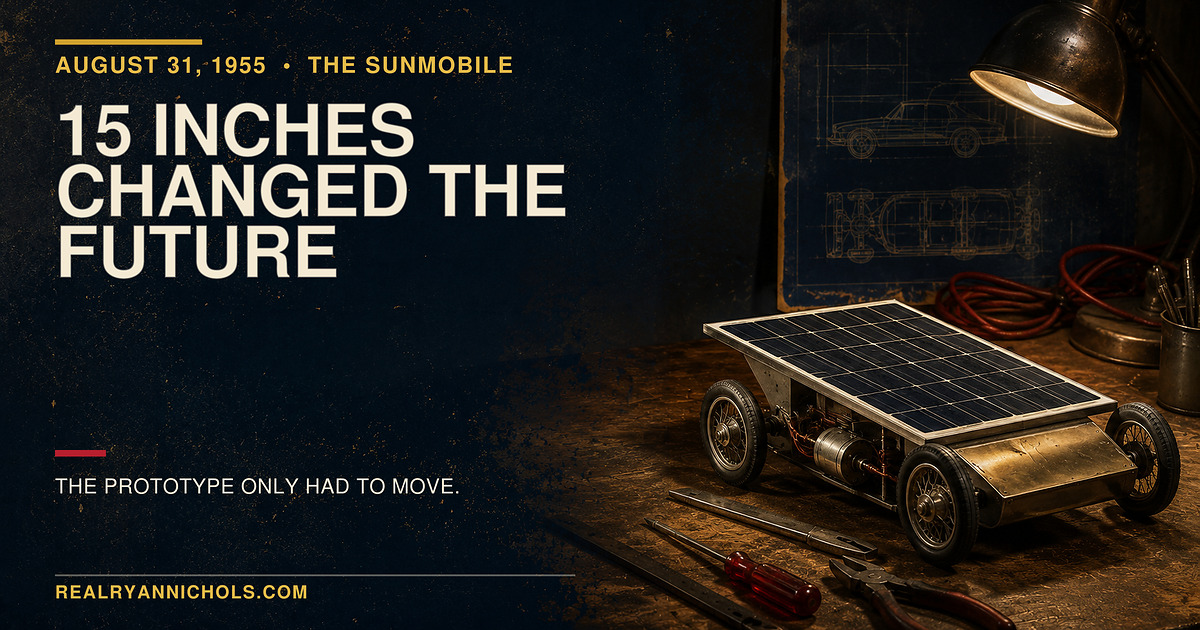
Editorial visual disclosure: The header image is an original AI-assisted conceptual reconstruction. It does not depict the original Sunmobile, a real exhibition photograph, a real document, or a real person.
You made it to the end
Most people quit at the headline. You didn’t.
So don’t stop here. Pick one.
Read the book
Fighting Shadows is the whole story in my own words: the road into January 6, the D.C. jail, and the fight to get the record out.See the book
Follow the case
The record is still being written. Get one email when something new drops on it.
Hire Ryan
I built this site. Want one that brings your business real leads? Start with a free 30-minute call.See the services



Tap how this hits you — no signup, everyone sees the count
Share this post — get it back in front of people
Comments
Speak here
Create an account to comment.
This is where people can say what gets buried or cancelled elsewhere. Comments are signed-only, moderated, and tied to a real profile so the record stays usable.
No approved comments yet. Create an account and put the first opinion on the record.