
Harry Beck Made London Legible by Leaving Most of London Out
Harry Beck made London’s Underground usable by replacing geographic detail with a clear network diagram. The lesson still applies to business systems.
By Ryan Nichols
- 183 total reach
- 0 reading now•0 active 24h
- 0 shares•0 inbound
- 0 comments
By Ryan Nichols
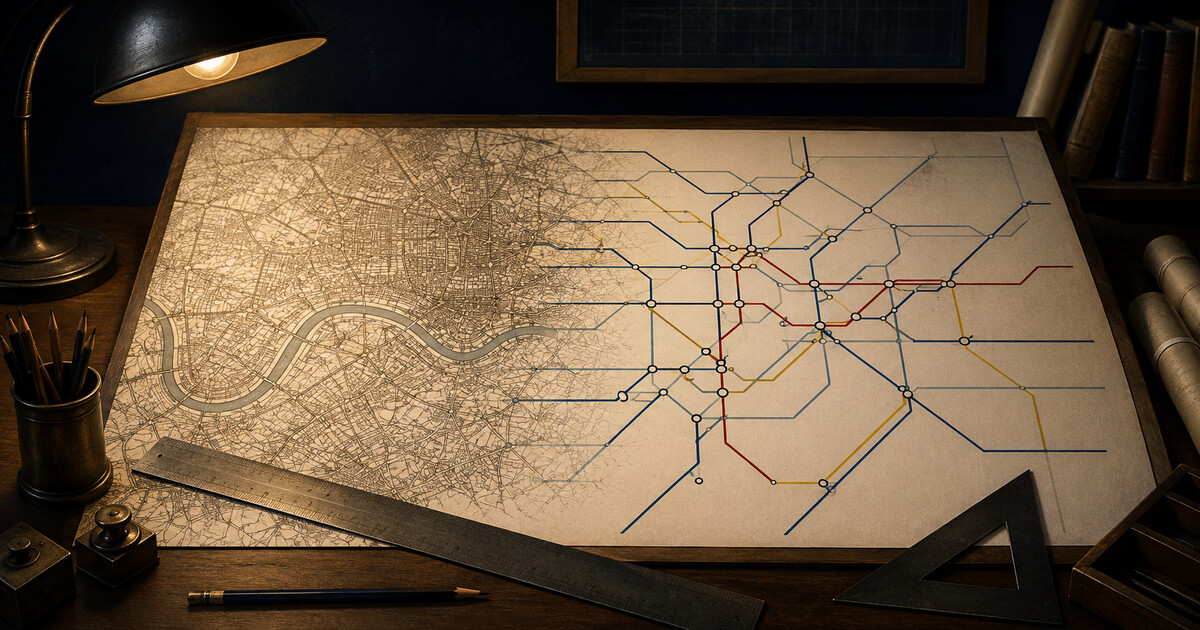
The map had more truth than the rider needed.
It showed geography. It showed distance. It tried to place a growing underground railway inside the real shape of London.
That accuracy made the system harder to use.
Harry Beck looked at the problem and removed most of the city.
He kept the lines. He kept the stations. He kept the places where one route connected to another. He simplified angles and stretched crowded areas until a passenger could see the next decision.
The result became one of the most recognizable maps in the world.
The lesson was not that detail is bad.
The lesson was that the right detail depends on the decision a person is trying to make.
The network had outgrown the old map
The London Transport Museum's history says Beck first devised his diagrammatic Underground map in 1931. The rail network had expanded until geographically accurate maps became crowded and difficult to read.
Beck was an electrical draughtsman. Instead of treating the Underground like streets seen from above, he treated it more like a circuit. Lines became straight verticals, horizontals, and diagonals. Central London was enlarged. Distant stations were pulled closer together. Interchanges became visible decisions.
Transport for London says the idea was initially considered too radical. Beck revised and resubmitted it. The first pocket edition using his diagrammatic style appeared in 1933.
The Design Museum explains why the departure worked: riders underground did not primarily need the physical location of every station. They needed to know how to move from one station to another and where to change lines.
Beck did not make the railway simpler.
He made the railway legible.
{{< poll id="beck-map-1" question="What confuses customers most in a growing business?" options="Too many entry points|Unclear next steps|Disconnected tools|No visible owner" >}}
He designed for the next decision
A conventional map answers, “Where is everything?”
Beck's diagram answered, “How do I get there?”
That change of question is the whole story.
Most business systems are built from the owner's view. The website shows every service. The intake form asks everything every department might someday want. The CRM mirrors an internal organization chart. The dashboard displays every number the software can collect.
Then a customer arrives with a smaller need.
Can you solve my problem? What will it cost? What happens after I submit this? Who is responsible now? When will I hear back?
If the interface cannot answer those questions, adding more information can make the experience worse.
The Three Questions Every Customer Asks Before They Call begins with the same principle. Information earns its place by helping somebody make the next decision.
The connections mattered more than the scale
Beck changed distance on purpose. Two stations far apart on the page might be closer in the real city, and the opposite could also be true.
That would be a serious flaw in a walking map. It was a useful trade in a network diagram.
The route relationship mattered more than geographic scale.
This is where many companies lose good leads. They optimize each tool separately and ignore the connection between them.
The advertisement works. The landing page works. The form works. The phone works. The calendar works. The payment link works. The service team works.
But the lead disappears between the form and the phone. The appointment does not create a reminder. The payment does not trigger delivery. The completed job does not trigger a review request. Each station exists, but the customer cannot see a dependable route.
The First FedEx Night Moved 186 Packages Through One Hub tells the operations version of this lesson. Isolated assets become a system only when the handoffs work.
{{< poll id="beck-map-2" question="Which handoff is least visible in your business?" options="Lead to response|Response to booking|Payment to delivery|Delivery to follow-up" >}}
Simplicity required judgment, not less work
Beck's map looks simple because difficult decisions were already made.
What must remain accurate? What can be compressed? Which connection deserves emphasis? Where will the user hesitate? Which exception belongs on the main map, and which one belongs somewhere else?
Good simplification is not deleting information at random. It is choosing a hierarchy.
The main route should carry what almost everybody needs. Exceptions should still exist, but they should not block the common trip. A customer should not have to understand the entire company before taking the first step.
That is why The Start Button Made a Complicated Machine Feel Possible matters. A visible start does not reduce the power of the machine. It gives people a way into it.
The same rule applies behind the scenes. A worker should be able to open one record and see the customer, the last action, the next action, the owner, and the deadline. If that information lives across six systems, the employee is navigating geography when they need a route map.
Draw the journey before buying another tool
Take one customer type and draw the path from first attention to final follow-up.
Use boxes for actions and circles for handoffs. Mark every place where information is retyped, copied, remembered, forwarded, or left for somebody to notice.
Then ask four questions:
- What decision is the customer trying to make here?
- What information do they actually need for that decision?
- What system or person owns the next handoff?
- How will we know the handoff happened?
Do not begin with the software you already own. Begin with the route that should exist.
Software should serve the map. The map should not become a diagram of software limitations.
{{< poll id="beck-map-3" question="What would make your customer journey easier to follow?" options="One clear starting point|One customer record|Visible handoff ownership|Automatic next-step reminders" >}}
Harry Beck did not improve the Underground by adding another line to the map. He improved it by showing the lines in the way a human being needed to understand them.
If your business has good people and good tools but customers still get lost between attention, response, booking, payment, and delivery, work with Ryan and The LeadFlow Pro to draw the route and build the connected operating system behind it. Start at The LeadFlow Pro and ask for a business growth diagnostic.
{{< share >}}
Verification note: Historical claims were checked against the London Transport Museum, Transport for London, and the Design Museum on August 29, 2026.
Editorial visual disclosure: The header image is an original AI-assisted historical illustration. It is symbolic, contains no real person's likeness, and is not documentary evidence of Harry Beck's work or the London Underground.
You made it to the end
Most people quit at the headline. You didn’t.
So don’t stop here. Pick one.
Read the book
Fighting Shadows is the whole story in my own words: the road into January 6, the D.C. jail, and the fight to get the record out.See the book
Follow the case
The record is still being written. Get one email when something new drops on it.
Hire Ryan
I built this site. Want one that brings your business real leads? Start with a free 30-minute call.See the services



Tap how this hits you — no signup, everyone sees the count
Share this post — get it back in front of people
Comments
Speak here
Create an account to comment.
This is where people can say what gets buried or cancelled elsewhere. Comments are signed-only, moderated, and tied to a real profile so the record stays usable.
No approved comments yet. Create an account and put the first opinion on the record.