
The Night the Telegraph Wires Woke Up
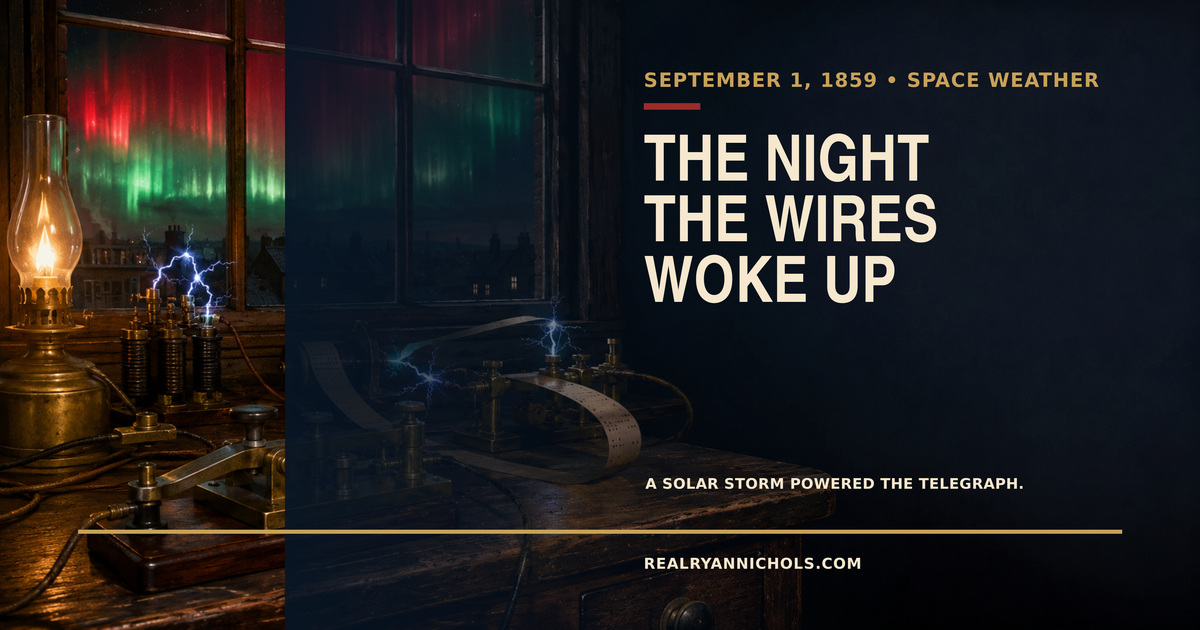
On September 1, 1859, Richard Carrington saw a solar flare. Hours later, auroras and electrical currents disrupted telegraph systems around the world.
By Ryan Nichols
- 170 total reach
- 0 reading now•0 active 24h
- 0 shares•0 inbound
- 0 comments
By Ryan Nichols
At about eleven in the morning on September 1, 1859, English astronomer Richard Carrington was studying sunspots when two brilliant patches appeared.
He hurried to find a witness. By the time he returned, the light was fading.
Carrington had seen what the National Oceanic and Atmospheric Administration identifies as the first recorded observation of a white-light solar flare. Roughly seventeen hours later, Earth entered the kind of storm that would make the young telegraph network behave as if the wires had joined the sky.
The night moved south
Auroras normally belong much closer to the poles. During the Carrington Event, red and green light appeared far beyond the usual range.
NOAA's historical account says auroras were reported as far south as the Caribbean. Newspapers could be read outdoors by the glow in some places. People woke and mistook the brightness for morning or fire.
The spectacle was only the visible part.
A solar eruption had disturbed Earth's magnetic field. That disturbance induced electrical currents in long conductors on the ground. In 1859, the newest large communications network was made of long telegraph wires.
Operators saw sparks. Equipment malfunctioned. Telegraph paper reportedly caught fire in some offices. Some operators disconnected their batteries and still found that storm-induced current could carry messages for a time.
The network did not understand what was happening. It simply conducted the energy.
The miracle and the weakness were the same thing
The telegraph had already changed distance.
A message that once moved at the speed of a horse, train, or ship could travel through wire in moments. Businesses could coordinate. Newspapers could gather reports. Governments and railroads could make decisions across long distances.
The strength was connection.
The weakness was also connection.
A long conductor can carry the intended signal. It can also collect energy nobody planned to send. The more useful the network became, the more people depended on equipment that could be affected by forces far outside the telegraph office.
That pattern keeps returning.
The Hotline That Was Never a Red Telephone tells how nations built a direct communications path after delay and misunderstanding became dangerous. The Three Digits That Replaced a Wall of Emergency Numbers shows a different lesson: a system becomes valuable when people know how to reach it under pressure.
The Carrington story adds another truth. A connected system also needs a plan for the day connection itself becomes the problem.
Space weather did not stay in 1859
The sun still releases flares and coronal mass ejections. Earth still has a magnetic field. Modern society has many more systems that can be affected.
Satellites support navigation, weather observation, communications, finance, farming, transportation, and emergency response. High-frequency radio can be disrupted. Navigation signals can become less accurate. Strong geomagnetic storms can induce currents in long power lines and pipelines.
NOAA operates space-weather forecasting and warning services because the risk is operational, not just historical. The agency's Space Weather Follow On program supports observations intended to improve warnings for events that can affect infrastructure.
That does not mean every solar flare will shut down the grid or erase the internet. It means operators watch the sun because timing and intensity matter, protections differ, and warnings can create time to respond.
The honest version of resilience is not pretending a system cannot fail. It is learning how the system fails, watching for evidence, and deciding what can be isolated, protected, delayed, or recovered.
What the telegraphers teach builders
The people working the wires in 1859 did not have modern space-weather forecasts. They experimented carefully with the equipment in front of them.
Their experience leaves four useful questions for any connected system:
- What outside force can enter through the connection? That may be electrical current, bad data, a compromised account, a vendor outage, or simple human confusion.
- What can be isolated? A backup is useful only if it is not destroyed by the same failure.
- What still works manually? A paper contact list, local procedure, alternate channel, or clear chain of command can matter when the main system is unavailable.
- Who decides when to disconnect and restore? A response plan without a named owner becomes another document people look for too late.
The lesson is similar to The Black Box Began With a Memo Nobody Wanted. Important systems improve when somebody turns a hard failure into a record that can guide the next design.
A bright warning
Carrington's observation lasted minutes. The storm became history because the light connected to consequences on the ground.
The aurora was beautiful. The induced current was dangerous. The telegraph network was both an extraordinary achievement and a new surface for failure.
That is the tension inside almost every technology worth building. Connection creates reach. Reach creates dependency. Dependency creates a duty to prepare.
If stories like this help you see modern systems more clearly, join the RealRyanNichols.com email and text list. The next useful warning may not look like danger at first. Sometimes it looks like a bright patch on the sun.
{{< poll id="carrington-system-lesson" question="Which resilience question matters most for the systems you depend on?" options="Outside risks|Isolation|Manual backup|Named decision owner" >}}
{{< share >}}
Sources
- NOAA NESDIS: What Was the Carrington Event?
- NOAA Heritage: Five Historically Huge Solar Events
- NOAA NESDIS: Space Weather Follow On Program
Editorial visual disclosure: The header image is an original AI-assisted conceptual illustration based on the documented effects of the 1859 storm. It does not depict a specific telegraph office or historical photograph.
You made it to the end
Most people quit at the headline. You didn’t.
So don’t stop here. Pick one.
Read the book
Fighting Shadows is the whole story in my own words: the road into January 6, the D.C. jail, and the fight to get the record out.See the book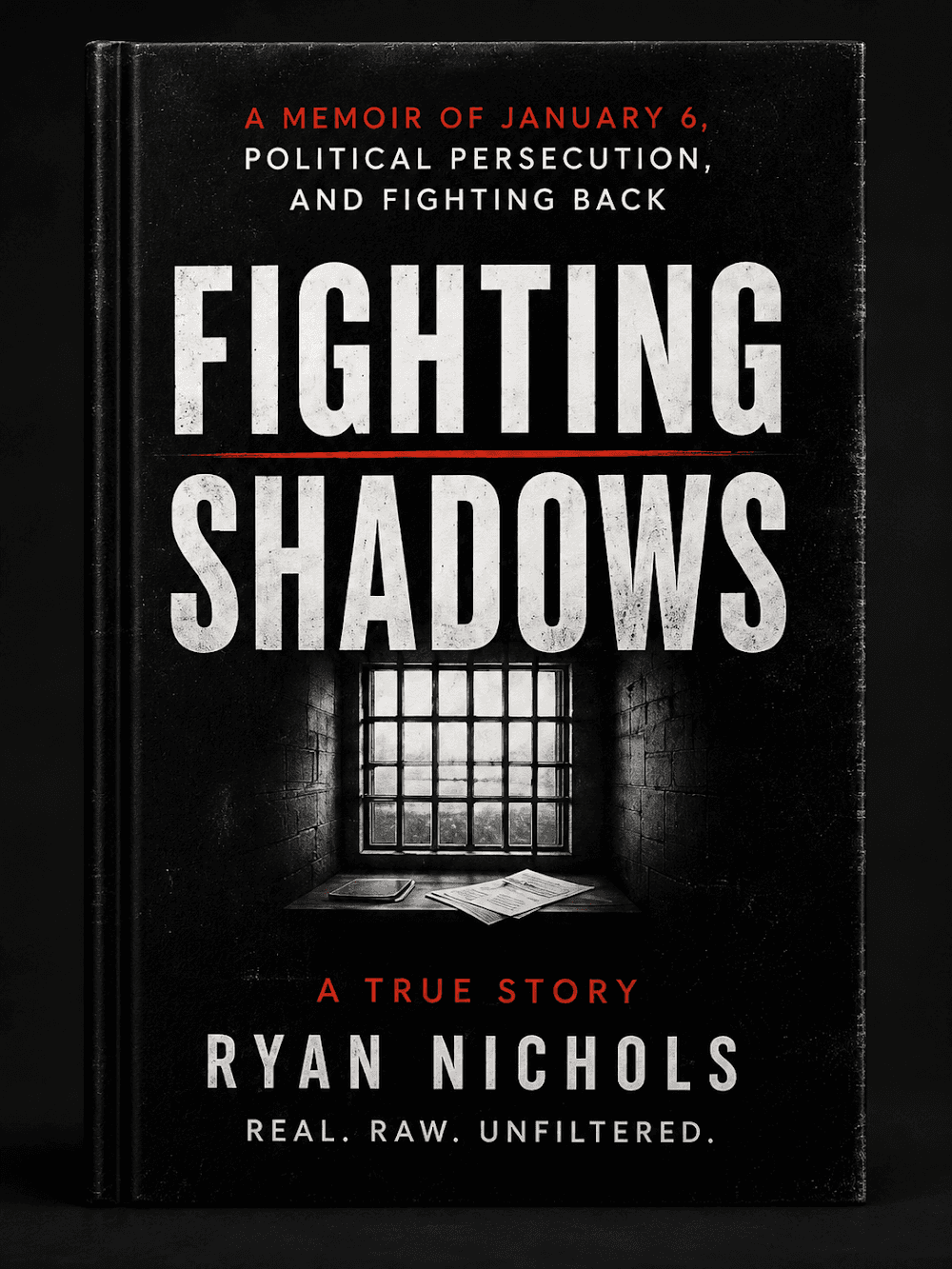
Follow the case
The record is still being written. Get one email when something new drops on it.
Hire Ryan
I built this site. Want one that brings your business real leads? Start with a free 30-minute call.See the services
Tap how this hits you — no signup, everyone sees the count
Share this post — get it back in front of people
Comments
Speak here
Create an account to comment.
This is where people can say what gets buried or cancelled elsewhere. Comments are signed-only, moderated, and tied to a real profile so the record stays usable.
No approved comments yet. Create an account and put the first opinion on the record.