
The Law That Told America to Use the Parks Without Using Them Up
On August 25, 1916, the National Park Service received a lasting challenge: welcome people into treasured places while leaving them unimpaired and useful.
By Ryan Nichols
- 156 total reach
- 0 reading now•0 active 24h
- 0 shares•0 inbound
- 0 comments
By Ryan Nichols
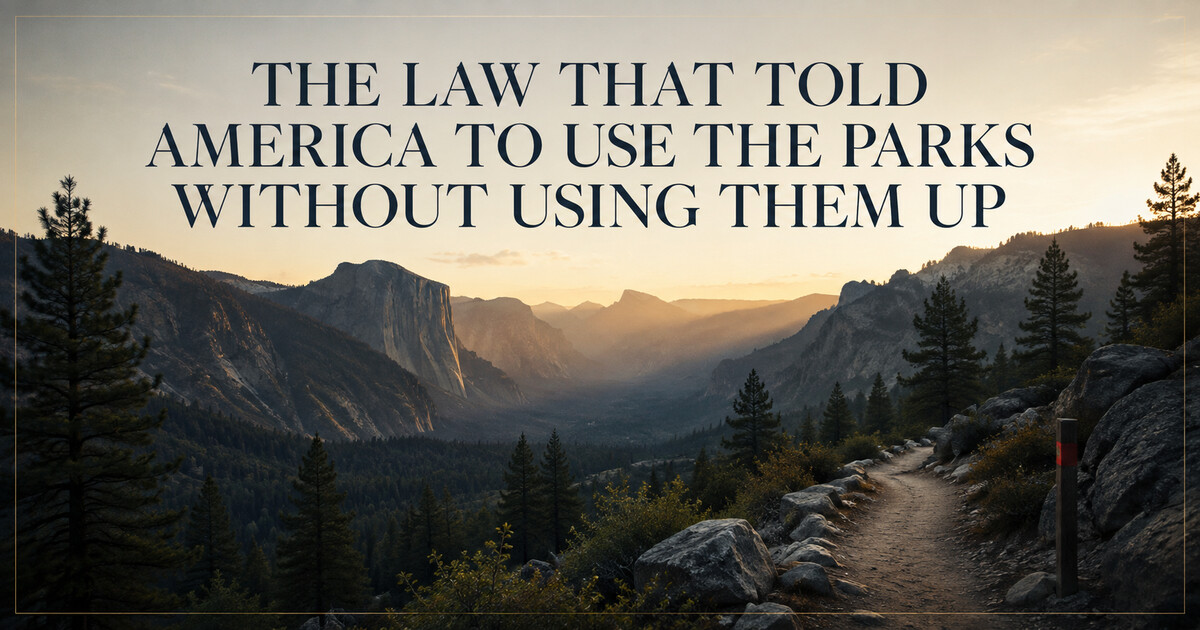
The sentence sounds simple until you try to obey both halves.
Conserve the place. Let people enjoy the place. Leave it unimpaired for people who have not been born yet.
On August 25, 1916, President Woodrow Wilson signed the law that created the National Park Service. Congress did more than establish a federal bureau. It handed that bureau a permanent tension: make extraordinary places available to the public without letting public use destroy what made them extraordinary.
One hundred ten years later, that tension still reaches far beyond parks.
Before there was one service
America had national parks before it had a National Park Service. Yellowstone was established in 1872. Other parks and monuments followed, but management was divided and inconsistent.
The National Archives’ record of H.R. 15522 says Representative William Kent introduced the bill on May 10, 1916. Wilson signed it on August 25. The law created a service inside the Department of the Interior.
According to the National Park Service’s history, the new bureau became responsible for 35 national parks and monuments already managed by Interior, along with areas that would be established later.
That solved an organizational problem. It did not solve the harder question of purpose.
{{< poll id="park-law-1" question="Which duty should carry more weight when a park is under heavy pressure?" options="Protect the place first|Keep public access first|Balance both case by case|It depends on the specific resource" >}}
The words that created the tension
The 1916 law said the service should promote and regulate the use of the parks, monuments, and reservations according to a fundamental purpose.
That purpose was to conserve the scenery, natural and historic objects, and wildlife, while also providing for their enjoyment in a way that would leave them unimpaired for future generations.
The exact legal language matters because it refuses two easy answers.
It does not say lock everything away. Enjoyment is part of the mission.
It does not say maximize attendance, traffic, or revenue. Conservation and an unimpaired future are part of the mission too.
The law requires stewardship, and stewardship is harder than possession. Possession asks, “What can we do with this now?” Stewardship asks, “What must remain when we are finished?”
Access can protect what it threatens
Public use puts pressure on a place. Roads, trails, waste, noise, crowding, erosion, and development all leave marks.
But access also creates witnesses.
People defend places they have seen. A child who stands beneath a giant tree, a worker who walks a battlefield, or a family that watches the light change across a canyon may carry that experience into decisions made decades later.
That was part of the early argument for a unified park service. The National Park Service’s creation history describes how advocates, journalists, nature groups, railroads, and political leaders built support. Their motives were not identical. Preservation, tourism, civic pride, and economic opportunity all helped move the idea.
That mixed coalition is not a flaw in the story. It is the story. Durable public work often survives because people arrive for different reasons and agree on one necessary structure.
The Golden Gate Bridge safety net offers a related lesson. It protected workers while allowing construction to continue. Read The Golden Gate Safety Net That Caught Nineteen Workers. Good systems do not choose between mission and human reality when they can design for both.
{{< poll id="park-law-2" question="What creates the strongest long-term support for protected places?" options="Firsthand visits|Education and history|Strict legal protection|Local economic value" >}}
“Unimpaired” is not the same as untouched
A park with roads, visitor centers, campgrounds, and trails is not untouched. The law did not demand an impossible absence of human influence.
It demanded a standard for what the influence could not destroy.
That distinction matters. A system can change without losing its purpose. A city can rebuild after disaster without pretending nothing happened. The story of how Galveston Raised an Entire City After the 1900 Storm shows that preservation sometimes requires enormous change. The question is what the work is trying to save.
For the parks, the law’s answer included scenery, natural and historic objects, wildlife, enjoyment, and the claims of future generations.
Future generations cannot vote in today’s meeting. They cannot complain about a short-term decision. They cannot outbid a developer or fill out a public survey. “Unimpaired” gives those absent people a place in the room.
The lesson for any work meant to last
Every business, church, nonprofit, public agency, and family eventually faces its own version of the 1916 problem.
How do we use a good thing without using it up?
How do we welcome people without lowering every standard?
How do we grow without consuming the trust, land, time, skill, or reputation that growth depends on?
The answer begins with a purpose strong enough to limit today’s appetite.
The Organic Act did not provide a neat formula for every trail, road, fire, animal, concession, or crowd. It provided a direction. Protect the thing. Let it serve people. Do not let today’s use erase tomorrow’s possibility.
That is the same logic behind systems that allow someone to stop the line when quality is failing. The Factory Rule That Let One Worker Stop Everything is another story about choosing long-term trust over short-term motion.
{{< poll id="park-law-3" question="Where do you most need an 'unimpaired for the future' standard?" options="Work or business|Community or service|Time and energy|A physical place I care about" >}}
A law is only as alive as the choices beneath it
The National Park Service now manages hundreds of units, but the original challenge has not aged out. Every generation receives places, institutions, and promises it did not create alone. Every generation decides what condition they will be in when handed forward.
The 1916 law’s power is not that it eliminated conflict. Its power is that it named both duties before the conflict arrived.
Use the parks. Do not use them up.
That is a sentence worth carrying into more than a park.
{{< poll id="park-law-4" question="Which part of the 1916 mandate speaks most directly to you?" options="Conserve what matters|Make it available to people|Leave it unimpaired|Hold both duties together" >}}
If you want more verified stories about the laws, systems, and ordinary decisions that shaped the world we inherited, join the RealRyanNichols.com email and text list for the next one.
{{< share >}}
Verification note: Historical claims were checked against the National Archives and National Park Service on August 25, 2026. The Organic Act was signed August 25, 1916.
Editorial visual disclosure: The header image is an original AI-assisted editorial illustration. It is a symbolic park landscape and not documentary evidence of the 1916 event.
You made it to the end
Most people quit at the headline. You didn’t.
So don’t stop here. Pick one.
Read the book
Fighting Shadows is the whole story in my own words: the road into January 6, the D.C. jail, and the fight to get the record out.See the book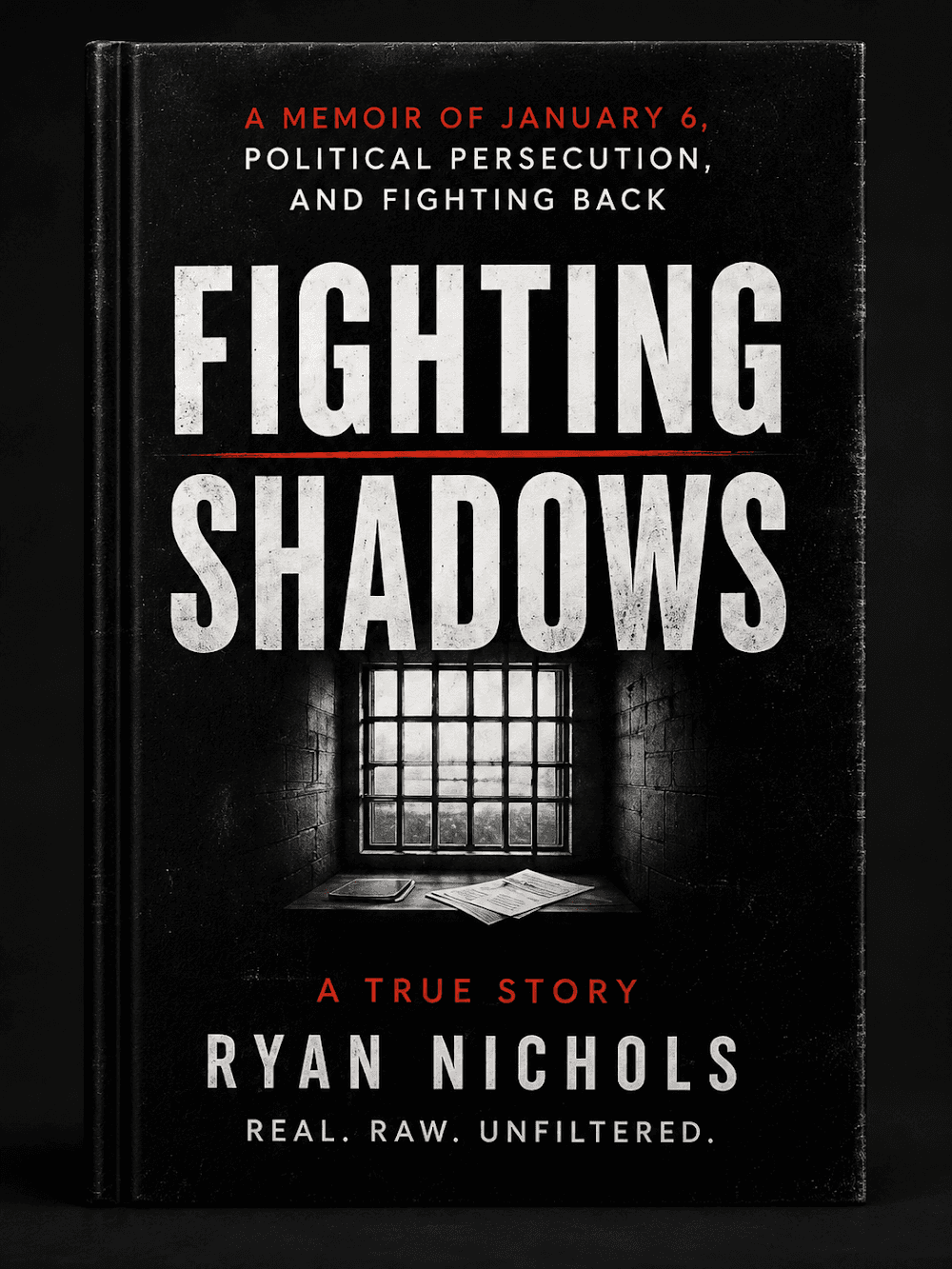
Follow the case
The record is still being written. Get one email when something new drops on it.
Hire Ryan
I built this site. Want one that brings your business real leads? Start with a free 30-minute call.See the services
Tap how this hits you — no signup, everyone sees the count
Share this post — get it back in front of people
Comments
Speak here
Create an account to comment.
This is where people can say what gets buried or cancelled elsewhere. Comments are signed-only, moderated, and tied to a real profile so the record stays usable.
No approved comments yet. Create an account and put the first opinion on the record.