
The Bullet Train Opened Ten Days Before the World Came to Tokyo
By Ryan Nichols
- 32 total reach
- 0 reading now•1 active 24h
- 0 shares•0 inbound
- 0 comments
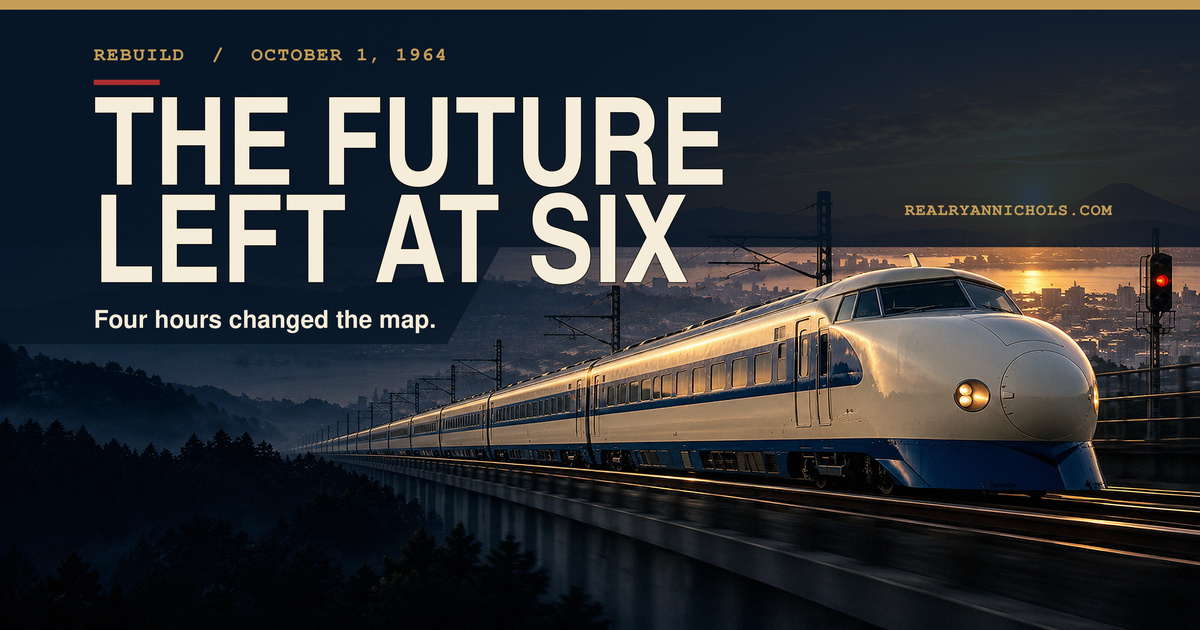
At six in the morning on October 1, 1964, Japan put its future on the rails.
The first Tokaido Shinkansen trains left Tokyo and Shin-Osaka in opposite directions. Ten days later, the Tokyo Olympics would open before a global audience.
The timing made the new line look like a showcase built for the Games. The deeper story had been building for years. Japan’s busiest transportation corridor was running out of room, the country was rebuilding after war, and engineers were trying to make a new kind of railway work at commercial scale.
The train did not merely arrive on time for a ceremony. It changed the distance between two centers of national life.
The old line had become the limit
Tokyo and Osaka were already connected by rail. The problem was capacity and time.
Japan’s Showa-kan museum explains that economic growth increased the movement of people and goods until the Tokaido Main Line became strained. Construction on the new line began in April 1959 and took about five years. The museum’s 60th-anniversary history says the new service opened on October 1, 1964, and connected Tokyo and Shin-Osaka in about four hours.
This was not a faster train dropped onto the old track.
It was a dedicated high-speed system. New track, new operating assumptions, new electrical and signaling work, and a train designed to hold speed over a long intercity route.
The Japan Society of Mechanical Engineers identifies the Tokaido Shinkansen as the world’s first high-speed railway and records a top operating speed of 210 kilometers per hour.
Reader poll
What makes the Shinkansen story matter most?
Tap your answer to vote
One tap. Free and anonymous. No signup to vote.
Four hours changed the map people carried in their heads
JR Central’s company history says the fastest Tokyo to Osaka trip had taken six hours and thirty minutes before the Shinkansen. At inauguration, the new service reduced it to four hours.
Two and a half hours did not disappear from a timetable only.
They disappeared from business travel, family visits, scheduling, delivery planning, and the mental calculation people make before deciding whether a place is too far away.
Infrastructure changes behavior when it becomes dependable enough to plan around.
That is why the Shinkansen’s story is bigger than speed. It joined speed to a system people could use repeatedly. The line turned a technical achievement into ordinary national capacity.
It opened before the spotlight arrived
The first Tokyo Olympics began on October 10, 1964.
The train began service ten days earlier.
The Games gave Japan a stage. The Shinkansen gave the stage a moving symbol. Visitors could see a country that was not asking the world to imagine reconstruction. It was carrying passengers through it.
That distinction matters.
Rebuilding is often described with speeches about what will exist someday. The strongest version becomes visible in the system that opens, the ticket that works, the train that leaves, and the arrival that happens close enough to the promise for people to trust it again.
The First Public Railway Carried the Future in 36 Wagons tells an earlier version of the same pattern. A new machine matters. A working route changes a society.
The lesson was integration
The Shinkansen was not one breakthrough.
It depended on civil engineering, power, rolling stock, signaling, operations, maintenance, stations, scheduling, and human discipline working together.
One fast train without a safe line is a demonstration. One safe line without reliable operations is an expensive promise. One strong launch without maintenance becomes a memory.
The finished system had to make all of those parts meet at the same hour.
That lesson applies far outside railroads. A website is not only a page. A business is not only a product. A rescue is not only the moment somebody is found. The result depends on the quiet pieces agreeing with one another before the public moment arrives.
Neptune Was Found on Paper Before It Was Found in the Sky is a story about prediction before confirmation. The First Solar Car Was 15 Inches Long is a story about a small prototype proving a direction. The Shinkansen sits between them: an audacious idea turned into daily service.
Rebuilding needs a departure time
There is a point when planning has to become movement.
Not reckless movement. Not a public show built on unfinished work. Movement after the testing, the arguments, the money, the construction, and the thousands of details that do not fit into the photograph.
October 1, 1964, was that point.
The train left.
People boarded.
The route that had taken six and a half hours could now be crossed in four.
The world saw speed. Japan had built proof.
Reader poll
Which part of a rebuild is hardest to finish?
Tap your answer to vote
One tap. Free and anonymous. No signup to vote.
For the next verified story about the systems, records, and people that changed what was possible, join the RealRyanNichols.com email list. No algorithm decides whether you see the next part.
Historical note: Dates and operating figures were checked against the linked Showa-kan, Japan Society of Mechanical Engineers, and JR Central sources on October 1, 2026.
Editorial visual disclosure: The header image is an original AI-assisted historical concept. It is not a photograph of a specific 1964 train, station, departure, or documented scene.
You made it to the end
Most people quit at the headline. You didn’t.
So don’t stop here. Pick one.
Read the book
Fighting Shadows is the whole story in my own words: the road into January 6, the D.C. jail, and the fight to get the record out.See the book
Follow the case
The record is still being written. Get one email when something new drops on it.
Hire Ryan
I built this site. Want one that brings your business real leads? Start with a free 30-minute call.See the services



Tap how this hits you — no signup, everyone sees the count
Share this post — get it back in front of people
Comments
Speak here
Create an account to comment.
This is where people can say what gets buried or cancelled elsewhere. Comments are signed-only, moderated, and tied to a real profile so the record stays usable.
No approved comments yet. Create an account and put the first opinion on the record.