
Neptune Was Found on Paper Before It Was Found in the Sky
On September 23, 1846, Johann Galle found Neptune near the position Urbain Le Verrier predicted. The telescope confirmed what the math had revealed.
By Real Ryan Nichols Editorial Team
- 10 total reach
- 0 reading now•0 active 24h
- 0 shares•0 inbound
- 0 comments
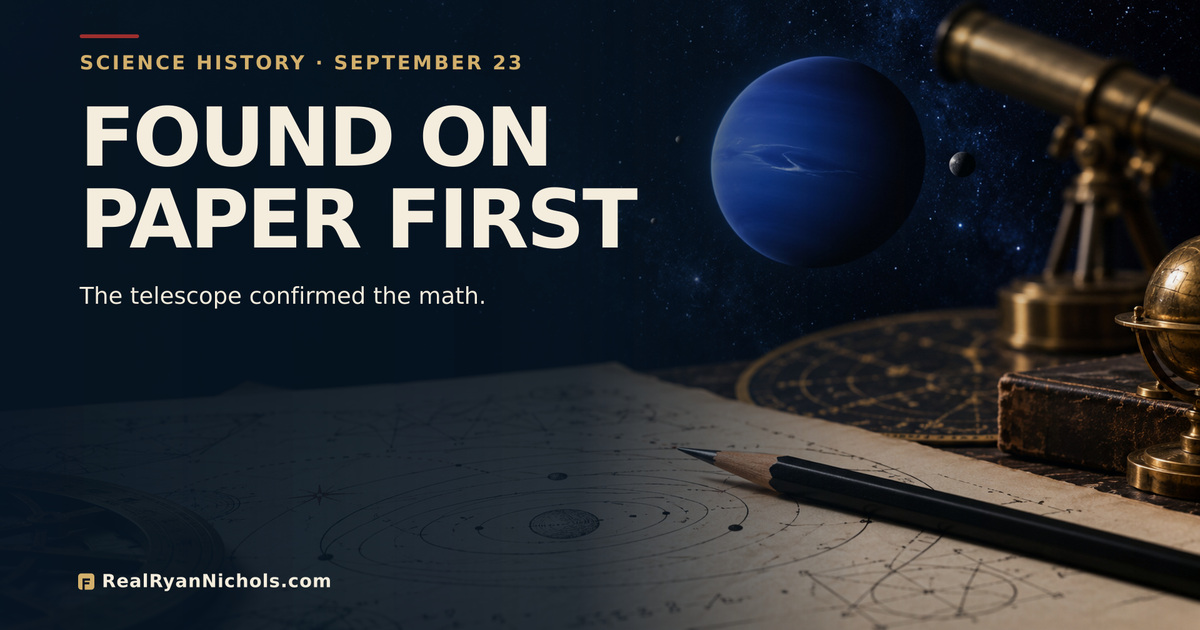
The telescope did not begin the search.
The numbers did.
On the night of September 23, 1846, German astronomer Johann Gottfried Galle looked into the sky from the Berlin Observatory and found Neptune near the position French mathematician Urbain Le Verrier had predicted.
It was the first planet found through mathematical prediction before direct observation.
The discovery began with a problem that would not behave.
Uranus would not stay where the tables put it
Astronomers already knew about Uranus. They could calculate its expected orbit and compare those calculations with observation.
The match was not perfect.
Something appeared to be tugging on the planet.
According to NASA’s history of the discovery, the irregularities in Uranus’s orbit led astronomers to consider the gravitational influence of an unknown planet farther from the Sun.
This was not a blurry object waiting for somebody to notice it in a photograph.
It was an unseen cause inferred from the movement of something visible.
Two mathematicians worked the problem
In Britain, John Couch Adams calculated where the unknown planet might be. In France, Le Verrier independently attacked the same problem.
The Royal Observatory Greenwich account describes the parallel work and the later argument over credit. Both men produced predictions, but the decisive observation followed Le Verrier’s communication to Berlin.
Le Verrier sent his predicted position to Galle.
Galle and his assistant Heinrich d’Arrest compared the sky with a star chart. The object they found was not listed as a fixed star. Its position was close to the one Le Verrier had calculated.
The Smithsonian National Postal Museum records the discovery date as September 23, 1846, at the Berlin Observatory.
The pencil had narrowed the sky enough for the telescope to know where to look.
Prediction made the observation stronger
There is a difference between finding something unexpected and predicting where it should be before seeing it.
A prediction takes a theory out of the safety of explanation and gives it a place to fail.
If the planet was not near the calculated position, the assumptions or the arithmetic would need another look. If it was there, the observation would confirm that gravity could reveal an object across an enormous distance before light through a telescope did.
That is what made Neptune’s discovery more than a new dot on a chart.
It was a demonstration that a hidden thing could leave measurable consequences.
The new planet was still a difficult world
Finding Neptune did not make it familiar.
NASA’s Neptune facts place the planet about 30 astronomical units from the Sun. Sunlight takes roughly four hours to reach it. One Neptune year lasts about 165 Earth years.
Humans did not get a close view until Voyager 2 flew past in 1989.
The planet turned out to be dark, cold, blue, and violent. NASA says its winds can exceed 1,200 miles per hour.
The clean elegance of the prediction opened the door to a world far stranger than the calculation sheet.
A model is valuable when it can be tested
The Neptune story is often reduced to a line about a planet discovered with mathematics.
The deeper lesson is about evidence.
Le Verrier did not merely say that an unseen planet might exist somewhere. He gave astronomers a position. The claim could be checked.
That is a useful standard far beyond astronomy.
A business forecast should name what result would confirm it. A public claim should point to a record. A technical diagnosis should predict what will happen when one variable changes. A personal plan should identify the next observable action.
Without a test, an explanation can keep moving every time reality disagrees.
With a test, the truth gets a chance to answer.
The credit was not perfectly clean
History did not wrap the discovery in a simple bow.
Adams had made his own calculations. British astronomers later argued that he deserved shared credit. Communication delays and institutional decisions affected who looked, when they looked, and whose prediction produced the confirmed observation.
The discovery belongs to a chain: earlier observations, orbital tables, Newtonian gravity, independent calculations, a letter to Berlin, a star chart, and a telescope pointed at a narrow piece of sky.
That does not weaken the story.
It makes the story more honest.
Breakthroughs often arrive through several kinds of work that become visible at different times.
The sky answered the page
On September 23, 1846, Galle looked where Le Verrier told him to look.
The planet was there.
The discovery did not prove that equations can replace observation. It showed why the two are stronger together.
The mathematics made a risky claim. The telescope tested it. The sky answered.
Sometimes the first sign of a hidden truth is not the thing itself.
It is the pattern the hidden thing cannot help leaving behind.
Read “Voyager 1 Left Earth Carrying a Record for Strangers” for another story about turning a calculation into a journey beyond the familiar sky.
What problem in your life or work would become clearer if you wrote down one prediction before you went looking for the answer?
Read next
Fighting Shadows · Pre-order
Early access for $29.99$29.99
Read it first and own a piece of the story — or become a Founding Supporter (limited to 250).
Don't lose this story to an algorithm.
The next chapter gets posted here first — on my own domain, where no platform can throttle it and no one can ban it. Drop your email or number and the update reaches you the moment it's live.
Email gets one confirmation click. Unsubscribe anytime. No spam, no selling your data — ever.
Tap how this hits you — no signup, everyone sees the count
Share this post — get it back in front of people
Comments
Speak here
Create an account to comment.
This is where people can say what gets buried or cancelled elsewhere. Comments are signed-only, moderated, and tied to a real profile so the record stays usable.
No approved comments yet. Create an account and put the first opinion on the record.