
The Film Festival That Had to Wait Seven Years to Begin
Cannes was ready to open in September 1939 when war stopped the festival. Seven years later, the first full edition finally began on September 20.
By Real Ryan Nichols Editorial Team
- 2 total reach
- 1reading now•1 active 24h
- 0 shares•0 inbound
- 0 comments
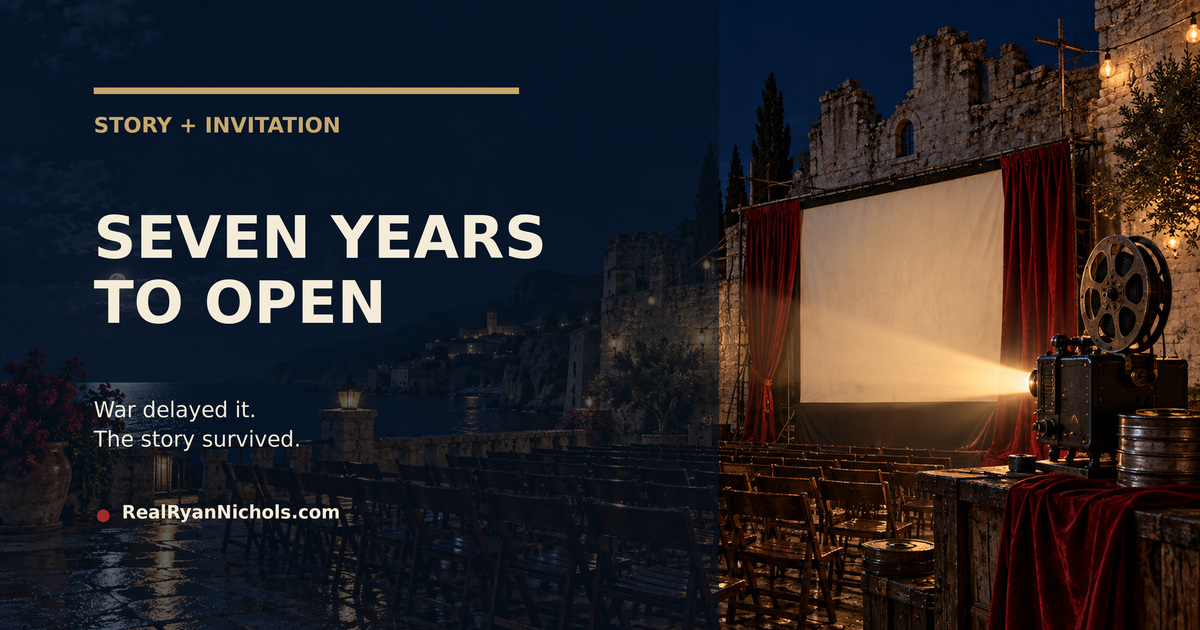
The chairs were ready. The films had arrived. The idea had a name and a place on the French coast.
Then history changed the program.
The first Cannes film festival was scheduled to begin in September 1939. Germany invaded Poland. France and Britain declared war. The festival stopped almost as soon as it tried to start.
It would take seven years for Cannes to hold its first full edition.
That edition opened on September 20, 1946.
The festival began as an answer
Cannes was not created only because people liked movies and beaches.
The idea grew from a fight over whether a film festival could remain independent while fascist governments pressured the Venice Film Festival.
TIME’s history of the first Cannes festival explains that France planned an international festival of its own for 1939. The event was meant to offer a freer alternative and draw filmmakers from multiple countries.
The first edition had prestige, anticipation, and a resort prepared to host it.
It did not have peace.
The German invasion of Poland on September 1 pushed Europe into war. The festival plans collapsed as nations mobilized.
One idea had run directly into an event larger than every organizer in the room.
Seven years is long enough to call something over
Seven years can change governments, borders, careers, technology, and the people who first made a plan.
It is long enough for an abandoned event to become a historical footnote.
The people behind Cannes could have said the moment had passed. The name belonged to a world that no longer existed. Europe had larger problems. Audiences had changed. Money and buildings were needed elsewhere.
All of that would have been understandable.
The festival came back anyway.
The first full Cannes Film Festival opened on September 20, 1946, in a continent still carrying the damage of war. It was not the polished global machine people recognize now. It was an institution being built in public while the world around it was rebuilding too.
The first success was simply beginning
Modern Cannes is associated with premieres, stars, business deals, fashion, and competition.
That can make the origin look inevitable.
It was not.
An institution that now helps define the international film calendar first had to survive being canceled before it had a history.
The Festival de Cannes describes itself as a place that has celebrated and served cinema for decades. Reuters, in its 2026 festival explainer, traced the event from that postwar beginning to its current position at the center of world cinema.
The distance between those two points was not created by one perfect opening night.
It was created by returning to the idea after the original launch had become impossible.
Delay changes the work
There is a comforting version of persistence that says you can resume exactly where you stopped.
Sometimes you cannot.
The conditions change. The people change. The audience changes. The original plan no longer fits the world that exists.
Persistence is not preserving every detail. It is preserving the reason the work mattered, then rebuilding the form around reality.
Cannes in 1946 could not be Cannes in 1939 with the calendar moved forward. It had to become a postwar festival.
That is a harder kind of return.
It asks what must remain and what must be released.
Some beginnings happen after the loss
We often talk about a comeback as if the first version already proved itself.
Cannes had not.
It was an untested event interrupted at the threshold. The organizers did not have years of successful results to defend. They had an idea, a failed opening, and a reason to try again when conditions allowed.
That matters for anyone rebuilding work that never had time to become what it was supposed to be.
You may not be returning to success.
You may be returning to an unfinished beginning.
The interruption does not prove the idea was wrong. It does not prove the idea was right either. It means the idea still has to meet reality.
The invitation inside the story
September 20 is not important because every delayed project becomes Cannes.
Most do not.
It is important because a famous institution still carries the date when an interrupted idea finally got its first full chance.
The seven-year wait did not disappear from the story. It became part of the story.
If something you meant to build was interrupted, ask two questions:
- Does the reason still matter?
- What form would let it live in the world that exists now?
Do not confuse faithfulness with copying the abandoned plan.
Sometimes the way back is a new beginning with the old reason still inside it.
Read the related story, “The 27-Minute Ceremony That Ended World War II”, for another moment when history changed in less time than anyone could feel.
What unfinished beginning deserves a fresh design instead of another memorial?
Read next
Fighting Shadows · Pre-order
Early access for $29.99$29.99
Read it first and own a piece of the story — or become a Founding Supporter (limited to 250).
Don't lose this story to an algorithm.
The next chapter gets posted here first — on my own domain, where no platform can throttle it and no one can ban it. Drop your email or number and the update reaches you the moment it's live.
Email gets one confirmation click. Unsubscribe anytime. No spam, no selling your data — ever.
Tap how this hits you — no signup, everyone sees the count
Share this post — get it back in front of people
Comments
Speak here
Create an account to comment.
This is where people can say what gets buried or cancelled elsewhere. Comments are signed-only, moderated, and tied to a real profile so the record stays usable.
No approved comments yet. Create an account and put the first opinion on the record.