
The First Electronic Television Image Was One Straight Line
On September 7, 1927, Philo Farnsworth transmitted a simple line with an all-electronic television system. The tiny proof still shapes modern media.
By Ryan Nichols
- 143 total reach
- 0 reading now•0 active 24h
- 0 shares•0 inbound
- 0 comments
The first useful proof did not look like the future.
It looked like a line.
On September 7, 1927, 21-year-old inventor Philo T. Farnsworth used an all-electronic television system to transmit a simple image in his San Francisco laboratory. The image was a straight line, moved and turned to show that the receiving screen was reproducing what the camera system saw.
There was no broadcast audience. No studio set. No breaking-news banner. No living room built around the screen.
There was a small glowing result that answered the only question that mattered that day: can this work?
Farnsworth had already chosen the hard problem
Early television experiments often relied on mechanical parts to scan an image. Farnsworth's idea was different. He wanted the picture captured, transmitted, and reconstructed electronically.
The National Inventors Hall of Fame says Farnsworth joined Crocker Research Laboratories in San Francisco in 1926 and produced the first all-electric television image at age 21. It credits his television patents with advances in scanning, focusing, synchronization, contrast, controls, and power.
His U.S. Patent No. 1,773,980, filed January 7, 1927, describes a system for converting the light and shades of an image into electrical variations and reconstructing them at a receiver. The published patent explains that the process did not require mechanically moving parts for the image scan.
That technical distinction mattered more than the drama of the picture on the screen. A single line could be a legitimate milestone because the invention was the system, not the subject.
A farm field helped shape the idea
Farnsworth grew up around farming and electricity. Accounts of his youth describe him thinking about images as rows, much like the back-and-forth pattern of plowing a field.
That mental move is worth noticing.
He did not begin by asking how to make the existing mechanical approach spin faster. He reframed the picture as information that could be scanned line by line.
Builders often get trapped trying to improve the visible object. The breakthrough sometimes comes from changing the representation underneath it.
The first solar car was tiny because the point was proving that sunlight could move a vehicle. The first successful electronic television picture was simple because the point was proving that an electronic system could carry an image.
The First Solar Car Was 15 Inches Long tells that related story of a small demonstration carrying a much larger claim.
The straight line was a disciplined test
A simple test target removes excuses.
If the team had begun with a face, landscape, or moving scene, every defect could have come from several places. A straight line made the result easier to read. Was it present? Did it move when the source moved? Did it rotate when the source rotated?
That is good experimental design hiding inside a famous story.
The test did not try to impress a future customer. It isolated the hardest unknown.
Operators can use the same rule today:
- Name the claim your system must prove.
- Remove every feature that does not test that claim.
- Create one result that can clearly pass or fail.
- Record what happened.
- Add complexity only after the core path works.
The straight line was not a weak demo. It was the right demo for the question.
The patent record shows how much lived behind the picture
The finished image was minimal. The machinery and thinking were not.
Farnsworth's patent discusses light-sensitive materials, electrical currents, oscillators, synchronization, image analysis, and the receiving screen. That is a reminder that a clean output can sit on top of years of complicated work.
People usually meet an invention at the surface. They see the picture, press the button, or turn the dial. They do not see the failed components, financing pressure, legal fights, recalibration, or long nights behind the interface.
The Night the Telegraph Wires Woke Up shows an earlier communications system meeting the public in a different form. The Broken Laser Pointer That Proved the Market Was There shows how a rough prototype can reveal demand before the polished product exists.
Build the smallest proof that tells the truth
The lesson is not to celebrate every crude prototype as genius.
The lesson is to make the proof match the uncertainty.
If you are testing whether a customer will answer, you may need one working message, not a full CRM rebuild. If you are testing whether a process saves time, measure one repeated task before automating the department. If you are testing whether a reader wants the story, publish the first verified part before designing a ten-part series.
Small proofs become dangerous when they claim more than they show. Farnsworth's line did not prove that television had solved programming, manufacturing, regulation, business models, or culture. It proved that the core electronic image path could work.
That was enough to open the next door.
The invitation
Ninety-nine years later, screens carry war, worship, comedy, advertising, testimony, instruction, and noise across the world. The first electronic picture did not predict all of that.
It did not need to.
One honest line established a new possibility.
If you value stories about the small, verified moments that changed business and technology, join the RealRyanNichols.com email and text list. The next part may begin with another result that looked too small to matter.
Sharing this is the biggest help. Put it in front of one more person.
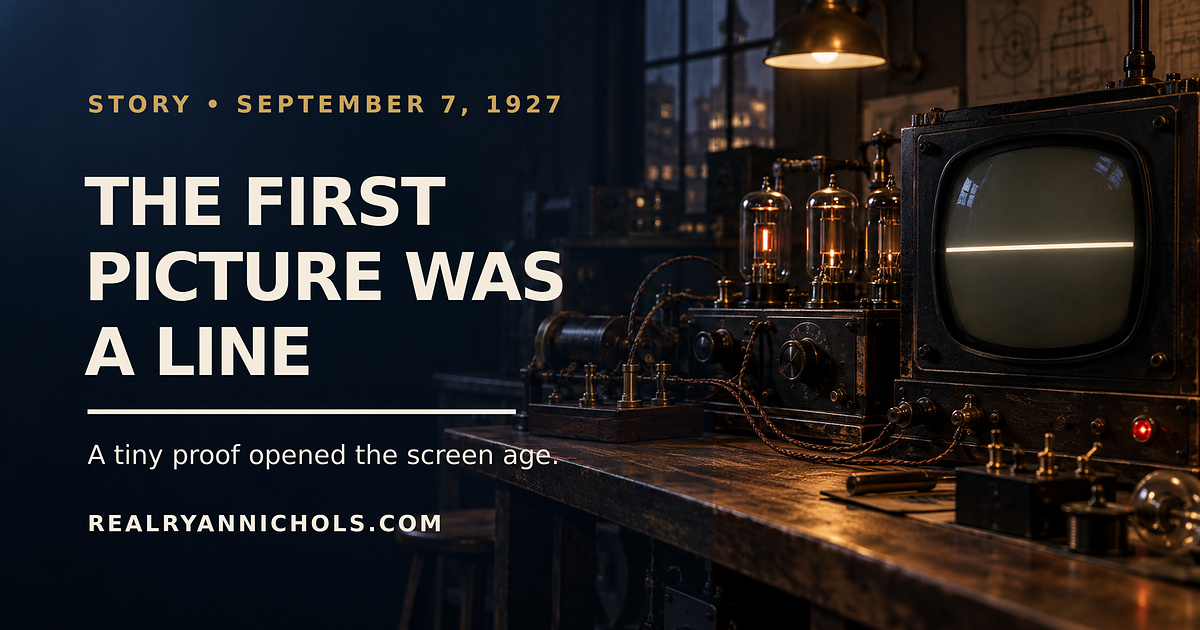
Editorial visual disclosure: The header image is an original AI-assisted conceptual illustration of a 1920s electronics bench. It is not a photograph of Farnsworth's laboratory, apparatus, patent, or the 1927 event.
You made it to the end
Most people quit at the headline. You didn’t.
So don’t stop here. Pick one.
Read the book
Fighting Shadows is the whole story in my own words: the road into January 6, the D.C. jail, and the fight to get the record out.See the book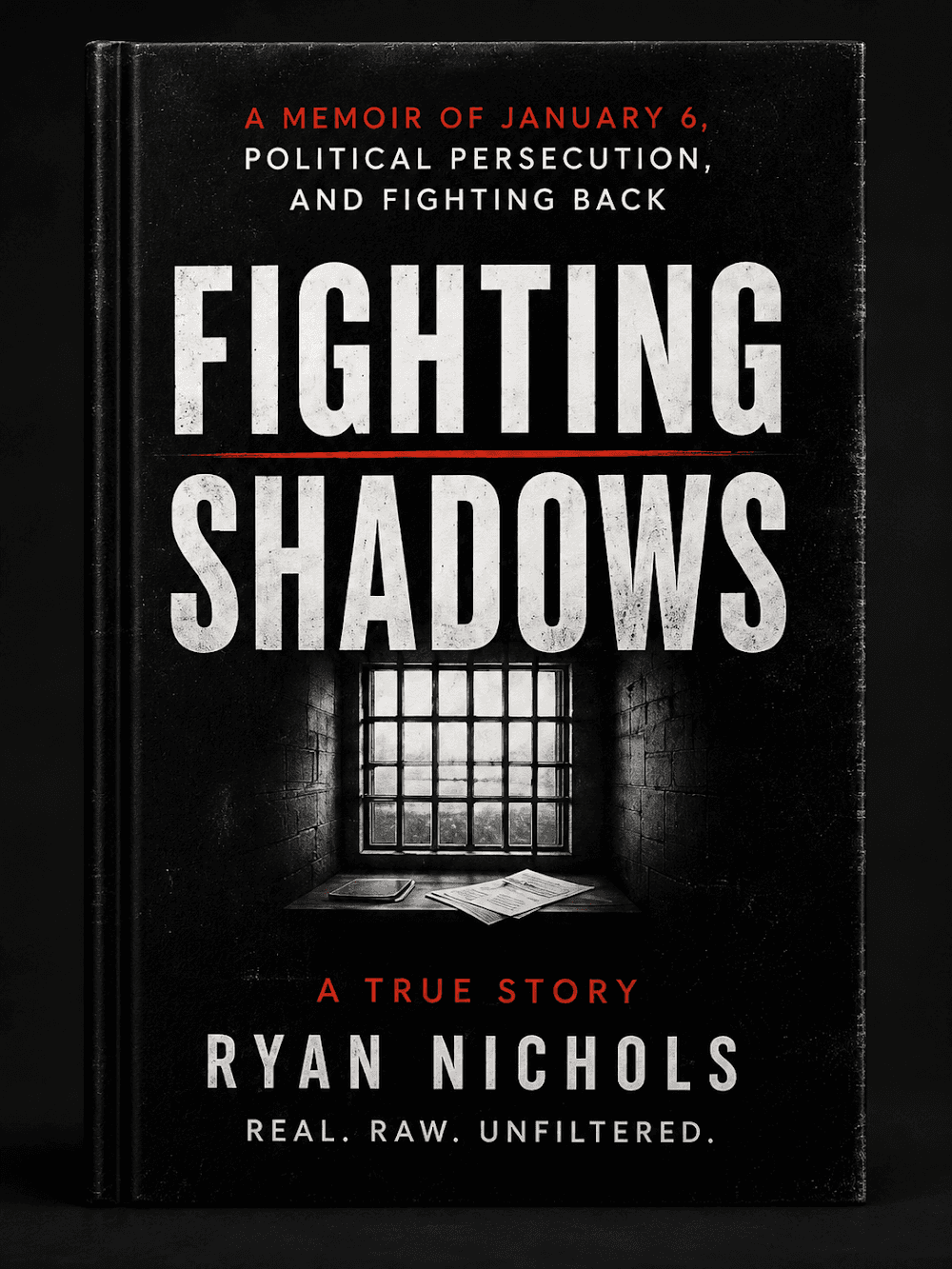
Follow the case
The record is still being written. Get one email when something new drops on it.
Hire Ryan
I built this site. Want one that brings your business real leads? Start with a free 30-minute call.See the services



Tap how this hits you — no signup, everyone sees the count
Share this post — get it back in front of people
Comments
Speak here
Create an account to comment.
This is where people can say what gets buried or cancelled elsewhere. Comments are signed-only, moderated, and tied to a real profile so the record stays usable.
No approved comments yet. Create an account and put the first opinion on the record.