
Sputnik Was 23 Inches Wide. It Changed the Scale of the Race.
By Ryan Nichols
- 3 total reach
- 0 reading now•0 active 24h
- 0 shares•0 inbound
- 0 comments
The sound was not a speech.
It was a beep.
Then another.
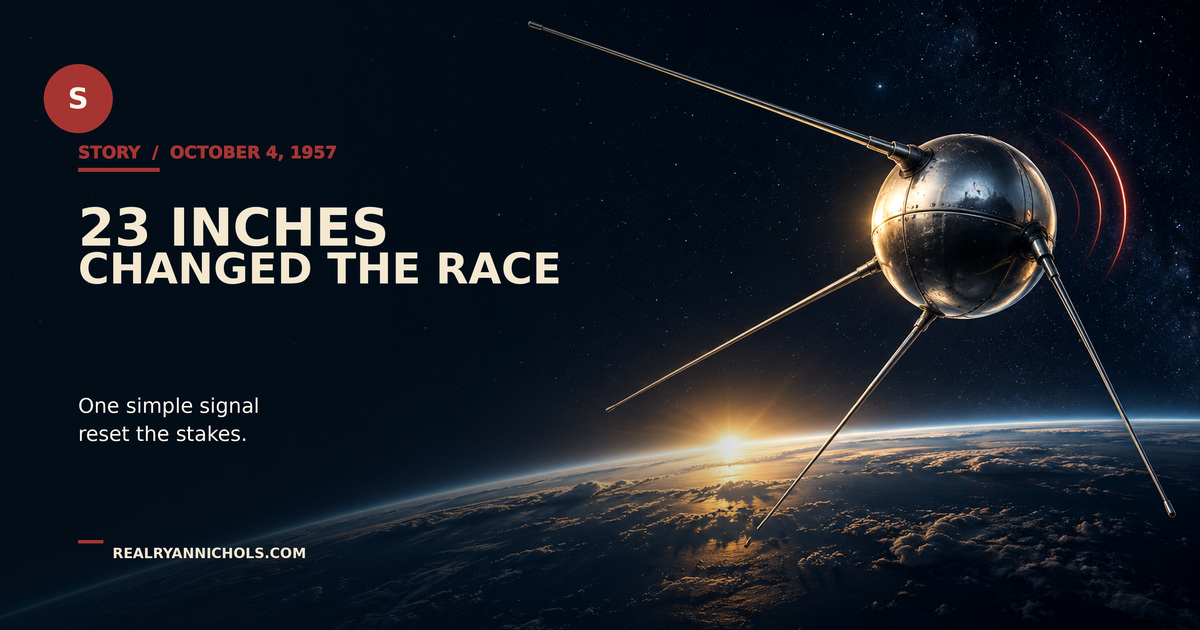
On October 4, 1957, the Soviet Union placed Sputnik 1 into orbit. The first artificial satellite was about 23 inches across, weighed about 184 pounds, and took roughly 98 minutes to travel around Earth on its elliptical path.
It carried no camera. NASA’s history says it carried no scientific instruments, only a transmitter that sent a signal people around the world could monitor.
The signal was simple.
What it proved was not.
A small object made a large claim
The NASA History Office describes Sputnik as about the size of a beach ball. Its physical scale made the reaction look almost unreasonable.
How could something so small disturb a country?
Because the polished sphere was not the whole demonstration.
The launch proved that the Soviet Union could place hardware above Earth and keep it there. In the middle of the Cold War, that achievement carried scientific, military, political, and psychological meaning at the same time.
The satellite’s transmitter gave the public a way to hear the proof directly. The signal crossed borders. It did not require a press conference to make the accomplishment real.
Reader poll
What makes a breakthrough impossible to ignore?
Tap your answer to vote
One tap. Free and anonymous. No signup to vote.
The beep did not last long
NASA’s 65th-anniversary account says Sputnik’s batteries ran out on October 26, 1957. The satellite reentered Earth’s atmosphere on January 4, 1958.
Its operating life was measured in weeks.
Its consequences were measured in decades.
The reaction in the United States included public shock, political hearings, accelerated investment, and a sharper sense that space was not a distant subject for science fiction. NASA notes that the response ultimately contributed to the agency’s creation in 1958.
The State Department’s historical account adds the diplomatic and military context. Sputnik intensified Cold War tension because rocket capability could not be separated neatly from missile capability.
The satellite was not dangerous because of what it carried.
It was consequential because of what the launch demonstrated.
The United States had plans too
Sputnik did not arrive in a world where nobody else had thought about satellites.
Both the United States and the Soviet Union had announced intentions to launch artificial satellites during the International Geophysical Year, a multinational scientific effort running from July 1957 through December 1958.
But intention and orbit are different things.
One country had a plan. The other country had a signal passing overhead.
That gap changed the conversation.
It is easy to dismiss a simple first version when you are looking at the sophisticated systems that come later. Sputnik had no modern sensor suite, no high-resolution imagery, no computer people would recognize today.
It did the one job that mattered first.
It reached orbit and proved it.
A visible result can reorganize priorities
Organizations often carry the same list for years.
Research matters. Training matters. Infrastructure matters. The new system would be useful. The risk deserves attention.
Then somebody else produces a visible result, and every old priority gets a new number.
That is not always wise. Competition can create panic, waste, and bad shortcuts. It can also expose the difference between a stated priority and a funded one.
Sputnik forced American leaders to confront that difference.
The lesson is not that every project needs a rival or a crisis. The lesson is that proof changes what planning alone cannot.
The same pattern appears in Neptune Was Found on Paper Before It Was Found in the Sky. Calculation created a testable position, and observation finished the argument. Voyager 1 Left Earth Carrying a Record for Strangers shows what happened when space technology became capable of carrying not only instruments, but a deliberate message about humanity. The First Electronic Television Image Was One Straight Line begins with an even smaller demonstration that pointed toward an industry.
The first proof does not need to contain the whole future
Sputnik did not contain the Moon landing.
It did not contain a space station, satellite navigation, weather forecasting, planetary science, or the ordinary communications systems that later generations would take for granted.
It made those futures harder to dismiss.
That is what a strong first proof does.
It does not finish the story. It changes the burden of proof for everybody still saying the story cannot happen.
The Soviet satellite was 23 inches wide.
The argument it ended was much larger.
The argument it started was larger still.
For more verified stories about the small demonstrations that changed technology and public life, join the RealRyanNichols.com email or text list. The next story will come straight to you, without an algorithm deciding whether you see it.
What small, undeniable proof would change the priority of the work in front of you?
Reader poll
What should the next history story follow?
Tap your answer to vote
One tap. Free and anonymous. No signup to vote.
Verification note: Historical claims were checked at 4:25 a.m. Central on October 4, 2026, against NASA History and the U.S. State Department’s Office of the Historian.
Editorial visual disclosure: The header image is an original AI-assisted conceptual illustration. It is not a documentary photograph of Sputnik 1, its launch, or a specific historical scene.
You made it to the end
Most people quit at the headline. You didn’t.
So don’t stop here. Pick one.
Read the book
Fighting Shadows is the whole story in my own words: the road into January 6, the D.C. jail, and the fight to get the record out.See the book
Follow the case
The record is still being written. Get one email when something new drops on it.
Hire Ryan
I built this site. Want one that brings your business real leads? Start with a free 30-minute call.See the services



Tap how this hits you — no signup, everyone sees the count
Share this post — get it back in front of people
Comments
Speak here
Create an account to comment.
This is where people can say what gets buried or cancelled elsewhere. Comments are signed-only, moderated, and tied to a real profile so the record stays usable.
No approved comments yet. Create an account and put the first opinion on the record.