
Should Texas Require a Warning Before Towing a Resident's Car?
Texas regulates private-property towing and requires signs in many cases. Should apartment residents receive one direct warning before a routine tow?
By Ryan Nichols
- 142 total reach
- 0 reading now•0 active 24h
- 0 shares•0 inbound
- 0 comments
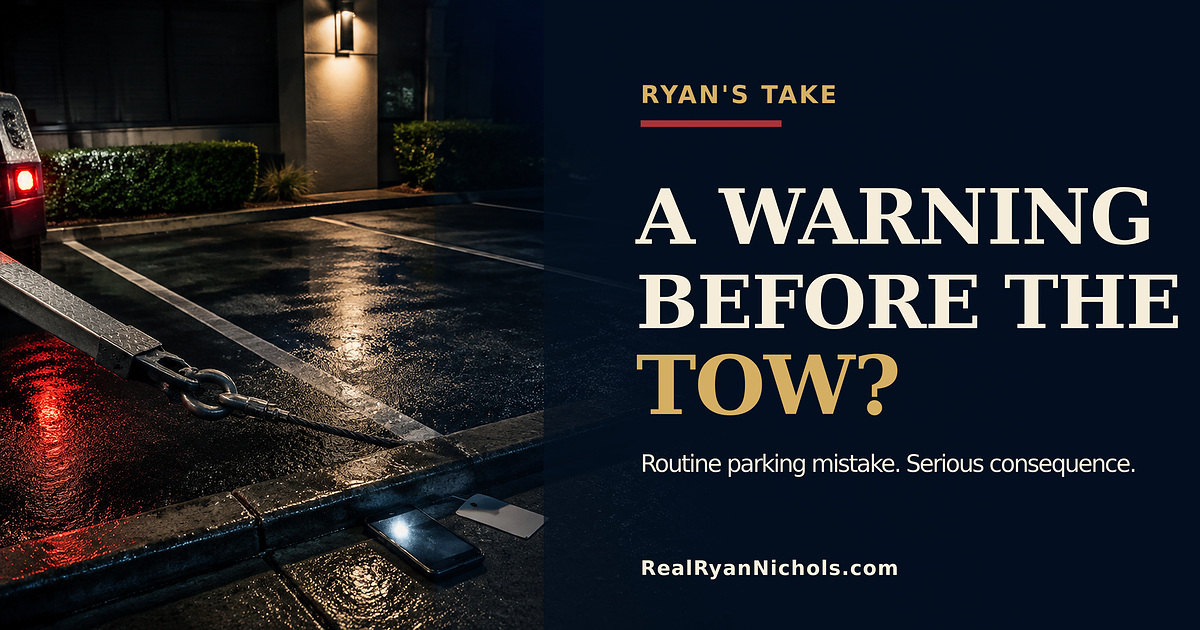
A resident walks outside for work and finds an empty parking space.
The car was not stolen. It was towed from the apartment property where the resident lives.
Maybe the permit fell from the mirror. Maybe the registration changed. Maybe the car sat in the wrong numbered space. Maybe the tow was lawful and the resident missed a sign.
Texas already regulates private-property towing. The question is whether signs are enough in a place where the property owner often has the resident's name, vehicle information, phone number, and email address.
Should Texas require one direct warning before an apartment complex orders a routine tow of a resident's registered vehicle?
The verified starting point
The Texas Department of Licensing and Regulation says cars parked in a tow-away zone or on property without permission may be towed at the owner's expense. It explains several consumer rights after a private-property tow, including the right to request a tow hearing in a Justice of the Peace court within 14 days if the owner believes the vehicle was wrongfully towed, stored, booted, or overcharged.
Texas also sets detailed requirements for many tow-away signs. TDLR says signs must be conspicuously visible at entrances, include the towing symbol and enforcement language, explain who may park, state enforcement hours, and provide a 24-hour number for locating a vehicle.
After a private-property tow reaches a vehicle storage facility, the facility must notify local law enforcement within two hours and provide identifying and location information, according to the state's vehicle storage notification guidance.
Those rules create notice, recovery, and challenge procedures. They do not amount to a universal promise that every apartment resident will receive a text, call, email, or door notice immediately before every tow.
The strongest case for a direct warning
The best argument for a warning is proportionality.
Towing a car can disrupt work, child care, medical appointments, and family logistics. The owner may face a towing charge, daily storage costs, transportation expenses, and lost time. TDLR currently lists a statewide maximum of $272 for a private-property tow of a vehicle weighing up to 10,000 pounds, although local limits may be lower.
When an apartment manager already knows the vehicle belongs to a resident, a short warning can solve many nonemergency problems without moving the car at all.
“Your permit is not visible. Move or correct the vehicle by 8 a.m.” is cheaper than a tow, faster than a court hearing, and more likely to fix the underlying parking issue.
A direct notice would also create a timestamped record. The property could show that it warned the resident. The resident could not honestly claim the first notice came from an empty parking space.
Reader poll
When should a direct warning be required?
Tap your answer to vote
One tap. Free and anonymous. No signup to vote.
The strongest case against a universal warning
Some vehicles need to move now.
A car blocking a fire lane, accessible space, gate, loading zone, hydrant, travel lane, or another resident's assigned space can create immediate safety or access problems. A mandatory delay could leave the property unable to protect people who followed the rules.
Managers may not know who owns every car. Plates change. Guests arrive. Contact information goes stale. A resident may register one vehicle and park another. A text can fail without the property knowing it failed.
There is also a fair argument that conspicuous signs and lease terms already provide notice. Requiring a customized warning for every violation could create administrative cost, encourage repeat violations, and produce new disputes over whether a message was sent, received, or sufficiently clear.
The strongest opposition is not a defense of surprise. It is a warning that one rigid statewide procedure may fit a fallen permit but fail badly in a blocked fire lane.
Ryan's Take
The following is editorial analysis, not a claim that Ryan supplied a personal statement for this article.
Texas should require one direct warning before a routine apartment tow when three facts are present:
- the property can reasonably identify the vehicle as belonging to a current resident
- the violation does not create an immediate safety or access problem
- the resident has not received a warning for the same issue within a defined period
The rule should allow delivery by text, email, resident portal, or a weather-resistant notice on the vehicle. It should state the violation, the deadline to correct it, and the number to call with a question.
It should not delay a tow from a fire lane, accessible space without authorization, blocked gate, travel lane, hydrant, or another location where waiting causes a real problem. It should not protect an abandoned, dangerous, or clearly unauthorized vehicle indefinitely.
The point is not to make parking rules optional.
The point is to make the consequence useful. If a six-hour warning gets the permit fixed and the space cleared, the parking rule worked without creating a second crisis.
What residents can do under current rules
Until any law changes, residents can reduce confusion with a short parking record:
- photograph the current parking permit in the place where it must be displayed
- save the lease page and parking addendum that describe towing rules
- update the property when the plate, vehicle, phone number, or email changes
- photograph the entrance signs and assigned space numbers
- call the number on the posted sign if the vehicle is missing
- request the tow ticket and keep every receipt
- review TDLR's consumer guidance promptly if the tow appears improper
A tow hearing deadline can move faster than an angry phone call. TDLR says the request must be made within 14 days of the tow. Anyone facing a real dispute should read the current rules and seek qualified legal advice when needed.
Reader poll
What is the fairest rule?
Tap your answer to vote
One tap. Free and anonymous. No signup to vote.
This is a narrow policy question, not an accusation against a particular apartment property, manager, or towing company.
Should Texas require one direct warning before a routine tow of a known resident's car, or do posted signs provide enough notice?
Sharing this is the biggest help. Put it in front of one more person.
Texas towing guidance was verified September 4, 2026. This article is general editorial analysis, not legal advice about a specific tow, lease, or property.
Editorial visual disclosure: The header image is an original AI-assisted conceptual illustration. It does not depict a real apartment property, vehicle, tow, permit, or notice.
You made it to the end
Most people quit at the headline. You didn’t.
So don’t stop here. Pick one.
Read the book
Fighting Shadows is the whole story in my own words: the road into January 6, the D.C. jail, and the fight to get the record out.See the book
Follow the case
The record is still being written. Get one email when something new drops on it.
Hire Ryan
I built this site. Want one that brings your business real leads? Start with a free 30-minute call.See the services

Tap how this hits you — no signup, everyone sees the count
Share this post — get it back in front of people
Comments
Speak here
Create an account to comment.
This is where people can say what gets buried or cancelled elsewhere. Comments are signed-only, moderated, and tied to a real profile so the record stays usable.
No approved comments yet. Create an account and put the first opinion on the record.