
Should Texas Set Statewide Rules for License Plate Reader Cameras?
Texas paused state funding for Flock cameras. The bigger debate is whether every license plate reader needs common rules for access, retention, and audits.
By Ryan Nichols
- 198 total reach
- 0 reading now•0 active 24h
- 0 shares•0 inbound
- 0 comments
By Ryan Nichols
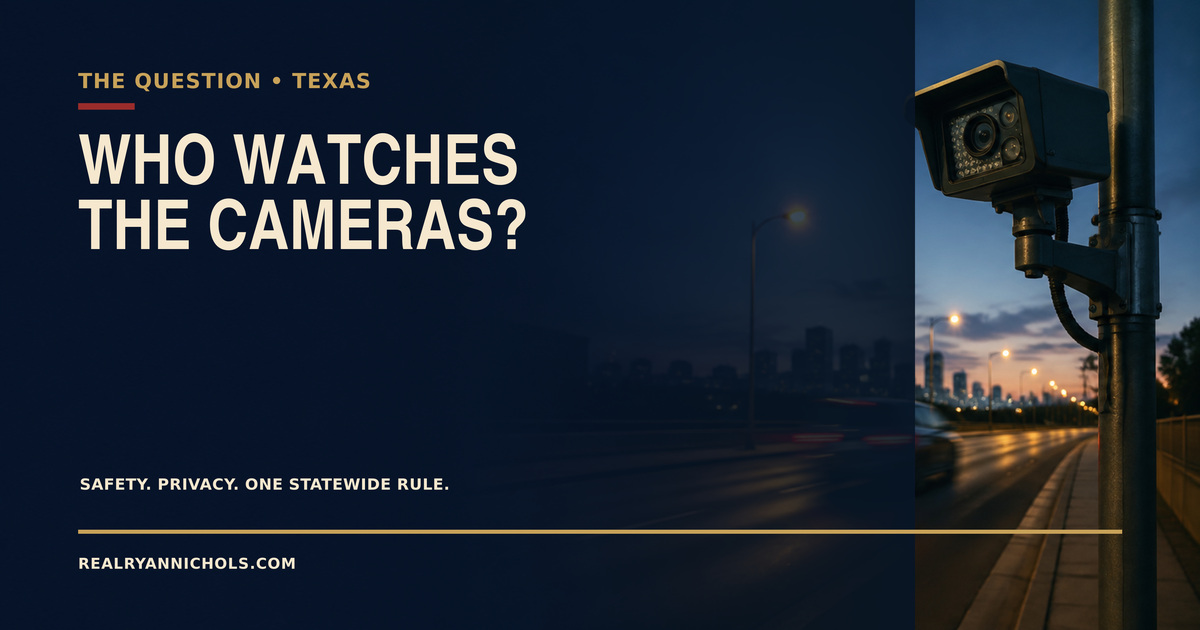
Texas has paused state-agency spending on one major license plate reader system. The cameras already installed across Texas have not disappeared.
On August 28, 2026, The Texas Tribune reported that Governor Greg Abbott directed state agencies to stop using state funds for Flock Safety cameras. The Tribune reported that Texas agencies had spent at least $30 million on more than 3,200 cameras since 2023, including a Department of Public Safety contract for 1,200 cameras.
That order creates a pause. It does not settle the larger policy question.
Who may search license plate reader data? How long should a location record remain available? When may another agency access it? What must the public be told? What audit trail should exist when a search is improper?
Information in this article was verified at 3:45 a.m. Central on September 1, 2026.
What these systems do
An automated license plate reader captures an image of a passing vehicle and reads the plate. Depending on the system and settings, the resulting record may include the plate number, time, location, vehicle characteristics, and images.
Police can use that information to look for a stolen vehicle, a car connected to an Amber Alert, or a vehicle associated with a reported crime. The same network can also reveal where an ordinary vehicle was seen even when the driver is not suspected of wrongdoing.
Flock says its customers control access to their data and that searches require a stated reason. In an August 13 policy update, the company said its standard retention period was changing to seven days. Its published legal policy also says agency agreements and customer settings govern retention, access, and sharing.
Company policy matters. Public law matters more because it applies even when vendors, contracts, and local leadership change.
The strongest case for statewide rules
The case for common Texas rules begins with consistency.
A driver can cross several jurisdictions on one trip without knowing that each may use different retention periods, access controls, sharing agreements, or disclosure practices. A basic privacy protection should not depend entirely on which side of a city limit captured the plate.
Statewide rules could require:
- a documented purpose for every search
- automatic audit logs
- a short default retention period for vehicles not linked to an active investigation
- supervisory approval for sensitive or broad searches
- clear limits on sharing outside the original agency
- public notice of camera locations or counts when disclosure would not compromise an investigation
- regular reports on hits, errors, improper searches, and corrective action
- a process for handling data connected to protected activities or sensitive locations
The federal Office of Justice Programs guidance says agencies need policy choices covering collection, access, use, sharing, retention, and purge. A Government Accountability Office report also warned that detection technologies can create privacy and civil-liberties risks when policies do not fully address the personal information involved.
Statewide minimums would not have to ban the technology. They could make every use answerable to the same floor.
The strongest case against one statewide rulebook
The case against a single statewide framework begins with operational differences.
A rural sheriff's office, a border task force, a city police department, and a state highway unit do not face identical problems. A retention period useful for investigating a pattern of vehicle burglaries may be too broad for a camera used only to alert on stolen plates. A rigid state rule could force agencies into procedures that do not fit their missions.
Local control also makes elected city councils, county commissioners, sheriffs, and police chiefs directly responsible to their own communities. A community that wants strict limits can adopt them. Another facing a specific crime problem can authorize broader use after public debate.
There is also a cost argument. New reporting systems, independent audits, notice requirements, and technical controls require staff time and money. A poorly written mandate could pull resources away from active investigations without producing meaningful privacy protection.
Finally, detailed public disclosure can create operational risks. Publishing exact technical coverage, search methods, or active information-sharing arrangements could help offenders avoid detection.
Those concerns are real. A rule can become a box-checking exercise or an obstacle if lawmakers write it without understanding how the system is used.
Ryan's Take
This is editorial analysis, not a statement supplied personally by Ryan.
Texas should set a narrow statewide floor and leave room for local agencies to be stricter.
The floor should focus on what no government user should be allowed to skip: a legitimate purpose, a recorded search reason, role-based access, short retention for non-hit data, audited sharing, consequences for misuse, and a public annual report that does not expose active investigations.
Local agencies could still decide where cameras are useful, which crimes justify alerts, and whether their community wants stronger limits.
The funding pause is not enough. It applies to state money and one vendor. The principles should follow the data, not the logo on the camera or the line in the budget.
That is the same accountability question behind Should Texas Publish Job and Wage Results for Every Workforce Grant?. If public power or public money is used, the public deserves a result card. It also connects to Should Texas Require Customer-Service Bots to Say They Are AI?, where disclosure is a baseline rather than a ban.
The direct question
Reasonable people can value both faster investigations and freedom from unjustified tracking. The hard work is turning both values into rules that can be tested.
Should Texas create one statewide minimum for license plate reader access, retention, sharing, and audits, or should each local agency keep setting its own rules?
{{< poll id="texas-alpr-rules-2026" question="Who should set the minimum rules for license plate readers in Texas?" options="The state|Local agencies|State floor plus local control|Do not use the cameras" >}}
{{< share >}}
Sources
- The Texas Tribune, August 28, 2026
- Flock Safety policy update, August 13, 2026
- Flock Safety LPR policy
- U.S. Office of Justice Programs ALPR guidance
- U.S. Government Accountability Office report GAO-25-107302
Editorial visual disclosure: The header image is an original AI-assisted conceptual illustration. It does not depict a real camera, road, government system, or specific location.
You made it to the end
Most people quit at the headline. You didn’t.
So don’t stop here. Pick one.
Read the book
Fighting Shadows is the whole story in my own words: the road into January 6, the D.C. jail, and the fight to get the record out.See the book
Follow the case
The record is still being written. Get one email when something new drops on it.
Hire Ryan
I built this site. Want one that brings your business real leads? Start with a free 30-minute call.See the services

Tap how this hits you — no signup, everyone sees the count
Share this post — get it back in front of people
Comments
Speak here
Create an account to comment.
This is where people can say what gets buried or cancelled elsewhere. Comments are signed-only, moderated, and tied to a real profile so the record stays usable.
No approved comments yet. Create an account and put the first opinion on the record.