
Should Texas Require Temperature-Safe Backup Power at Every Long-Term-Care Facility?
Texas requires emergency planning, but backup power may not maintain safe indoor temperatures. Should every long-term-care facility be required to do so?
By Ryan Nichols
- 195 total reach
- 0 reading now•0 active 24h
- 0 shares•1 inbound
- 0 comments
By Ryan Nichols
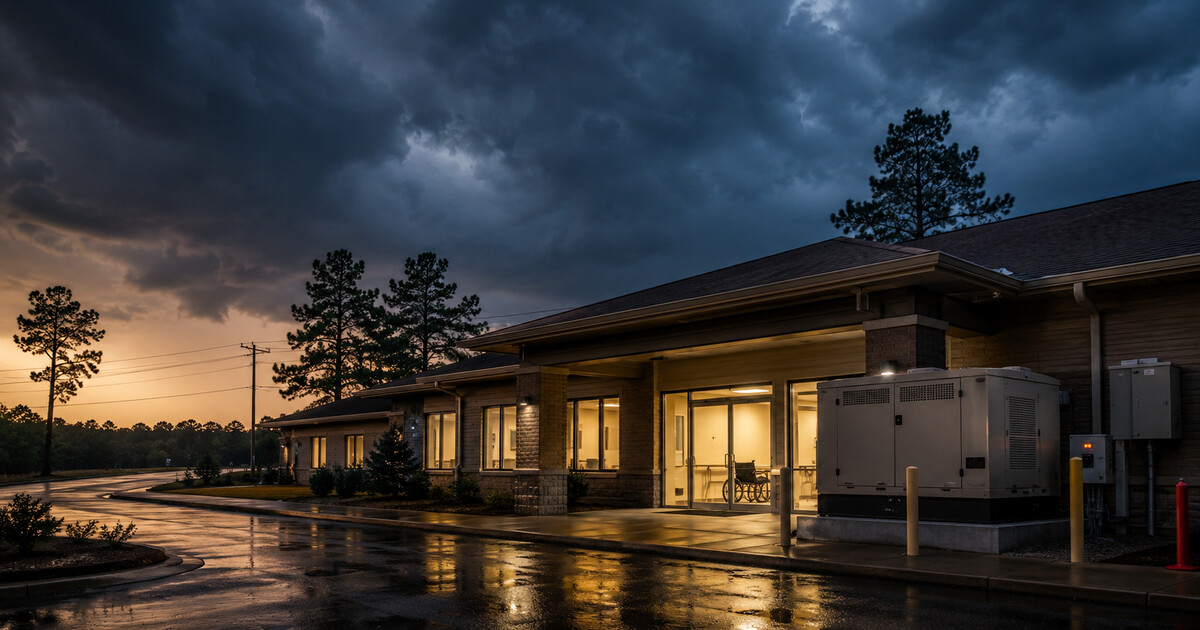
A generator can keep an exit sign lit while the building becomes dangerously hot.
That sentence explains the gap in this debate.
Texas long-term-care facilities have emergency-planning duties, and many have backup power. But “has a generator” does not automatically mean the system can maintain safe temperatures throughout a long outage.
During hurricane season, that distinction stops being technical. It becomes a question about residents who may not be able to relocate quickly, regulate their own temperature, or explain that conditions are becoming unsafe.
Should Texas require every nursing home and assisted living facility to maintain temperature-safe backup power?
The verified facts
As verified on August 29, 2026, Texas Health and Human Services reminded regulated providers to update emergency plans for hurricane season on June 1. The agency said facilities with generators should routinely maintain and test them so they function during an outage.
The federal Centers for Medicare & Medicaid Services emergency-preparedness rule requires covered providers to maintain an emergency program based on local hazards. CMS identifies risk assessment, policies, communications, training, and testing as core elements. Federal rules also require certain inpatient providers, including long-term-care facilities, to address emergency and standby power based on their plans and applicable safety rules.
Texas law requires assisted living facilities to maintain emergency-preparedness and contingency plans. Health and Safety Code Section 247.0452 requires those plans to identify building equipment, including the location and type of generator or backup power source, if any.
That “if any” matters.
A 2022 Texas Long-Term Care Ombudsman report described survey results showing that, among assisted living facilities reporting a generator, 63 percent said it could power air conditioning, 67 percent said it could power heating, and 38 percent said it could power all systems. Those figures are dated and should not be treated as a current statewide inventory, but they document why generator capacity matters as much as generator presence.
Texas lawmakers have proposed broader requirements more than once. In 2025, Senate Bill 481 proposed temperature-regulation requirements for nursing and assisted living facilities. Its legislative analysis said existing backup requirements did not necessarily extend to heating and air conditioning. The bill did not become law.
The live question is not whether facilities should plan. They already must. The question is what minimum physical capability the plan should guarantee.
{{< poll id="care-backup-power-1" question="What should emergency power guarantee first?" options="Safe indoor temperature|Medical equipment|Elevators and lighting|A designated safe zone" >}}
The strongest case for a statewide requirement
A plan that depends on evacuation can fail at the same moment every other facility is trying to evacuate.
Residents may need medication, mobility assistance, oxygen equipment, refrigeration, transportation, or staff who understand complex care plans. Moving them is not like closing an office and telling employees to work from home.
A statewide temperature standard would create a clear floor. Families would not have to decode whether “backup generator” means full climate control, one cooled room, emergency lighting, or only critical medical equipment.
The requirement could also improve accountability before a storm. Facilities would need to document capacity, fuel duration, maintenance, testing, and the number of residents the protected area can safely support. Regulators could inspect a concrete capability instead of reviewing a promise that is difficult to test until the grid fails.
Texas already treats nursing homes and assisted living facilities as priorities for power-restoration planning under Utilities Code Chapter 38. But priority restoration is not immediate restoration. Backup power covers the dangerous space between the outage and the repair.
The strongest argument is simple: a facility accepting responsibility for vulnerable residents should be able to keep them in a safe temperature range when ordinary power disappears.
The strongest case against a one-size-fits-all mandate
“Power the whole building for days” sounds clear until engineers price it.
Facilities vary in size, construction, electrical service, fuel access, resident needs, and evacuation options. Retrofitting an older building for full-load generation can require more than buying a generator. It may involve switchgear, ventilation, fuel storage, fire-code work, structural changes, ongoing testing, and contracts for refueling during the same disaster affecting everyone else.
Those costs do not vanish because the Legislature passes a mandate. They can become higher resident rates, fewer available beds, deferred maintenance elsewhere, or closure pressure on small and rural facilities.
There is also a question of design. Full-building air conditioning may not be the only safe answer. A facility might protect residents through a hardened temperature-safe zone, redundant portable systems, battery storage, a microgrid, or a binding transfer agreement with transportation already secured.
A rigid technology mandate can become obsolete. A performance standard can create flexibility, but it may also be harder for inspectors and families to understand.
The strongest opposition is not “do nothing.” It is that Texas should not confuse one expensive piece of equipment with a complete emergency system.
{{< poll id="care-backup-power-2" question="What kind of rule would be fairest?" options="Full-building backup|Protected temperature-safe zone|Performance standard with options|Keep current planning rules" >}}
Ryan's Take: guarantee the outcome, allow more than one design
Editorial analysis: Texas should require every licensed nursing home and assisted living facility to prove that it can maintain a safe temperature for every resident during an extended outage.
The law should define the safety outcome, not require the same machine at every address.
A compliant plan could use full-building generation, a properly sized protected zone, batteries paired with generation, or another inspected system. But it should have to show five things in plain language:
- The temperature range the system will maintain.
- The number of residents it can protect.
- How long it can operate before refueling or recharging.
- When it was last tested under realistic load.
- What happens if the primary backup system fails.
Texas should phase the rule in and create financing help for smaller facilities. Public reporting should show capability and test status without publishing security-sensitive technical details.
This is the same difference between an announcement and a result explored in Should Texas Publish Job and Wage Results for Every Workforce Grant?. “We have a plan” is an input. “We can protect every resident for the required period” is an outcome.
For another Texas heat-and-safety debate, read Should Texas Require Paid Heat Rest Breaks for Outdoor Workers?. The transportation version of the same local-control argument appears in Should Texas Require Air Conditioning on Every School Bus?.
{{< poll id="care-backup-power-3" question="Should Texas require every long-term-care facility to prove it can maintain safe temperatures during an extended outage?" options="Yes, statewide|Yes, with grants and phase-in|Only for larger facilities|No, keep local flexibility" >}}
Should Texas require every nursing home and assisted living facility to prove it can keep every resident at a safe temperature when the grid goes down?
{{< share >}}
Verification note: Current claims were checked against Texas Health and Human Services, Texas statutes, Texas Legislature records, the Texas Long-Term Care Ombudsman, and CMS on August 29, 2026. This article is editorial analysis, not legal or engineering advice.
Editorial visual disclosure: The header image is an original AI-assisted conceptual illustration. It does not depict a real facility, resident, outage, inspection, or government record.
You made it to the end
Most people quit at the headline. You didn’t.
So don’t stop here. Pick one.
Read the book
Fighting Shadows is the whole story in my own words: the road into January 6, the D.C. jail, and the fight to get the record out.See the book
Follow the case
The record is still being written. Get one email when something new drops on it.
Hire Ryan
I built this site. Want one that brings your business real leads? Start with a free 30-minute call.See the services



Tap how this hits you — no signup, everyone sees the count
Share this post — get it back in front of people
Comments
Speak here
Create an account to comment.
This is where people can say what gets buried or cancelled elsewhere. Comments are signed-only, moderated, and tied to a real profile so the record stays usable.
No approved comments yet. Create an account and put the first opinion on the record.