
East Texas Heat Advisory Covers Longview and Marshall Through 8 P.M.: What to Do Now
A July 23 heat advisory covers Longview, Marshall, Gregg and Harrison counties through 8 p.m. See official risks, symptoms and local cooling options.
By Ryan Nichols
- 253 total reach
- 0 reading now•0 active 24h
- 0 shares•0 inbound
- 0 comments
By Ryan Nichols
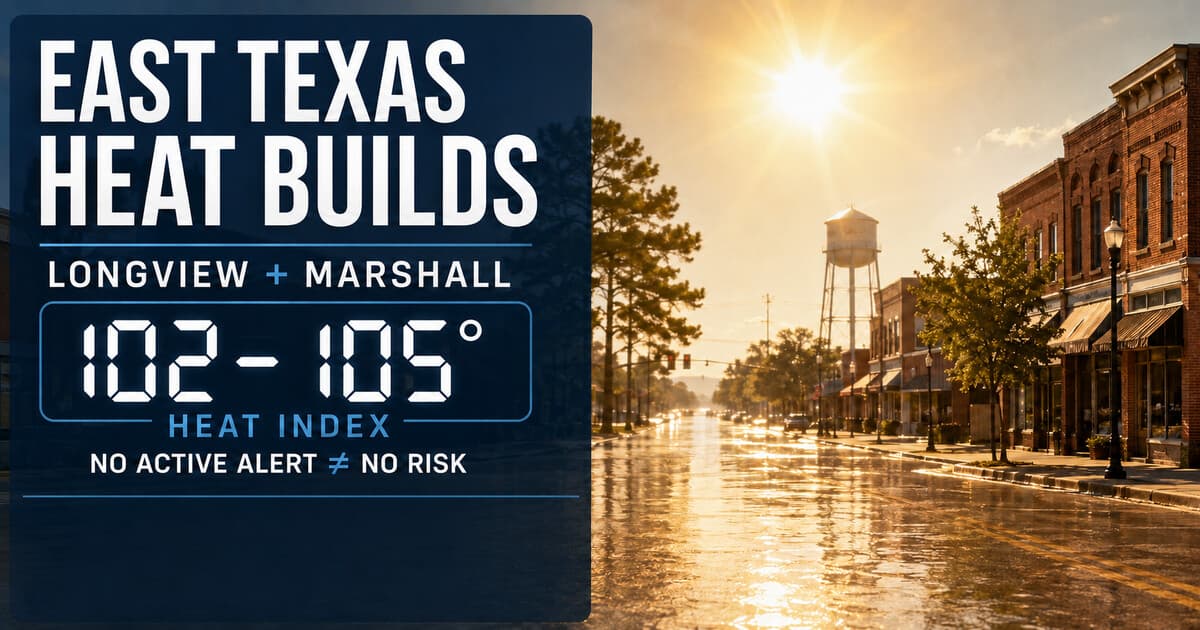
A heat advisory is in effect across a large part of East Texas from 7 a.m. until 8 p.m. Thursday, July 23, including Longview, Marshall, Gregg County and Harrison County.
The National Weather Service office in Shreveport says heat-index values could reach 108°F. Its advisory also covers Wood, Upshur, Smith, Cherokee, Rusk, Panola, Nacogdoches, Shelby, Angelina, San Augustine and Sabine counties.
This is not the same alert East Texas had Wednesday.
Wednesday’s more severe warning expired. Thursday’s official product is a Heat Advisory, not an Extreme Heat Warning. The distinction matters for accuracy, but it does not make the health risk imaginary. The Weather Service says hot temperatures and high humidity can cause heat illness, especially for people working or spending time outdoors.
The most useful response is not panic. It is changing the next several hours before symptoms begin.
What officials have established
The Weather Service issued the advisory at 12:08 a.m. Thursday with these key facts:
- Area: Longview, Marshall and much of East and northeast Texas.
- Timing: 7 a.m. to 8 p.m. CDT on July 23.
- Expected peak heat index: Up to 108°F.
- Primary hazard: Heat illness caused by the combination of temperature and humidity.
- Recommended precautions: Drink fluids, stay in air conditioning when possible, avoid unnecessary sun exposure, check on relatives and neighbors, and take extra precautions during outdoor work.
The official Longview forecast should be used for location-specific updates. Conditions can differ across the advisory area, and the exact heat index at one home, work site or parking lot may not match the regional maximum.
KLTV’s July 23 forecast independently reports afternoon heat-index values generally between 100°F and 110°F across East Texas. The station says temperatures are expected to be lower than Wednesday’s triple-digit highs, but humidity will keep the apparent temperature dangerous.
Reader poll
What is the hardest heat-safety problem in your household today?
Tap your answer to vote
One tap. Free and anonymous. No signup to vote.
Who is most affected
Anyone can become ill in high heat. The risk is higher for:
- Outdoor workers in construction, road work, landscaping, agriculture, delivery and utility jobs.
- Older adults and young children.
- People with chronic medical conditions or medicines that affect temperature regulation or hydration.
- Households without reliable air conditioning.
- People experiencing homelessness or living in vehicles.
- Athletes, marching bands and families attending outdoor practices or events.
- People repairing storm, water or utility infrastructure.
- Pets left outside without dependable shade and water.
Marshall’s draft hazard-mitigation plan identifies older adults, people with chronic illness, low-income households without functional cooling and outdoor workers among the populations most exposed during extreme heat. It also identifies peak electricity demand as a strain on the energy system.
That planning document describes long-term local risk. It does not prove that a particular household, facility or part of the grid is in distress today.
Heat exhaustion and heat stroke are not the same
The CDC and National Institute for Occupational Safety and Health list headache, nausea, dizziness, weakness, irritability, thirst, heavy sweating, elevated body temperature and reduced urine output among the signs of heat exhaustion.
If those symptoms begin:
- Stop the activity.
- Move the person into shade or air conditioning.
- Remove unnecessary outer clothing.
- Cool the person with cold wet cloths, water and circulating air.
- Do not leave the person alone.
- Seek medical help if symptoms worsen or do not improve.
Heat stroke is an emergency. Confusion, loss of consciousness, seizures, slurred speech or a very high body temperature can signal that the body is no longer regulating heat safely.
Call 911 and begin rapid cooling while help is coming. Do not force an unconscious or confused person to drink.
A practical plan for the rest of Thursday
Before noon
- Move demanding outdoor work to the earliest safe window or reschedule it.
- Fill water containers before leaving home.
- Put the Weather Service forecast and a reliable local radar source on the phone you will carry.
- Check that children, older relatives and neighbors have working cooling.
- Make a backup destination now if an air conditioner fails.
During the afternoon peak
- Use air conditioning when available. A fan can help people feel cooler, but it does not make dangerously hot indoor air safe by itself.
- Drink water regularly rather than waiting until severe thirst begins.
- Avoid alcohol during strenuous heat exposure.
- Wear light, loose clothing and use shade.
- Never leave a child, older adult or pet in a parked vehicle.
- Check workers and family members in pairs. Heat illness can affect judgment before the person recognizes the danger.
For outdoor employers and crews
OSHA’s heat guidance emphasizes water, rest and shade. As heat stress increases, employers should increase the length and frequency of rest breaks.
A simple work-site check should answer:
- Is cool drinking water immediately available?
- Is there a shaded or air-conditioned recovery area?
- Are new or returning workers being gradually acclimatized?
- Does everyone know who will call 911 and give the exact site address?
- Can the heaviest task wait until conditions improve?
Production goals do not change the symptoms of heat illness.
Verified Longview and Marshall public-facility options
The following facilities are listed on official city pages as operating Thursday. They can provide recreation or an air-conditioned public destination during their posted hours.
They have not been verified as formally designated emergency cooling centers for this advisory. Call before relying on a facility, especially if transportation or medical needs are involved.
Longview
- Longview Public Library, 222 W. Cotton St.: Thursday hours are 9 a.m. to 5 p.m.
- Broughton Branch Library, 801 S. Martin Luther King Jr. Blvd.: Thursday hours are 2 p.m. to 7 p.m.
- Ingram Pool, 1400 N. Tenth St.: posted Monday-through-Saturday hours are 12:30 p.m. to 6 p.m.; admission is $2 for ages 3–17 and $3 for adults.
- Stamper Park Family Aquatic Center, 501 Fair St.: posted Monday-through-Saturday hours are noon to 6 p.m., with the same listed admission rates.
- Longview splash pads: the city lists locations at Broughton, Rotary, Spring Hill and Lear parks, generally operating from 9 a.m. to sundown. Jack Mann Splash Pad is regularly closed Wednesdays, not Thursdays.
Water recreation does not eliminate sun exposure. Sunscreen, shade, hydration and active child supervision remain necessary.
Marshall
- Marshall Public Library, 300 S. Alamo Blvd.: Thursday hours are listed as 9:30 a.m. to 7:30 p.m.
People who need help locating heat assistance or an official cooling site can contact 2-1-1 Texas by dialing 2-1-1 or 877-541-7905. The state service includes an Extreme Heat Cooling Centers resource category.
What remains uncertain
Three facts should not be overstated.
First, a regional maximum of 108°F does not mean every thermometer in Gregg or Harrison County will display that number. The heat index combines temperature and humidity, and conditions vary by location and hour.
Second, rain is possible but not dependable. KLTV says outer bands associated with Tropical Storm Bertha could produce isolated showers or downpours, but it does not expect widespread rain across East Texas. A possible shower is not a heat-safety plan.
Third, no official source reviewed for this article identified a citywide power emergency or announced a dedicated Longview or Marshall cooling-center activation as of publication. That can change. Readers should use city alerts, the Weather Service and 2-1-1 Texas for updates rather than relying on an old social-media post.
Reader poll
What local heat information would be most useful next?
Tap your answer to vote
One tap. Free and anonymous. No signup to vote.
Ryan’s Take
East Texas knows heat. Familiarity can become its own risk.
The mistake is treating a dangerous afternoon like an ordinary one because the forecast does not sound as dramatic as yesterday’s. The official category changed from a warning to an advisory, but an exhausted roofer, an older neighbor with a failing air conditioner or a child in a parked vehicle does not experience weather through the label.
Public information should help people decide what to do next. Today that means making the phone call, moving the job, filling the water cooler, opening the library map and checking the person who may be too proud to say their house is getting hot.
That is not alarmism. It is local responsibility.
What readers can do now
- Send this article to one person working outside.
- Check one older or medically vulnerable neighbor before the afternoon peak.
- Save the NWS Shreveport page and 2-1-1 Texas contact information.
- Report a closed facility, newly announced cooling center or documented correction through the form below.
- If someone is confused, unconscious or showing signs of heat stroke, call 911.
Read our related coverage of Marshall’s water-infrastructure decisions, Longview’s dairy-plant construction window and utility questions, and neighbor responsibility during Texas disasters.
Do you have an official cooling-center notice, facility closure or documented correction?
Send the agency name, publication time and original public link so it can be verified.
Submit a heat-advisory update for editorial review.
Join the optional email or text list at the bottom of this page for verified East Texas alerts and local public-record reporting. You choose what contact information to provide, and you can unsubscribe. This article does not solicit donations.
Sharing this is the biggest help. Put it in front of one more person.
You made it to the end
Most people quit at the headline. You didn’t.
So don’t stop here. Pick one.
Read the book
Fighting Shadows is the whole story in my own words: the road into January 6, the D.C. jail, and the fight to get the record out.See the book
Follow the case
The record is still being written. Get one email when something new drops on it.
Hire Ryan
I built this site. Want one that brings your business real leads? Start with a free 30-minute call.See the services


Tap how this hits you — no signup, everyone sees the count
Share this post — get it back in front of people
Comments
Speak here
Create an account to comment.
This is where people can say what gets buried or cancelled elsewhere. Comments are signed-only, moderated, and tied to a real profile so the record stays usable.
No approved comments yet. Create an account and put the first opinion on the record.