
No Heat Alert Is Active—but Longview and Marshall Face a 102–105°F Heat Index This Weekend
Longview and Marshall face heat-index values of 102–105°F this weekend despite no active heat alert. See the verified forecast, risks and practical steps.
By Ryan Nichols
- 261 total reach
- 0 reading now•0 active 24h
- 0 shares•0 inbound
- 0 comments
By Ryan Nichols
Facts last checked: July 25, 2026, 9:26 a.m. Central
There was no active National Weather Service watch, warning or advisory for the Longview point forecast at 9:26 a.m. Central on Saturday, July 25.
That is useful information. It is not permission to ignore the heat.
The same live National Weather Service forecast expected the heat index—the temperature it feels like when humidity is combined with the air temperature—to reach about 102°F in Longview and 103°F in Marshall on Saturday. On Sunday, both point forecasts showed a heat index as high as 105°F.
Afternoon air temperatures were also forecast to keep climbing:
| Day | Longview forecast | Marshall forecast |
|---|---|---|
| Saturday, July 25 | High near 97°F; heat index up to 102°F | High near 96°F; heat index up to 103°F |
| Sunday, July 26 | High near 99°F; heat index up to 105°F | High near 97°F; heat index up to 105°F |
| Monday, July 27 | High near 100°F | High near 98°F |
| Tuesday, July 28 | High near 102°F | High near 100°F |
The point forecasts also included a 20% chance of showers and thunderstorms before early Saturday afternoon. A shower could temporarily cool one neighborhood while another stays hot. It does not erase the broader multi-day heat risk.
The practical message for Gregg and Harrison counties is straightforward:
No active alert does not mean no risk. Plan for the forecast conditions, keep checking for changes, and act before someone becomes sick.
Reader poll
Which heat problem is hardest to solve this weekend?
Tap your answer to vote
One tap. Free and anonymous. No signup to vote.
What the official record establishes
The National Weather Service Shreveport office supplies the point forecasts for Longview and Marshall.
For Longview, the live forecast expected:
- a Saturday high near 97°F;
- a heat index up to 102°F;
- a Sunday high near 99°F;
- a Sunday heat index up to 105°F;
- a Monday high near 100°F; and
- a Tuesday high near 102°F.
For Marshall, the live forecast expected:
- a Saturday high near 96°F;
- a heat index up to 103°F;
- a Sunday high near 97°F;
- a Sunday heat index up to 105°F;
- a Monday high near 98°F; and
- a Tuesday high near 100°F.
An automated check of the Weather Service’s active-alert feed for the Longview point returned zero current alerts at 9:26 a.m. Central.
That alert check is a snapshot, not a promise about the rest of the weekend. Forecast offices can issue, update or cancel products as conditions and confidence change. Readers should use the live forecast and alert feeds rather than relying on a screenshot or an article published earlier in the day.
This is also different from the Heat Advisory that covered Longview and Marshall on July 23. Saturday morning’s record did not show that same active alert, but the forecast still called for heat-index values above 100°F.
Who is most affected
High heat can affect anyone, but exposure and the ability to cool down are not evenly distributed.
People who deserve an early check-in include:
- outdoor workers and people doing yard, construction, road or farm work;
- athletes, coaches, marching groups and families at outdoor events;
- older adults and young children;
- people who do not have reliable air conditioning;
- people living alone;
- people who depend on someone else for transportation; and
- anyone who has already spent hours in the heat without enough water, rest or shade.
Vehicles are a separate danger. Never leave a child, dependent adult or pet in a parked vehicle, even for a short stop.
Employers and supervisors should not wait for a worker to ask for help. OSHA’s heat guidance calls for cool drinking water, frequent drinking before thirst, rest breaks that become longer and more frequent as heat stress rises, and a shaded or air-conditioned recovery area.
For work lasting more than two hours, OSHA says employers should also provide access to additional fluids containing electrolytes.
Know when heat illness becomes an emergency
Heat exhaustion can include headache, nausea, dizziness, weakness, heavy sweating, thirst and reduced urine output. A person with those symptoms should be moved out of the heat, cooled and evaluated promptly.
Heat stroke is an emergency.
The CDC lists warning signs that can include:
- confusion or an altered mental state;
- slurred speech;
- loss of consciousness;
- seizures;
- hot skin or profuse sweating; and
- a very high body temperature.
If heat stroke is suspected, call 911. Stay with the person, move them to shade or a cooler area, remove outer clothing and begin rapid cooling while emergency help is on the way.
Do not treat confusion, collapse or a seizure as something that can be fixed with a bottle of water and a ride home.
A 15-minute heat plan to complete before noon
The best time to make a heat plan is before the hottest part of the day.
Minute 1–3: Move the hardest work
List every outdoor task planned for the day.
Move strenuous work to the earliest or latest reasonable time. Delay anything nonessential that would place someone on a roof, pavement, in direct sun or around heat-producing equipment during the hottest hours.
If the work cannot be moved, reduce its duration and build in a replacement worker or buddy.
Minute 4–6: Set the water, rest and shade rule
Do not use “take a break if you need one” as the entire plan.
Decide:
- where cool water will be;
- who will refill it;
- where the shaded or air-conditioned recovery location is;
- how often breaks will occur; and
- who is watching for confusion, unsteady movement or unusual behavior.
New workers and people returning after time away from heat may need a gradual increase in exposure.
Minute 7–9: Check the people, not just the temperature
Choose two people to contact.
Ask direct questions:
- Is the air conditioner working?
- Is the home staying cool enough?
- Do you have water?
- Do you have a way to reach a cooler place if the power or air conditioning fails?
- Who will check again this afternoon?
Avoid collecting or posting private medical details. The goal is a practical safety check, not public disclosure.
Minute 10–12: Turn on local alerts
Longview residents can register for the city’s Smart911 emergency alerts, which can deliver phone, text and email notifications.
Marshall residents can register for CivicReady alerts, including phone, text and email delivery in English or Spanish.
Those systems carry local emergency information. They do not replace the live National Weather Service forecast.
Minute 13–15: Write the emergency rule
Put this where the household, crew or team can see it:
Confusion, collapse, seizure or loss of consciousness in the heat: call 911 and cool the person immediately.
Then assign one person to make the call and one person to begin cooling. A clear rule is easier to follow under stress than a vague intention.
What remains uncertain
Several facts could change after publication:
- The exact amount and location of Saturday’s showers or thunderstorms.
- How much cloud cover limits afternoon heating in a particular neighborhood.
- The final observed temperature and humidity, which may differ from the forecast.
- Whether the Weather Service issues an advisory or warning later in the weekend.
- Whether a power outage or air-conditioning failure creates a new local emergency.
- Whether Longview, Marshall, Gregg County or Harrison County designates a public cooling location.
No official designated cooling center was verified for this article. A library, store, church or other air-conditioned building should not be described as an emergency cooling center unless the responsible organization confirms that role, its hours and its access rules.
Readers who know of an officially announced cooling resource, power outage or correction can send the source for verification below.
Report a verified cooling resource, outage or forecast correction
What should neighbors know?
Include the location, hours, official source and date. Do not submit private medical information.
Ryan’s Take
This is editorial analysis. It is not presented as a firsthand quotation from Ryan.
A weather alert should not be the starting gun for neighbor care.
Official alerts matter. They help the public recognize dangerous conditions and coordinate action. But a forecast can still demand responsibility before an alert appears.
If the heat index is expected to reach 102 to 105 degrees, the useful questions are not limited to “Is there a warning?”
They are:
- Who is working outside?
- Whose air conditioner is failing?
- Who cannot drive to a cooler place?
- Who is alone?
- Who will check again before late afternoon?
Resilience is not pretending the heat is harmless. It is doing ordinary work early enough that an emergency becomes less likely: moving the job, filling the cooler, scheduling the breaks, checking the neighbor and knowing when to call 911.
Faith can show up in the same practical way. Loving a neighbor may look like a phone call, a ride, a case of water or two minutes spent helping someone turn on local alerts.
Do not wait for a dramatic moment to become useful.
Make the plan while everyone is still able to make one.
Check the live sources
- National Weather Service Longview point forecast
- National Weather Service Marshall point forecast
- National Weather Service active alerts for the Longview point
- National Weather Service Shreveport office
- CDC heat-related illness guidance
- OSHA water, rest and shade guidance
- City of Longview Smart911 registration
- City of Marshall CivicReady registration
For another current local action item, read Marshall’s 19-project hazard-mitigation plan and how to comment before July 31.
Sharing this is the biggest help. Put it in front of one more person.
Want future East Texas updates? You may choose to join the RealRyanNichols.com email or text list. Signup is optional, consent is never assumed, and every message includes an unsubscribe or STOP option.
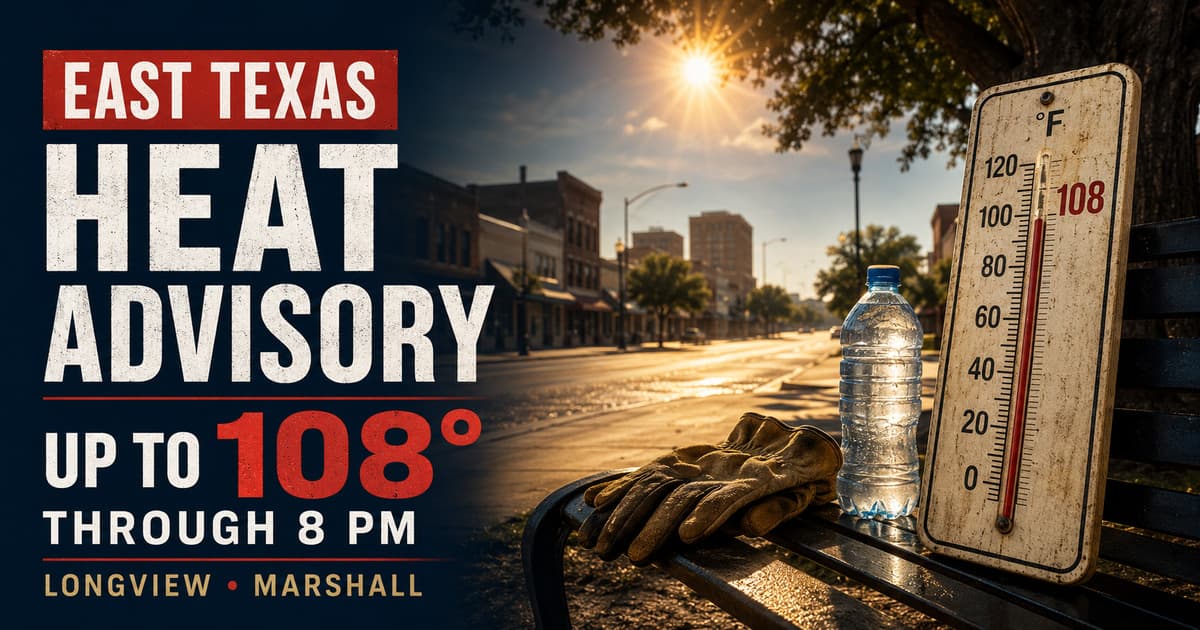
OG artwork disclosure: The social image is an original symbolic editorial illustration. It does not depict a verified Longview or Marshall street, an official weather graphic or an active government alert.
You made it to the end
Most people quit at the headline. You didn’t.
So don’t stop here. Pick one.
Read the book
Fighting Shadows is the whole story in my own words: the road into January 6, the D.C. jail, and the fight to get the record out.See the book
Follow the case
The record is still being written. Get one email when something new drops on it.
Hire Ryan
I built this site. Want one that brings your business real leads? Start with a free 30-minute call.See the services

Tap how this hits you — no signup, everyone sees the count
Share this post — get it back in front of people
Comments
Speak here
Create an account to comment.
This is where people can say what gets buried or cancelled elsewhere. Comments are signed-only, moderated, and tied to a real profile so the record stays usable.
No approved comments yet. Create an account and put the first opinion on the record.