
Trump Orders Warning Signs Outside Smithsonian Museum: What the July 24 Executive Order Actually Does
Trump ordered warning signs outside the Smithsonian’s American History museum. Here is what the July 24 order does, who governs the museum and what remains disputed.
By Ryan Nichols
- 234 total reach
- 0 reading now•0 active 24h
- 0 shares•0 inbound
- 0 comments
By Ryan Nichols
Facts last checked: July 25, 2026, 6:55 a.m. Central
President Donald Trump signed an executive order on July 24 directing the federal government to place temporary warning signs and corrective historical material outside the Smithsonian’s National Museum of American History.
That is the clearest immediate action in the order.
The broader order also tells the Department of the Interior, Office of Management and Budget, General Services Administration and White House Domestic Policy Council to identify and use available legal, funding and contract authority to press the Smithsonian to address findings in a new White House report.
But the order does not itself:
- remove a Smithsonian leader;
- rewrite a named exhibit inside the museum;
- close the museum;
- transfer the Smithsonian to the Department of the Interior;
- abolish its 17-member Board of Regents; or
- establish that every disputed statement in a Smithsonian exhibit is false.
The distinction matters because the Smithsonian has an unusual legal structure. Congress created it as a federal trust instrumentality, and a Board of Regents—not the President alone—governs the institution.
The July 24 order is therefore both concrete and incomplete: visitors may see administration-directed material on National Park Service property outside the museum, while the larger fight over exhibits, personnel, funding and institutional authority remains unresolved.
What the executive order says
The July 24 executive order rests on a 162-page Domestic Policy Council report titled Saving America’s Story: How Ideological Capture at the Smithsonian Institution’s National Museum of American History Erases Our Heritage.
The order establishes three main actions.
1. Use available federal leverage
Section 2 directs four administration actors to identify and use “any and all available authorities” to promote the order’s policy:
- the Secretary of the Interior;
- the Director of the Office of Management and Budget;
- the Administrator of General Services; and
- the Assistant to the President for Domestic Policy.
The listed mechanisms include encouraging the Smithsonian to correct issues identified by the White House report and comply with applicable statutes, regulations, executive actions, funding requirements and contract conditions.
That language is potentially broad, but it is not a blank check. The order’s general provisions say implementation must remain consistent with existing law and available appropriations. It does not identify a specific appropriation to withhold, contract to cancel or regulation to invoke.
2. Install temporary warning signs outside the museum
The order directs the Interior Secretary, acting through the National Park Service and coordinating with the Domestic Policy Council, to install temporary signs along NPS-maintained sidewalks and walkways used to reach the museum.
The signs are supposed to:
- inform visitors about the White House report’s findings;
- state the administration’s policy that the exhibits should be renovated consistently with the report; and
- direct visitors to other locations and resources the administration considers accurate.
This section is more specific than the general funding language. It uses land and walkways maintained by the executive branch rather than ordering museum employees to alter an indoor display.
The order does not publish the final sign design, wording, installation date or removal date. Those details were unknown at the time of this review.
3. Add temporary material about the Declaration’s signers
The order says the museum has failed to appropriately honor the 56 signers of the Declaration of Independence during the nation’s 250th-anniversary year.
It directs Interior and NPS to place temporary exhibits or signs on NPS-maintained sidewalks, walkways and land that the administration says will correct inaccurate material inside the museum.
Again, the order does not reproduce the proposed material or identify, line by line, which museum labels the outdoor display will answer.
Reader poll
What should the public see before the signs are installed?
Tap your answer to vote
One tap. Free and anonymous. No signup to vote.
What the White House report alleges
The Domestic Policy Council’s report is the administration’s case against current Smithsonian and museum leadership.
It argues that the National Museum of American History has shifted from presenting a shared national inheritance toward political activism. Across 162 pages, it criticizes museum mission statements, staff remarks, partnerships, educational resources, displays and planning documents.
The report alleges that some museum work:
- treats American history mainly as oppression and grievance;
- encourages activism instead of historical education;
- minimizes national progress and achievement;
- applies ideological frameworks to race, sex, immigration, firearms and other contested subjects; and
- gives inadequate attention to the Declaration’s signers during the 250th anniversary.
Those are the White House report’s conclusions. They should not be presented as neutral findings accepted by historians, Congress or the Smithsonian.
The report includes citations, screenshots and quotations, but the presence of footnotes does not eliminate disputes about context, selection, interpretation or the proper purpose of a national museum.
The opposing official report reaches the opposite conclusion
Democratic staff for the Committee on House Administration released a competing report titled The White House Campaign to Seize Control of the Smithsonian and Rewrite American History.
That report argues the White House selectively quotes museum materials, ignores contrary context and is attempting to impose a political narrative on an institution Congress placed under a Board of Regents.
This is also an advocacy document, not a neutral adjudication. It comes from the committee’s Democratic staff and uses openly critical language about the President.
The existence of two official-looking reports does not create two sets of facts. It creates competing claims that should be tested exhibit by exhibit:
- What exact museum wording is at issue?
- What was displayed before and after any change?
- What primary source supports the label?
- What context does each side say is missing?
- Who has legal authority to order a correction?
Without that itemized comparison, phrases such as “ideological capture” and “rewrite American history” remain political conclusions.
Who legally governs the Smithsonian
The Smithsonian’s own governance record says Congress vested administration of the institution in a 17-member Board of Regents.
The board includes:
- the Chief Justice of the United States;
- the Vice President;
- three U.S. senators;
- three U.S. representatives; and
- nine citizen regents.
The Smithsonian Institution Archives says the board governs the institution, oversees its mission, elects the Smithsonian Secretary, approves major policy and budgets, and evaluates institutional leadership.
The Government Accountability Office has described the Smithsonian as a unique federal trust instrumentality. A 2020 GAO report stated that it is not an executive-branch agency and is overseen by a Secretary who reports to the Board of Regents.
That does not make the Smithsonian independent of all federal power.
Congress provides substantial funding. Federal laws apply in various contexts. Federal agencies control surrounding property, administer contracts and grants, and can exercise whatever authority statutes actually give them.
It does mean the President’s relationship to the Smithsonian is different from his control over a Cabinet department.
Where the administration has immediate control—and where it may not
The order’s outside-sign strategy appears designed around that structural boundary.
The National Park Service is part of the Interior Department. The President can direct executive officials to use NPS-managed property, subject to law and appropriations. That creates a clearer chain of authority for signs on an exterior walkway than for changing an exhibit controlled by Smithsonian leadership.
The broader instructions involving money, contracts and compliance will depend on details that the order does not supply.
For example:
- Congress, not the President alone, enacts appropriations.
- OMB can shape executive budget proposals and administration of funds, but it must act within appropriations law.
- GSA authority depends on the property, procurement or contract involved.
- Interior authority depends on the specific statute or federal property at issue.
- The Board of Regents retains statutory governance responsibilities unless Congress changes the governing law or a court rules otherwise.
Anyone claiming that the order gives Trump total control of the Smithsonian is moving beyond the text.
Anyone claiming that the order is merely symbolic is also moving too fast. Exterior government messaging, budget recommendations, contract conditions and agency compliance tools can create real institutional pressure even without direct command over curators.
The funding claim needs precision
The White House fact sheet says the Smithsonian receives more than $1 billion from taxpayers each year.
The Smithsonian’s current facts page likewise says its federal appropriation exceeds $1 billion and that about 62% of the institution is federally funded when annual appropriations, grants and contracts are considered.
The Smithsonian also receives nonfederal trust funds, including private donations, endowment income and business revenue.
The accurate description is therefore not “fully private” or “just another executive agency.” It is a congressionally created trust instrumentality with mixed funding and an unusual governing board.
That hybrid structure is precisely why the next steps may involve Congress, the Regents, executive agencies and possibly the courts.
What is verified, disputed and still unknown
| Issue | Current status |
|---|---|
| Trump signed the July 24 order | Verified by the published White House order |
| Temporary signs are directed for NPS walkways | Verified by section 3 |
| Indoor museum exhibits have already been changed because of this order | Not established by the reviewed public record |
| The museum is ideologically captured | White House conclusion; disputed |
| The administration is trying to seize the Smithsonian | Democratic committee conclusion; disputed |
| The Board of Regents governs the institution | Verified by the Smithsonian charter structure and governance materials |
| The Smithsonian receives more than $1 billion in federal support | Verified in general terms by Smithsonian materials; exact totals vary by fiscal year and measure |
| Final wording, design and date for the warning signs | Unknown |
| Specific funding or contracts the administration will target | Unknown |
| Whether the Regents will accept, resist or negotiate exhibit changes | Unknown |
| Whether litigation will challenge any implementation step | Unknown |
Questions the public record should answer next
The administration should publish the final signs before installation and attach primary sources for every factual statement.
The Smithsonian should answer the White House report at the same level of specificity: exhibit title, exact disputed text, underlying evidence, curatorial explanation and any planned correction.
The Board of Regents should publicly state:
- which parts of the July 24 order it believes are within presidential authority;
- which requests require board action;
- whether any exhibits or personnel decisions are under review;
- how it will protect scholarly standards from partisan pressure; and
- how it will correct genuine factual errors when they are documented.
Congress should identify the exact appropriations and contract conditions at issue rather than debating only slogans.
Reader poll
Who should have the strongest role in resolving disputed museum content?
Tap your answer to vote
One tap. Free and anonymous. No signup to vote.
Send the exact exhibit title, photographed wording, date observed and a primary-source link. Do not submit private information, copyrighted books or unsupported accusations.
Report what you saw at the D.C. Jail.
If you witnessed these officers — or were held there yourself — say what you saw. Anonymous is fine; leave contact only if we can follow up. Every report is reviewed by hand and becomes part of the record.
Ryan’s Take
This is editorial analysis. It is not presented as a firsthand quotation from Ryan.
America’s museums should tell the whole truth.
That includes slavery, war, broken promises, government abuse and the long fight to make constitutional ideals real. It also includes courage, sacrifice, invention, faith, self-government, national progress and the people who risked everything to build and defend the country.
A museum that hides America’s failures cannot be trusted. A museum that presents America as nothing but failure cannot be trusted either.
The answer is not to replace one political filter with another. Put the disputed words, the source documents and the competing interpretation in front of the public.
If the White House says an exhibit is inaccurate, it should name the exact sentence and prove the correction. If the Smithsonian says a quotation was taken out of context, it should show the full context. If federal money or contract leverage is used, the legal authority and conditions should be public.
Temporary signs outside a museum may alert visitors to a real dispute, but they are not a substitute for a transparent, source-by-source review. The Board of Regents should hold that review in public and make both the evidence and decisions searchable.
The standard should be simple: no erasing the country’s sins, no erasing its greatness, and no asking Americans to trust a conclusion that officials will not let them inspect.
Read the documents yourself
- July 24 executive order
- White House fact sheet
- Domestic Policy Council’s 162-page report
- Democratic Committee on House Administration staff report
- Smithsonian Board of Regents membership and structure
- Smithsonian governance history
- GAO description of the Smithsonian’s legal structure
For more fact-first coverage, read what Trump’s new forced-labor tariffs actually cover and what remains unresolved in the U.S.–Saudi nuclear agreement.
Sharing this is the biggest help. Put it in front of one more person.
Want future Political Facts First articles? You may choose to join the RealRyanNichols.com email or text list. Signup is optional, consent is never assumed, and every message includes an unsubscribe or STOP option.
OG artwork disclosure: The social image is an original symbolic editorial illustration. It does not reproduce an official sign, museum exhibit or government document.
You made it to the end
Most people quit at the headline. You didn’t.
So don’t stop here. Pick one.
Read the book
Fighting Shadows is the whole story in my own words: the road into January 6, the D.C. jail, and the fight to get the record out.See the book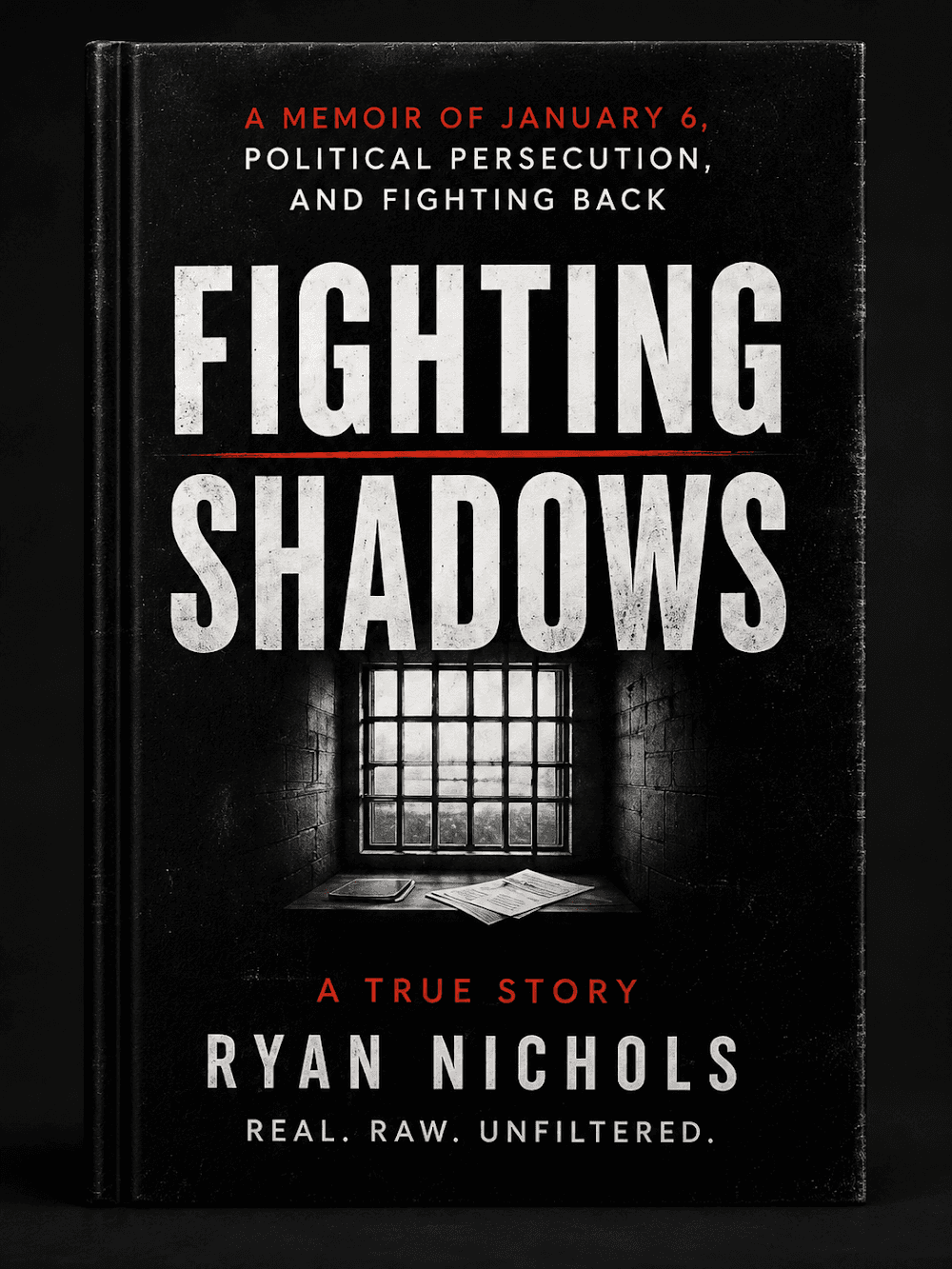
Follow the case
The record is still being written. Get one email when something new drops on it.
Hire Ryan
I built this site. Want one that brings your business real leads? Start with a free 30-minute call.See the services
Tap how this hits you — no signup, everyone sees the count
Share this post — get it back in front of people
Comments
Speak here
Create an account to comment.
This is where people can say what gets buried or cancelled elsewhere. Comments are signed-only, moderated, and tied to a real profile so the record stays usable.
No approved comments yet. Create an account and put the first opinion on the record.