
Thomas Webster J6 Case Record: Trial, 10-Year Sentence, Full Pardon and Denied Vacatur
Thomas Webster’s verified January 6 case record: six-count jury verdict, 10-year sentence, 2024 appeal, full 2025 pardon and denied 2026 vacatur request.
By Ryan Nichols
- 258 total reach
- 0 reading now•0 active 24h
- 0 shares•0 inbound
- 0 comments
By Ryan Nichols
Thomas Webster’s January 6 case did not end when he left federal prison.
It moved through five distinct legal stages: arrest and indictment, a jury trial, a 10-year sentence, a published appellate decision, and a full presidential pardon. Then, in January 2026, Webster asked the trial court to vacate the convictions through a writ of error coram nobis. The court denied that request.
Those stages are easy to collapse into an inaccurate slogan.
Webster was not acquitted. His convictions were not vacated on direct appeal. His full pardon ended the punishment and restored rights covered by the clemency action, but the January 2026 court ruling did not erase the historical verdict.
At the same time, a conviction and sentence do not tell a reader everything about a human being. Webster is a United States Marine Corps veteran and a retired New York Police Department officer. He testified in his own defense, later received full clemency, and has continued to give his account of the confrontation and its aftermath.
This article separates those parts of the record so readers can see what was alleged, what a jury decided, what Webster said, what the appellate court held, what the President granted, and what remains unresolved.
Thomas Webster case at a glance
- Full name: Thomas Webster
- Federal case: United States v. Webster, No.
1:21-cr-00208-APM-1 - Court: U.S. District Court for the District of Columbia
- Trial judge: U.S. District Judge Amit P. Mehta
- Custody date used by this archive: February 22, 2021
- Plea: Not guilty
- Jury verdict: May 2, 2022
- Sentence: September 1, 2022
- Direct appeal: D.C. Circuit No.
22-3064 - Appellate decision: May 28, 2024
- Clemency: Full pardon on January 20, 2025
- Post-pardon petition: Coram nobis denied January 28, 2026
- Current verified posture: Pardoned; no post-pardon judicial vacatur verified
Read the connected Thomas Webster archive profile, then use the Case Nexus to explore people, documents and dated events across the larger January 6 record.
What the charging record alleged
The Justice Department’s contemporaneous arrest announcement says Webster voluntarily entered federal custody on February 22, 2021 and appeared in the Southern District of New York the following day.
A later DOJ sentencing release gives February 21 as the custody date. Because the earlier release was published at the time of the arrest, this archive uses February 22 while preserving the conflict. The native arrest and booking records remain the best documents for conclusively resolving it.
The complaint and later indictment accused Webster of confronting Metropolitan Police Officer Noah Rathbun near the West Terrace police line, using a metal flagpole during the encounter, crossing the barrier and tackling the officer.
At the complaint stage, those were government allegations used to support probable cause. They were not findings of guilt. The archive preserves that distinction in the connected DOJ arrest record.
The grand jury ultimately charged six counts:
- Assaulting, resisting or impeding certain officers using a deadly or dangerous weapon under 18 U.S.C. §111(a)(1) and (b).
- Civil disorder under 18 U.S.C. §231(a)(3).
- Entering and remaining in a restricted building or grounds with a deadly or dangerous weapon under 18 U.S.C. §1752(a)(1) and (b)(1)(A).
- Disorderly and disruptive conduct in a restricted building or grounds with a deadly or dangerous weapon under 18 U.S.C. §1752(a)(2) and (b)(1)(A).
- Engaging in physical violence in a restricted building or grounds with a deadly or dangerous weapon under 18 U.S.C. §1752(a)(4) and (b)(1)(A).
- An act of physical violence in the Capitol grounds or buildings under 40 U.S.C. §5104(e)(2)(F).
Webster pleaded not guilty and chose a jury trial.
Reader poll
Which part of the Webster record most needs additional primary-source capture?
Tap your answer to vote
One tap. Free and anonymous. No signup to vote.
Webster’s firsthand position and the jury’s decision
Webster testified at trial that he acted in self-defense. That was his firsthand litigation position, not an invention by this publication.
The D.C. Circuit’s published opinion records the government’s evidence, the defense arguments, the jury result and the later appellate claims. The opinion says the government introduced multiple videos of the confrontation. It also says the jury heard Webster testify and rejected his self-defense theory.
The correct way to report that record is direct:
- Webster said he acted in self-defense.
- Prosecutors disputed that account.
- The jury found him guilty on all six counts on May 2, 2022.
- The verdict resolved criminal liability at trial; it did not authorize a publisher to reduce his entire identity to the case.
The DOJ verdict release presents the government’s description of the evidence and result. The archive’s verdict source page keeps that government account linked to the dated jury-verdict timeline event.
This separation matters because two opposite errors are common in January 6 coverage.
One error treats every complaint allegation as if a jury already proved it. The other pretends a later pardon rewrote the trial record. Neither approach gives readers a reliable archive.
The 120-month sentence
Judge Mehta sentenced Webster on September 1, 2022.
The official DOJ sentencing release reports:
- 120 months in federal prison
- 36 months of supervised release
- $2,060 in restitution
The D.C. Circuit opinion separately records a $510 special assessment. Those are different financial components and should not be silently merged.
The concurrent prison terms produced the 10-year sentence. The archive connects the sentencing source to the September 1, 2022 timeline event.
At the time, the sentence was among the longest imposed in a January 6 case. That comparison can help readers understand scale, but it is not a character judgment.
Sentencing reflects a court’s application of statutes, Guidelines, findings and 18 U.S.C. §3553(a) factors. It is possible to accurately report the court’s reasoning while separately debating whether January 6 charging and sentencing policy was evenhanded, proportionate or politically influenced.
What the D.C. Circuit decided
Webster appealed in D.C. Circuit No. 22-3064.
His appeal challenged several parts of the district-court proceedings, including:
- Venue and the claimed inability to obtain an impartial District of Columbia jury
- Restrictions on cross-examination
- The jury instruction for the §111(b) dangerous-weapon count
- Sentencing enhancements and claimed disparities
On May 28, 2024, a three-judge panel issued a 29-page published opinion in United States v. Webster, 102 F.4th 471. The panel rejected the challenges and affirmed the convictions and sentence.
The opinion did not hold that every political criticism of District of Columbia January 6 prosecutions was illegitimate. It held that Webster’s legal arguments did not justify reversal under the governing standards and the record presented in his appeal.
Readers can review the preserved D.C. Circuit opinion record and the corresponding appellate timeline event.
Full pardon, not a sentence commutation
President Donald J. Trump’s January 20, 2025 proclamation did three legally distinct things.
It commuted the sentences of 14 named people, granted full pardons to the other covered convicted defendants, and directed the Justice Department to seek dismissal of pending January 6 indictments.
Webster was not one of the 14 named commutation recipients. He was covered by the full-pardon provision.
The DOJ Office of the Pardon Attorney provides additional confirmation. Its certificate-recipient list expressly includes “WEBSTER, THOMAS” among people who requested and were issued a certificate under the proclamation.
That means “released,” “commuted” and “pardoned” are not interchangeable descriptions of Webster’s status. The accurate term is fully pardoned.
The archive connects the clemency proclamation, the Webster certificate-recipient record, the pardon timeline event, and the Donald J. Trump profile.
The 2026 attempt to vacate the convictions
A pardon and a judicial vacatur are different.
After his pardon, Webster filed a petition for a writ of error coram nobis. The extraordinary writ can provide relief from a conviction after a person is no longer in custody, but it requires a demanding showing.
In a January 28, 2026 memorandum opinion and order, Judge Mehta denied the petition.
The court concluded Webster had not established three required elements:
- Sufficient continuing adverse consequences after the pardon.
- A valid reason for not attacking the convictions earlier through a more usual remedy such as 28 U.S.C. §2255.
- An error of the fundamental character required for coram nobis relief.
Webster’s petition raised claims concerning the status of an administrative use-of-force investigation and the performance of trial counsel. The court rejected those arguments on the record before it and pointed to the trial evidence and the jury’s rejection of self-defense.
This is the verified procedural result: the petition was denied. The pardon remained effective, while the historical convictions were not judicially vacated.
The archive preserves the 2026 ruling and the denial timeline event. The public CourtListener docket provides a broader entry-level map of the federal case.
Post-pardon firsthand statements
Webster has continued to describe the case from his own perspective.
At a February 2025 public gathering covered by Mississippi Today, Webster maintained that law enforcement failed to de-escalate the confrontation and that he acted in self-defense after being provoked. Those are Webster’s attributed claims. The jury rejected the self-defense position at trial.
In a later Atlantic interview published in January 2026, Webster discussed rebuilding family life after release, continued to dispute the accepted account of the 2020 election, and said his sentencing apology should not be read as an admission of guilt. The article also supplied contrary context and criticism from law-enforcement voices.
An interview is evidence of what a person said. It is not automatic proof that every statement in the interview is true. The same rule applies to government press releases, political commentary and this site’s editorial analysis.
No photograph from either publication is reused here. A provenance-cleared image or direct reuse authorization is still needed before the archive can present a real Webster portrait as its own social card or profile image.
Reader poll
Which distinction in this case is most important for readers?
Tap your answer to vote
One tap. Free and anonymous. No signup to vote.
Thomas Webster timeline
January 6, 2021 — Capitol confrontation
Webster attended the rally and later reached the West Terrace police line. The government and Webster offered competing accounts of responsibility for the confrontation. Video evidence and trial testimony were later presented to a jury.
February 22, 2021 — Federal custody
The contemporaneous DOJ release says Webster voluntarily entered custody. The archive preserves the later one-day source conflict.
May 2, 2022 — Jury verdict
The jury found Webster guilty of five felony counts and one misdemeanor. It rejected his self-defense theory.
September 1, 2022 — Sentencing
Judge Mehta imposed a 120-month prison sentence, 36 months of supervised release and financial penalties recorded across the sentencing and appellate sources.
May 28, 2024 — Direct appeal decided
The D.C. Circuit affirmed the convictions and sentence in a published opinion.
January 20, 2025 — Full presidential pardon
The proclamation fully pardoned Webster’s covered convictions. The Pardon Attorney’s public list later confirmed that a certificate was issued to “WEBSTER, THOMAS.”
January 28, 2026 — Coram nobis denied
The district court denied Webster’s request to vacate the convictions. The pardon remained in effect, but the trial judgment was not judicially erased.
Ryan’s Take
The documentary record should come before anyone’s preferred political conclusion.
Thomas Webster faced a jury, was convicted on six counts, received a 10-year sentence, lost his direct appeal, received a full pardon, and later failed to obtain judicial vacatur. Those facts can coexist.
So can serious public questions about proportionality, venue, the use of sentencing enhancements, the government’s broader January 6 strategy and the political environment in which these cases were prosecuted.
This site’s editorial position is that many January 6 defendants were victims of Biden-era DOJ weaponization and an unequal system of political justice. That is analysis. It does not give us permission to rewrite Webster’s verdict, fabricate an exculpatory order or pretend the 2026 denial was a victory.
Public accountability requires the same rule for every side: show the filing, attribute the claim, identify the dispute, and correct the record when better evidence arrives.
Webster should also be treated as more than a docket number. His military service, law-enforcement career, family life, punishment, release and effort to rebuild are part of the human record. Respect does not require falsehood. Accuracy does not require dehumanization.
Related profiles and records
- Thomas Webster profile
- Donald J. Trump profile and clemency connections
- Julian Khater profile
- Brian Mock profile
- Joseph Fischer profile and Supreme Court legal context
- January 6 Top 25 case collection
- Case Nexus relationship explorer
- All case documents
What the archive still needs
The current record is meaningful, but it is not complete.
Priority capture targets include:
- Native complaint and indictment PDFs
- Jury-verdict form
- Complete trial transcripts, including Webster’s testimony
- Sentencing memoranda, judgment and sentencing transcript
- Complete appellate docket, briefs and mandate
- Native coram nobis petition, government response and reply
- File-level SHA-256 hashes for each native court PDF
- Bureau of Prisons custody and release records
- Webster’s individual pardon-certificate PDF
- A complete, time-coded post-pardon interview
- A photograph with documented provenance and permission for reuse
If you have one of these records, use the case evidence intake or the broader submission page. Identify where the file came from, preserve the original filename, and include enough information for the archive to authenticate it.
Corrections are welcome. Unsupported accusations, edited clips without provenance and mislabeled photographs are not treated as verified evidence.
Do you have a filing, interview, correction or authorized photograph for this profile?
Provide the source, date, original link and why it changes or strengthens the record.
Submit a documented correction, source lead or evidence description for editorial review.
Join the optional email or text list at the bottom of this page for new case-file additions and documented corrections. You choose what contact information to provide. This article does not solicit donations.
Sharing this is the biggest help. Put it in front of one more person.
You made it to the end
Most people quit at the headline. You didn’t.
So don’t stop here. Pick one.
Read the book
Fighting Shadows is the whole story in my own words: the road into January 6, the D.C. jail, and the fight to get the record out.See the book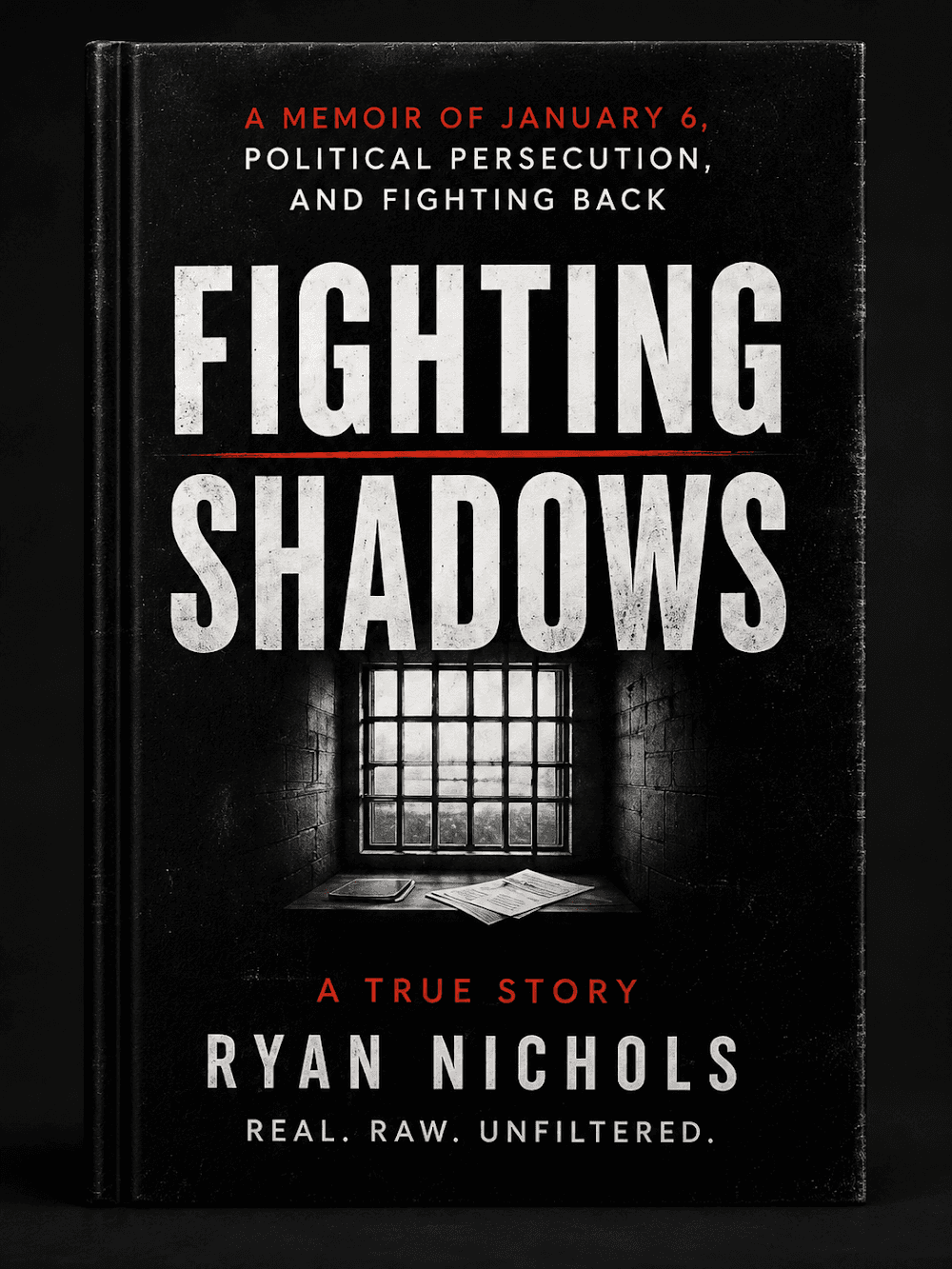
Follow the case
The record is still being written. Get one email when something new drops on it.
Hire Ryan
I built this site. Want one that brings your business real leads? Start with a free 30-minute call.See the services

Tap how this hits you — no signup, everyone sees the count
Share this post — get it back in front of people
Comments
Speak here
Create an account to comment.
This is where people can say what gets buried or cancelled elsewhere. Comments are signed-only, moderated, and tied to a real profile so the record stays usable.
No approved comments yet. Create an account and put the first opinion on the record.