
A Social Card Needs One Source of Truth
A social card can fail when the feed, hero, metadata, schema, and database disagree. Use this seven-point audit to keep every preview consistent.
By Real Ryan Nichols Editorial Team
- 11 total reach
- 0 reading now•0 active 24h
- 0 shares•0 inbound
- 0 comments
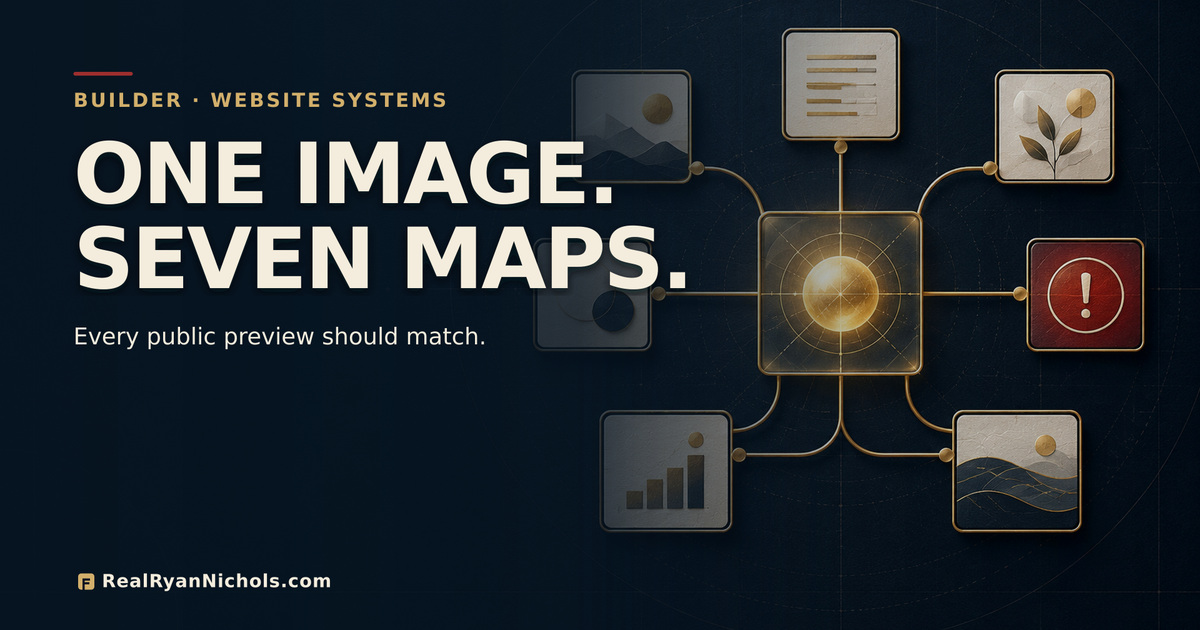
An article does not have one image just because the editor uploaded one file.
It has whatever image the feed reads, whatever the article hero renders, whatever Open Graph declares, whatever X reads, whatever structured data names, whatever the database stores, and whatever page-level override wins.
If those seven places can disagree, the system has seven opinions about the same article.
That is not flexibility. That is unfinished ownership.
A small audit showed the problem clearly
On September 23, a five-post spot check of the newest items on the RealRyanNichols.com feed found four records with an Open Graph image field but no thumbnail field. One record had neither field populated.
The feed still rendered four images because another path supplied them. The fifth item appeared without a card.
This is a five-post sample, not a sitewide failure rate. It is enough to expose the risk: a fallback can make a page look correct while the underlying mapping remains incomplete.
Image-field state in a five-post spot check
Source: RealRyanNichols.com feed and post records, verified September 23, 2026
The fallback is not the source of truth
Fallbacks are useful. They keep a missing field from turning every page into a broken image.
They are also dangerous when they hide drift.
A feed may fall back from thumbnail_url to og_image_url. The article page may use frontmatter. A crawler may see a page override. Structured data may use another helper. An administrator can inspect the page and believe the image is correct because one path happened to work.
Then a platform reads a different path.
Facebook shows the old card. X shows a default. Search schema points somewhere else. The hero is correct, so the error survives.
The repair is not another fallback. The repair is one finished asset mapped everywhere.
Define the canonical asset first
Before touching metadata, decide which public file is authoritative.
For this site, the useful contract is specific:
- One public 1200 by 630 image
- One stable URL on the production domain
- The same URL in every image-bearing field
- One page override for the exact article path
- A retained 3840 by 2016 master for future repair
The file should not be “close enough” to the hero image. It should be the same finished asset.
That removes a whole class of arguments.
Run the seven-map audit
For each published article, check these places in order.
1. Feed card
Load the real feed, not an editor preview. Confirm the card belongs to the right headline and remains readable at phone size.
2. Article hero
Open the public article. Confirm the first visual is the same file, not an older upload or generated fallback.
3. Open Graph metadata
Read the rendered og:image value. Do not assume the framework used the hero.
4. X metadata
Read the X image field separately. Matching Open Graph is the goal, not the assumption.
5. Article schema
Inspect the JSON-LD image field. Search systems can consume this even when a person never sees it.
6. Database fields
Check both the thumbnail and Open Graph image columns. A fallback does not excuse an empty canonical field.
7. Page override
Confirm the exact article path resolves to the same asset. Watch for a missing slash, stale slug, or old URL.
The audit passes only when all seven values resolve to one image.
Verify the picture, not only the response code
An image URL can return HTTP 200 and still be wrong.
It can be the wrong article, a textless background, a compressed export, an old crop, or a default card. Dimensions can be correct while the words are unreadable.
Open the file.
Read every word. Compare the cover copy. Check the subject. Inspect the phone-size preview. Make sure the brand line survives. Look at the feed and the hero, not only a command-line response.
Technical validation proves that a file arrived. Visual validation proves that the right file arrived.
Give the release one owner and one receipt
The last useful improvement is accountability.
The release record should name the asset URL, dimensions, mapping result, deployment state, and verification time. If one gate fails, the article stays unpublished or returns to repair.
That turns “I think the card is fixed” into a checkable statement.
It also makes the next failure faster to diagnose. You can see whether the defect began in design, export, repository mapping, deployment, database mapping, or cache behavior.
The twenty-minute operator audit
Choose the last three articles your business published.
For each one:
- Copy the feed image URL.
- Copy the hero image URL.
- Inspect Open Graph and X metadata.
- Inspect structured data.
- Check the database image fields.
- Check any page-specific override.
- Open the final image at full size and phone-preview size.
If any URL differs, stop calling the system finished.
Create one authoritative asset, map it across every surface, and verify the live result.
Run the seven-map audit on your newest three pages. If you need help tracing where a lead-facing page breaks, use The Lead Flow Pro diagnostic to document the path before changing it.
Read next
Fighting Shadows · Pre-order
Early access for $29.99$29.99
Read it first and own a piece of the story — or become a Founding Supporter (limited to 250).
Don't lose this story to an algorithm.
The next chapter gets posted here first — on my own domain, where no platform can throttle it and no one can ban it. Drop your email or number and the update reaches you the moment it's live.
Email gets one confirmation click. Unsubscribe anytime. No spam, no selling your data — ever.
Tap how this hits you — no signup, everyone sees the count
Share this post — get it back in front of people
Comments
Speak here
Create an account to comment.
This is where people can say what gets buried or cancelled elsewhere. Comments are signed-only, moderated, and tied to a real profile so the record stays usable.
No approved comments yet. Create an account and put the first opinion on the record.