
Should Texas Require Labels on AI-Generated Political Ads?
Texas restricts some election deepfakes, but broad AI-ad labels remain unsettled. Here is the strongest case for transparency and free expression.
By Ryan Nichols
- 594 total reach
- 0 reading now•0 active 24h
- 0 shares•4 inbound
- 0 comments
By Ryan Nichols
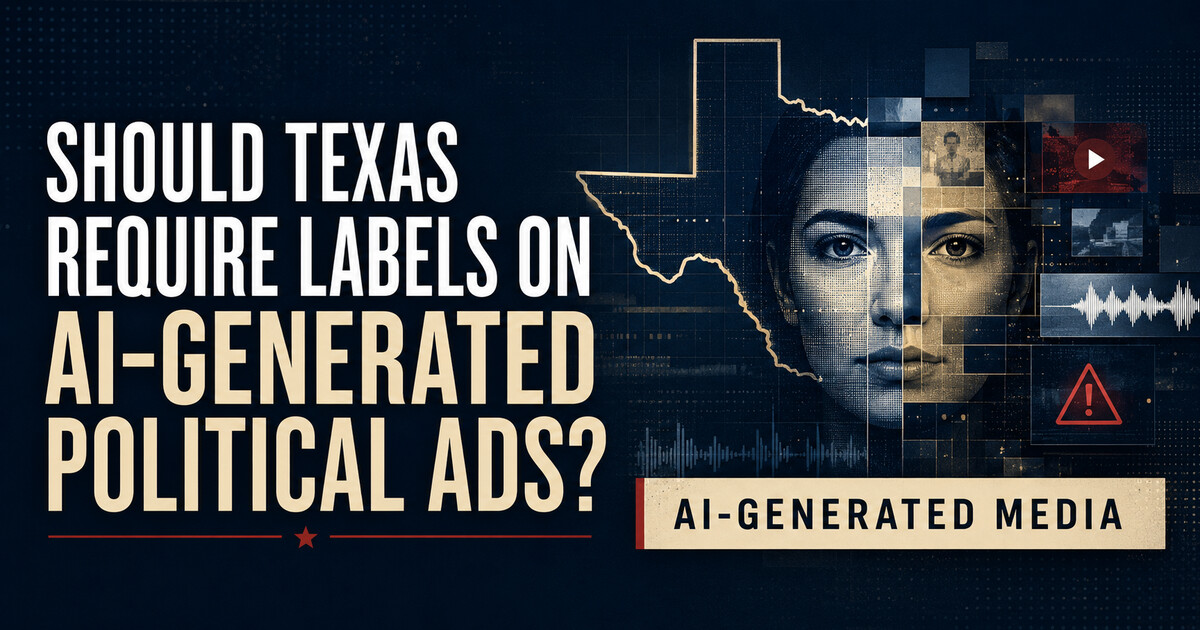
A political ad can now show a candidate saying words that were never spoken, standing in a place the candidate never visited, or appearing in a scene that never happened.
The technology is no longer the difficult part.
The difficult part is deciding who must tell the voter.
Texas law already addresses a narrow category of deceptive election video. A broader disclosure proposal passed the Texas House in 2025, drew serious free-speech objections, reached the Senate, and stopped there.
With another election season moving through increasingly synthetic feeds, the unresolved question is worth asking plainly:
Should Texas require a visible label on paid political advertising that uses realistic AI-generated or materially altered images, audio, or video?
Reader poll
What worries you most about AI political media?
Tap your answer to vote
One tap. Free and anonymous. No signup to vote.
The verified rules as of August 22, 2026
Texas Election Code Section 255.004 makes it an offense to create and distribute a “deep fake video” within 30 days of an election when the person intends to injure a candidate or influence the result. The statutory definition focuses on a video that appears to show a real person performing an action that did not occur.
That law does not create a universal label for every AI-assisted political communication. Its timing, intent, medium, and depiction requirements matter.
In 2025, House Bill 366 proposed a broader disclosure requirement for certain political advertising containing altered images, audio, or video. The official legislative history shows the measure passed the House and was received by the Senate on April 30, 2025. That was its last recorded action, so it did not become law.
The House version applied to candidates, officeholders, political committees, and certain paid distributors. It included exceptions for superficial edits such as changes to brightness or contrast and would have allowed the Texas Ethics Commission to prescribe the disclosure format. Violations could have carried a Class A misdemeanor.
At the federal level, the Federal Election Commission decided in September 2024 not to open a special AI-ad rulemaking. It instead explained that existing federal rules against fraudulent misrepresentation apply regardless of whether AI was used. Federal political communications also carry existing sponsor-disclaimer rules, but a “paid for by” line does not necessarily tell viewers that the image or voice was generated.
Those are the facts. The choice between a broader Texas label and the narrower current rules is an editorial and policy judgment.
The strongest case for requiring a label
The pro-label argument begins with a modest claim: voters deserve to know when realistic evidence is not evidence.
A disclaimer does not ban the ad. It adds context at the same moment the synthetic image, voice, or video reaches the viewer.
Campaigns already accept disclosure rules identifying who paid for many political communications. Supporters see an AI label as the next version of that bargain. A campaign may use the tool, but it should not receive the persuasive power of a fake recording while hiding how the recording was made.
Speed matters too. A convincing clip can move through group texts, social platforms, and reposted videos before a fact-check reaches the same audience. A visible disclosure travels with the original file, at least until somebody removes it.
A carefully written rule could focus on realistic, material alterations in paid ads by candidates, officeholders, committees, and compensated political advertisers. It could exempt ordinary editing, obvious animation, parody, satire, and technical cleanup.
The argument is not that voters are incapable of judgment. It is that a judgment should begin with an honest description of what they are watching.
The strongest case against a state mandate
Political speech receives the highest constitutional protection for a reason.
Once the government can punish a person for publishing altered political media without approved language, definitions matter enormously. What counts as “materially altered”? Is a translated voice AI-generated? Is a reenactment covered? What about an obvious meme that a prosecutor says looks realistic enough?
The failed House proposal carried a criminal penalty. Critics reasonably asked whether jail exposure was a proportionate response to a missing label and whether broad language could chill satire or criticism.
Enforcement can also become political. A rule that looks neutral on paper may be applied unevenly when officials decide which ad crossed the line, which alteration was realistic, and which publisher had the required intent.
Labels are not self-enforcing truth machines. Bad actors can crop them out. Anonymous overseas accounts may ignore Texas law. Meanwhile, campaigns and small political groups trying to comply may face uncertainty and legal costs.
The strongest opposition is not “fake ads are good.” It is that government power over political expression may create a second danger while trying to control the first.
Reader poll
What is the better enforcement tool?
Tap your answer to vote
One tap. Free and anonymous. No signup to vote.
Ryan's Take: Require transparency, but keep the crime narrow
Texas should require a clear disclosure on paid political ads when a realistic image, recording, or video materially depicts a candidate or officeholder doing or saying something that did not happen.
The rule should be narrow enough to read without a lawyer.
It should apply to the people paying for or knowingly distributing the political ad, not an ordinary voter reposting a meme. It should exempt obvious satire, parody, ordinary editing, accessibility tools, and clearly dramatized scenes. The first enforcement step should usually be correction and a civil penalty, not a criminal charge.
Intentional fraud close to an election can remain a separate offense, especially when a campaign fabricates a candidate's voice or conduct and tries to pass it off as authentic evidence.
That line respects both values.
Political speech stays broad. Synthetic evidence does not get to travel as authentic evidence without a label.
This site recently asked Should AI-Assisted Articles Carry a Label?. The political-ad question is harder because the state is not merely setting an editorial norm. It is attaching legal consequences to speech.
Should New Texas Data Centers Bring Their Own Power? and Should East Texas Slow Down Lithium Development Until the Rules Catch Up? raise the same structural problem in different industries. New technology can move faster than public rules. The answer should be a testable boundary, not panic and not blind trust.
If an ad shows a realistic event that never happened, the voter should not have to discover the fabrication after Election Day.
Should Texas require labels on realistic AI-generated political ads, or would that give the government too much power over political speech?
Reader poll
Where do you draw the Texas line?
Tap your answer to vote
One tap. Free and anonymous. No signup to vote.
Sharing this is the biggest help. Put it in front of one more person.
Verification note: Current and disputed claims were checked on August 22, 2026 against the Texas Election Code, Texas Legislature Online, Texas Ethics Commission materials, Federal Election Commission guidance, and contemporaneous legislative reporting. House Bill 366 did not become law.
OG artwork disclosure: The social image is an original synthetic conceptual illustration. It does not depict a real candidate, campaign, political ad, government record, or verified media event.
You made it to the end
Most people quit at the headline. You didn’t.
So don’t stop here. Pick one.
Read the book
Fighting Shadows is the whole story in my own words: the road into January 6, the D.C. jail, and the fight to get the record out.See the book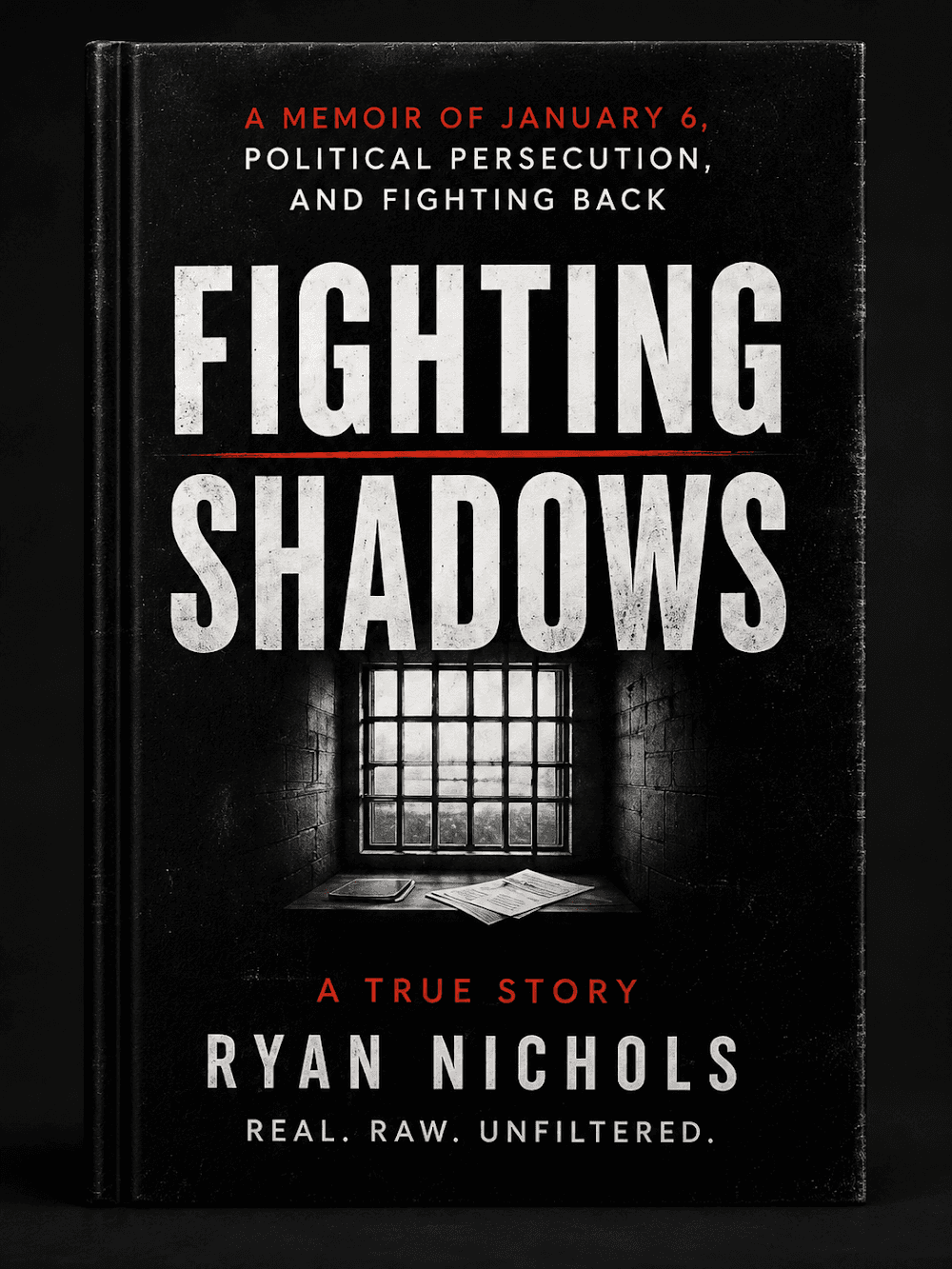
Follow the case
The record is still being written. Get one email when something new drops on it.
Hire Ryan
I built this site. Want one that brings your business real leads? Start with a free 30-minute call.See the services
Tap how this hits you — no signup, everyone sees the count
Share this post — get it back in front of people
Comments
Speak here
Create an account to comment.
This is where people can say what gets buried or cancelled elsewhere. Comments are signed-only, moderated, and tied to a real profile so the record stays usable.
No approved comments yet. Create an account and put the first opinion on the record.