
Should East Texas Slow Down Lithium Development Until the Rules Catch Up?
East Texas lithium could bring jobs and domestic battery supply, but residents want clear rules for brine wells, water, reporting, liability, and cleanup.
By Ryan Nichols
- 398 total reach
- 0 reading now•0 active 24h
- 0 shares•1 inbound
- 0 comments
By Ryan Nichols
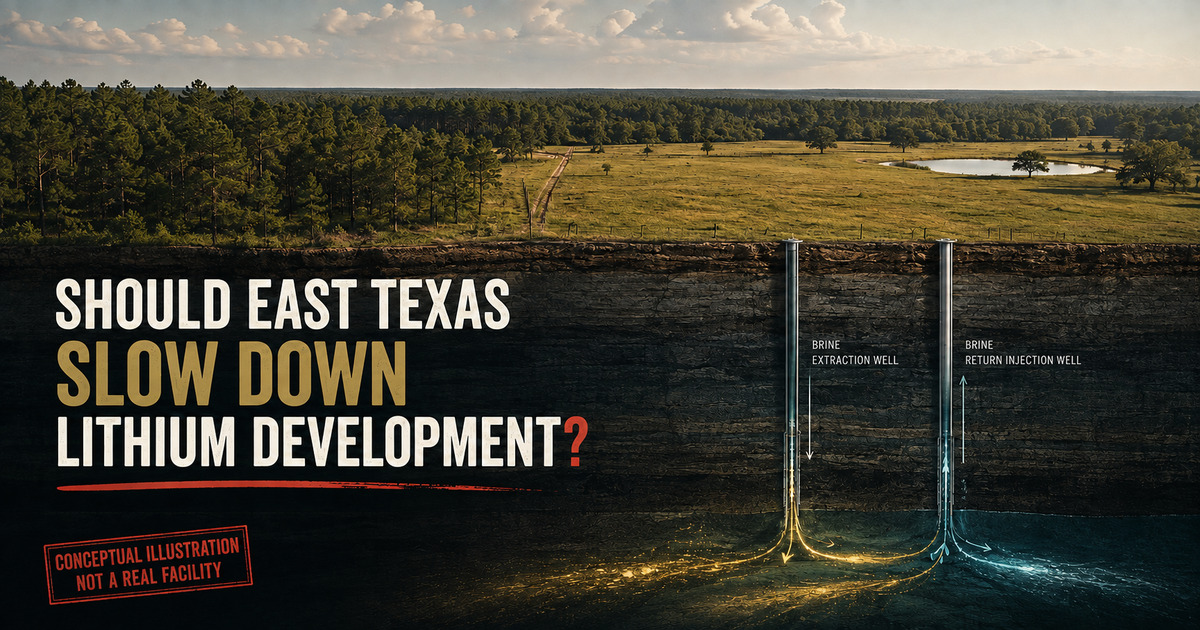
East Texas may be sitting above something the country says it needs badly.
Deep brines in the Smackover Formation contain lithium, a critical mineral used in batteries and other energy technologies. A development-stage company has reported a large inferred resource at its Franklin Project across Hopkins, Franklin, and Titus counties. That puts a national supply-chain argument directly beneath East Texas land, roads, water concerns, and local tax bases.
The disagreement is not simply “mining or no mining.”
It is whether Texas should let the industry move at full speed under the rules already in place, or require more lithium-specific reporting, monitoring, liability, and public transparency before commercial development expands.
That is a real question, and reasonable people can land on either side.
Reader poll
What should East Texas protect first?
Tap your answer to vote
One tap. Free and anonymous. No signup to vote.
The verified facts as of August 21, 2026
The Smackover is a geologic formation extending under parts of Texas, Arkansas, Louisiana, Mississippi, Alabama, and Florida. The U.S. Geological Survey has documented major lithium potential in the formation’s Arkansas brines, while warning that an in-place estimate is not the same as a technically recoverable resource.
In East Texas, Smackover Lithium, a joint venture between Standard Lithium and Equinor, announced an inferred resource for the Franklin Project in September 2025. The company reported 2.2 million metric tons of lithium carbonate equivalent at an average lithium grade of 668 milligrams per liter. Those figures are company claims supported by a technical report, not a guarantee of profitable commercial production. The project remains under development.
Texas does have a regulatory framework. The Railroad Commission of Texas requires a brine production project permit and individual Class V permits for spent-brine return injection wells. Applications must address the brine field, well design, confining zones, project boundaries, and financial assurance. State rule 16 TAC Section 3.82 also addresses well construction, spacing, monitoring, and protection of underground drinking-water sources.
Fresh reporting brought the issue back into public view on August 20 because companies are advancing East Texas plans while residents, industry participants, and policy specialists debate whether brine-mining rules written for a new industry are detailed enough for what comes next.
The strongest case for moving forward
Supporters can make a serious argument.
The United States relies on foreign sources for a meaningful share of its lithium. Building a domestic supply can reduce exposure to overseas disruptions and create an American source for a mineral used across modern manufacturing.
East Texas also has advantages that a new mining region would have to build from scratch. The area knows wells, pipelines, subsurface geology, industrial permitting, and energy work. Existing skills and service businesses could support development.
Direct lithium extraction is designed to pull lithium from brine and return the spent brine underground. Supporters argue that this can use a smaller surface footprint than a conventional open-pit mine or evaporation ponds.
They also point out that Texas did not leave the activity completely unregulated. The Railroad Commission adopted a lithium-inclusive brine rule, requires permits, and can set construction, monitoring, and financial-assurance conditions.
For communities that have watched industries and jobs move elsewhere, telling a regulated new employer to wait indefinitely can sound less like caution and more like surrendering an opportunity.
The strongest case for slowing down
Opponents do not have to reject lithium or economic development.
They can ask whether the public will receive enough information to measure what companies remove, what they return, how pressure changes underground, what chemicals are used, what happens after a leak, and who pays if a project closes.
“There is a permit” is not the same as “the public can see the performance.”
Commercial-scale direct lithium extraction is still new. A company can describe a process as lower impact while residents reasonably ask for operating data, baseline water tests, incident reporting, and closure plans that survive ownership changes.
Property rights also matter. A project can cross leases, mineral estates, surface estates, pipelines, and injection areas. The law must be clear about who owns the brine minerals, who receives compensation, and who carries the long-tail risk.
East Texans have seen what happens when public rules arrive after the damage. The East Texas Disaster That Gave Gas a Warning Smell is an extreme historical example, but its systems lesson is relevant: a warning and a response plan should exist before the failure.
Reader poll
What would build the most trust?
Tap your answer to vote
One tap. Free and anonymous. No signup to vote.
Ryan’s Take
East Texas should not slam the door on lithium.
It also should not confuse being open for business with asking residents to trust a process they cannot inspect.
The right standard is not an indefinite pause. It is a clear release gate.
Before large commercial operations begin, Texas should require public baseline water data, regular production and reinjection reporting, chemical disclosures with legitimate trade-secret protections, incident notices, enforceable cleanup funding, and a county-level emergency plan. Landowners should be able to understand how a project affects both surface and mineral interests before signing.
If an operator can meet those conditions, development should move. If it cannot, the state should not ask East Texas families to carry the uncertainty so somebody else can keep a schedule.
This is the same basic question Texas faces when new loads test the electric grid. Should New Texas Data Centers Bring Their Own Power? asks who should carry a project’s infrastructure burden. Lithium raises the underground version of that question.
Galveston Raised an Entire City After the 1900 Storm shows the cost of building safeguards after catastrophe. The better goal is to build enough of them before scale arrives.
The verified facts do not justify panic. They do justify rules that are specific enough to test, records that are public enough to trust, and liability strong enough to outlast a press release.
Should Texas allow East Texas lithium projects to move under the current framework, or require stronger public safeguards before commercial production begins?
Reader poll
What should Texas do next?
Tap your answer to vote
One tap. Free and anonymous. No signup to vote.
Sharing this is the biggest help. Put it in front of one more person.
Verification note: Current and disputed claims were checked against the Railroad Commission of Texas, U.S. Geological Survey, Texas legislative records, the company’s filed technical disclosures, and fresh reporting on August 21, 2026.
OG artwork disclosure: The social image is an original synthetic conceptual illustration. It is not a photograph, map, engineering drawing, or depiction of a real lithium facility.
You made it to the end
Most people quit at the headline. You didn’t.
So don’t stop here. Pick one.
Read the book
Fighting Shadows is the whole story in my own words: the road into January 6, the D.C. jail, and the fight to get the record out.See the book
Follow the case
The record is still being written. Get one email when something new drops on it.
Hire Ryan
I built this site. Want one that brings your business real leads? Start with a free 30-minute call.See the services


Tap how this hits you — no signup, everyone sees the count
Share this post — get it back in front of people
Comments
Speak here
Create an account to comment.
This is where people can say what gets buried or cancelled elsewhere. Comments are signed-only, moderated, and tied to a real profile so the record stays usable.
No approved comments yet. Create an account and put the first opinion on the record.