
Should Texas Publish Every Data Center’s Water Use?
Texas is pressing data centers to file required water-use reports. Should the state publish facility-level numbers so communities can judge the tradeoffs?
By Real Ryan Nichols Editorial Team
- 3 total reach
- 1reading now•1 active 24h
- 0 shares•0 inbound
- 0 comments
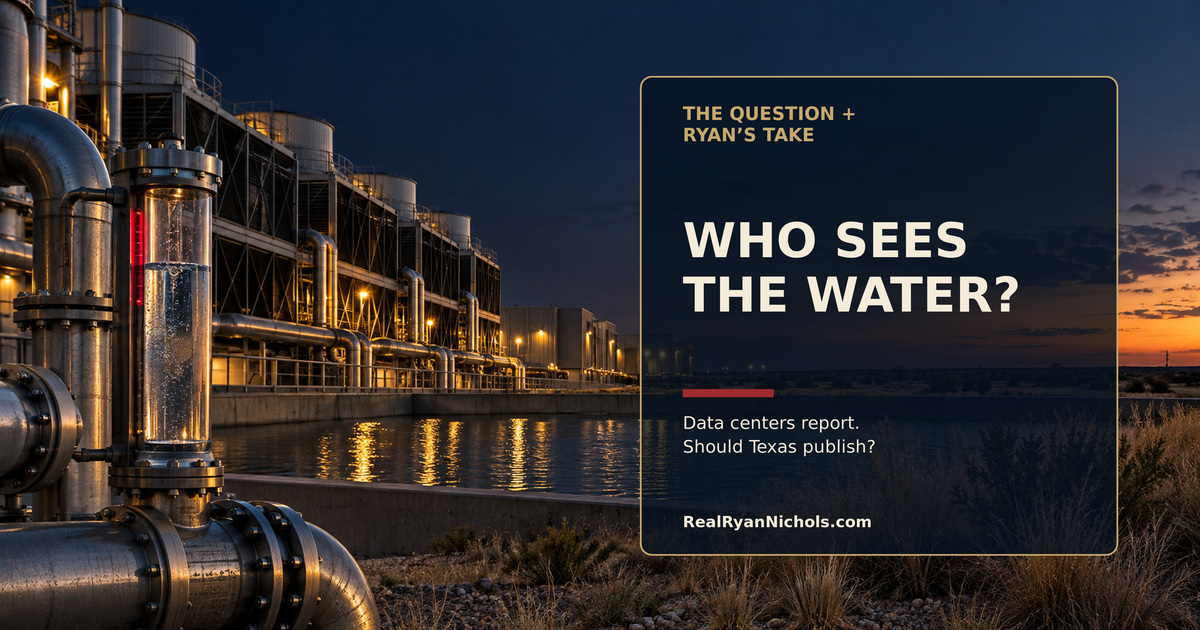
Texas wants data centers to report how much water they use.
The harder question is who gets to see the numbers.
On September 14, 2026, Governor Greg Abbott directed state regulators to penalize data centers and other major water users that do not comply with water-use reporting requirements, according to Reuters reporting published September 14 and updated September 15.
Texas already collects annual water-use information. The Texas Water Development Board says recipients of its Water Use Survey are legally required to respond. Failure to submit can block access to TWDB financial assistance and certain Texas Commission on Environmental Quality permits or renewals until the survey is administratively complete.
Enforcement is one issue. Public disclosure is another.
Should Texas publish facility-level water-use totals for every large data center, or should those reports remain primarily inside the state’s planning and regulatory systems?
What the state collects now
The TWDB uses annual surveys to estimate water use across municipal, industrial, agricultural, mining, power, and livestock categories.
The agency publishes historical water-use estimates and reports. It also maintains survey status information through its reporting systems.
Texas therefore is not starting from zero. The state already treats water-use data as necessary for planning.
Data centers make the question more urgent because the sector is expanding while many Texas communities are planning around drought, aging infrastructure, population growth, and competition for limited supplies.
The state also asks data centers to participate in a separate energy and water use survey through the Public Utility Commission.
The policy choice is whether facility-level results should become easy for the public to find and compare.
The strongest case for public numbers
Water is a local resource before it becomes a line in a statewide spreadsheet.
Residents may pay for new treatment capacity, larger pipes, wells, reservoirs, or conservation programs. Local governments may approve tax incentives or development agreements. Water suppliers may commit capacity that affects what remains available for homes and other employers.
Facility-level disclosure would let the public ask better questions:
- How much water was actually withdrawn or purchased?
- How much was consumed rather than returned?
- Did use match the estimates presented during approval?
- How does the facility perform over time?
- Is recycled or nonpotable water reducing demand on drinking-water systems?
Supporters can reasonably argue that the public cannot evaluate a tradeoff when the most important number is hidden or scattered across records that are difficult to use.
Disclosure can also reward better operators. A company investing in efficient cooling or reclaimed water should be able to show the difference.
The strongest case against a public facility list
One number can create a false picture.
A facility may withdraw water and return much of it. Another may purchase water through a utility that reports the total under a broader municipal account. Climate, computing load, cooling design, and reuse can change the meaning of a gallon.
Publishing raw totals without context could invite misleading comparisons.
Companies may also argue that detailed operational information can reveal capacity, utilization, or expansion plans. A highly specific public report may expose competitive information or security-sensitive infrastructure details.
There is a practical burden too. Texas would need consistent definitions, reporting periods, quality checks, correction procedures, and a way to distinguish estimated data from measured data. A rushed dashboard could look transparent while distributing numbers that are not comparable.
The strongest argument against disclosure is not that the public has no interest. It is that bad disclosure can produce confident conclusions from mismatched data.
Editorial analysis
Texas should publish annual facility-level totals for large data centers, with enough context to keep the figures honest.
The public report should distinguish water withdrawn, purchased, consumed, discharged, and reused when those categories apply. It should name the source, reporting year, measurement method, and whether the figure was corrected.
The state does not need to publish pipe diagrams, security plans, or real-time operating data. It can protect legitimate confidential details while still telling a community how much water a major facility used last year.
If public money, public permits, or a public water system help make the project possible, annual water use is not a trivial private detail.
It is part of the bargain.
What a fair disclosure rule needs
A workable rule should include five safeguards.
- One definition set. Facilities should report the same categories on the same calendar.
- Context beside the total. Withdrawal, consumption, discharge, and reuse should not be collapsed into one ambiguous number.
- A correction trail. Revised data should remain visible with the reason for the change.
- Protection for real security details. Transparency about totals should not become a map of vulnerable systems.
- A local view. Residents should be able to see facilities by water source, utility, basin, and county.
Texas can enforce reporting without publishing everything. It can publish totals without exposing everything.
The state should do both jobs carefully.
Ryan’s Take
If a community is being asked to trust that a giant new load will fit inside its water future, the community should not have to guess what the load became after construction.
Transparency will not settle every argument. It will make the argument more honest.
The number needs context, but context cannot become an excuse to hide the number.
Should Texas publish annual, facility-level water-use totals for every large data center, with clear definitions for consumption, discharge, and reuse?
Read next
Fighting Shadows · Pre-order
Early access for $29.99$29.99
Read it first and own a piece of the story — or become a Founding Supporter (limited to 250).
Don't lose this story to an algorithm.
The next chapter gets posted here first — on my own domain, where no platform can throttle it and no one can ban it. Drop your email or number and the update reaches you the moment it's live.
Email gets one confirmation click. Unsubscribe anytime. No spam, no selling your data — ever.
Tap how this hits you — no signup, everyone sees the count
Share this post — get it back in front of people
Comments
Speak here
Create an account to comment.
This is where people can say what gets buried or cancelled elsewhere. Comments are signed-only, moderated, and tied to a real profile so the record stays usable.
No approved comments yet. Create an account and put the first opinion on the record.