
The Law That Built the Federal Courts Started With Six Justices
On September 24, 1789, the Judiciary Act built the federal court system with six Supreme Court justices, district courts, and federal officers.
By Real Ryan Nichols Editorial Team
- 12 total reach
- 0 reading now•0 active 24h
- 0 shares•0 inbound
- 0 comments
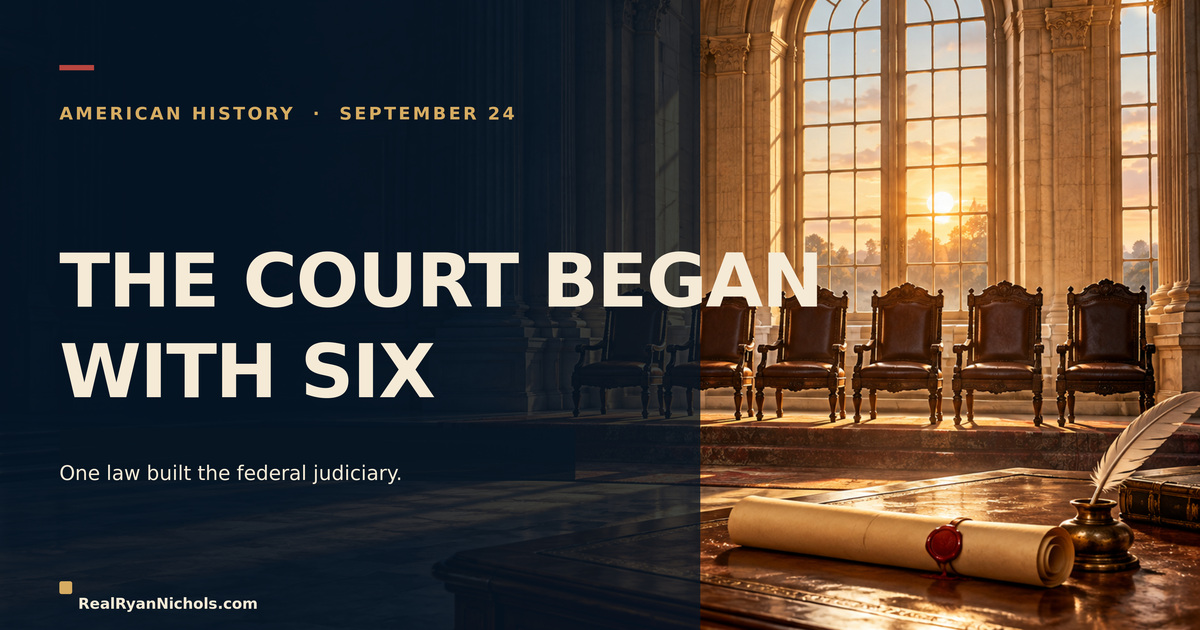
The Constitution said there would be a Supreme Court.
It did not deliver a finished court system.
There were no federal district maps, no circuit structure, no number of Supreme Court justices, no operating schedule, and no complete roster of officers ready to carry federal law into practice.
The promise existed. The machinery did not.
On September 24, 1789, President George Washington signed the Judiciary Act. Congress had taken the broad words of Article III and built a working institution around them.
The first court had six seats
The text of the Judiciary Act of 1789 began with a specific choice: one chief justice and five associate justices.
Six seats.
The number nine feels permanent now because it has lasted so long. It was not written into the Constitution. Congress set the original number by statute, and Congress changed it more than once before the modern nine-seat court settled into place.
The act also required four justices for a quorum and scheduled two annual Supreme Court sessions at the seat of government.
That first section is a reminder that institutions people experience as ancient and inevitable often began with practical decisions made by named people on a deadline.
Congress built a national map
The new country already had state courts. The harder question was how a federal judiciary should exist beside them.
The act created district courts and circuit courts with defined jurisdiction. It divided the states into federal judicial districts and organized circuits that linked the lower courts to the Supreme Court.
The Administrative Office of the U.S. Courts describes the act as establishing a federal court system separate from the individual state courts. It also notes that Congress assigned specific, limited jurisdiction to the lower federal courts while preserving the Supreme Court's original constitutional jurisdiction and creating paths for appeals.
The structure was not merely architectural. It answered where federal questions could be heard, how national law could operate across states, and how decisions could move upward for review.
Reader poll
Which part of the 1789 system surprises you most?
Tap your answer to vote
One tap. Free and anonymous. No signup to vote.
The justices had to travel
Early Supreme Court justices did not spend all their working time in one national courtroom.
The circuit system required them to travel and sit with district judges. That practice, known as circuit riding, was physically demanding and could consume months on rough roads and in uncertain weather.
The design connected the new national judiciary to distant communities, but it also exposed the difficulty of building a federal institution across a large country with slow travel and limited infrastructure.
The system would change. The first design did not have to be the final design to matter.
The act created more than courts
The law also established offices needed to make court orders real.
The U.S. Marshals Service history explains that the act authorized U.S. marshals and deputies to execute federal court orders. It set qualifications, duties, bonds, and an oath of office.
Section 35 provided for a federal attorney in each district and for an attorney general of the United States. The attorney general's original statutory duties included handling federal cases in the Supreme Court and advising the president and department heads on legal questions.
Court clerks, district attorneys, marshals, deputies, judges, and lawyers turned the statute into daily work.
A court without people to file the record, serve the process, present the case, keep order, and execute the judgment would be a promise without reach.
The law carried a compromise
The first Congress did not agree on every question of federal power.
Some lawmakers wanted a strong system of lower national courts. Others feared that federal courts would weaken state courts or pull too much authority toward the new central government.
The Judiciary Act carried that argument inside its structure. It gave the federal judiciary real authority while assigning limited jurisdiction and leaving much ordinary law in state courts.
That tension never disappeared. Americans still debate the reach of federal courts, the meaning of judicial review, the boundary between state and national power, the confirmation process, court administration, and the number of justices.
The responsible way to tell the origin story is not to pretend the first statute answered every future question. It created a system capable of receiving those questions.
A working system is built from specific duties
There is a practical lesson in the law's detail.
The Constitution supplied principle. The act supplied assignments.
Who hears the case? Where? Under what jurisdiction? Who keeps the record? Who serves the order? Who represents the United States? How does review happen?
Large missions fail when nobody turns them into named responsibilities.
That is true in government. It is true in a business, a rescue effort, a church, a family plan, and a rebuilding project.
The recent story of Neptune being found on paper before it was found in the sky shows the power of a prediction precise enough to test. The story of the Little Rock Nine reaching a locked school door shows what happens when a legal decision meets resistance in the real world. The Judiciary Act belongs between those lessons: principle needs a structure capable of carrying it into reality.
Six chairs became a national institution
The original court would change. The circuits would change. The number of justices would change. New courts, procedures, statutes, and constitutional decisions would reshape the judiciary again and again.
But the first Congress had to begin.
On September 24, 1789, a short constitutional command became a working federal system with courts, officers, jurisdiction, routes of appeal, and six seats at the top.
If you value verified stories about the institutions, inventions, and decisions that still shape daily life, join the RealRyanNichols.com email or text list. The next story will come directly to you instead of waiting for an algorithm.
Reader poll
What should the next history story explain?
Tap your answer to vote
One tap. Free and anonymous. No signup to vote.
Editorial visual disclosure: The header image is an original AI-assisted historical illustration. It does not depict a surviving courtroom, document, or specific person.
You made it to the end
Most people quit at the headline. You didn’t.
So don’t stop here. Pick one.
Read the book
Fighting Shadows is the whole story in my own words: the road into January 6, the D.C. jail, and the fight to get the record out.See the book
Follow the case
The record is still being written. Get one email when something new drops on it.
Hire Ryan
I built this site. Want one that brings your business real leads? Start with a free 30-minute call.See the services



Tap how this hits you — no signup, everyone sees the count
Share this post — get it back in front of people
Comments
Speak here
Create an account to comment.
This is where people can say what gets buried or cancelled elsewhere. Comments are signed-only, moderated, and tied to a real profile so the record stays usable.
No approved comments yet. Create an account and put the first opinion on the record.