
The First Working Microchip Had Five Parts and a Mess of Wires
On September 12, 1958, Jack Kilby tested a five-part germanium circuit at Texas Instruments. The rough prototype helped change modern technology.
By Real Ryan Nichols Editorial Team
- 46 total reach
- 0 reading now•0 active 24h
- 0 shares•0 inbound
- 0 comments
By Real Ryan Nichols Editorial Team\n\n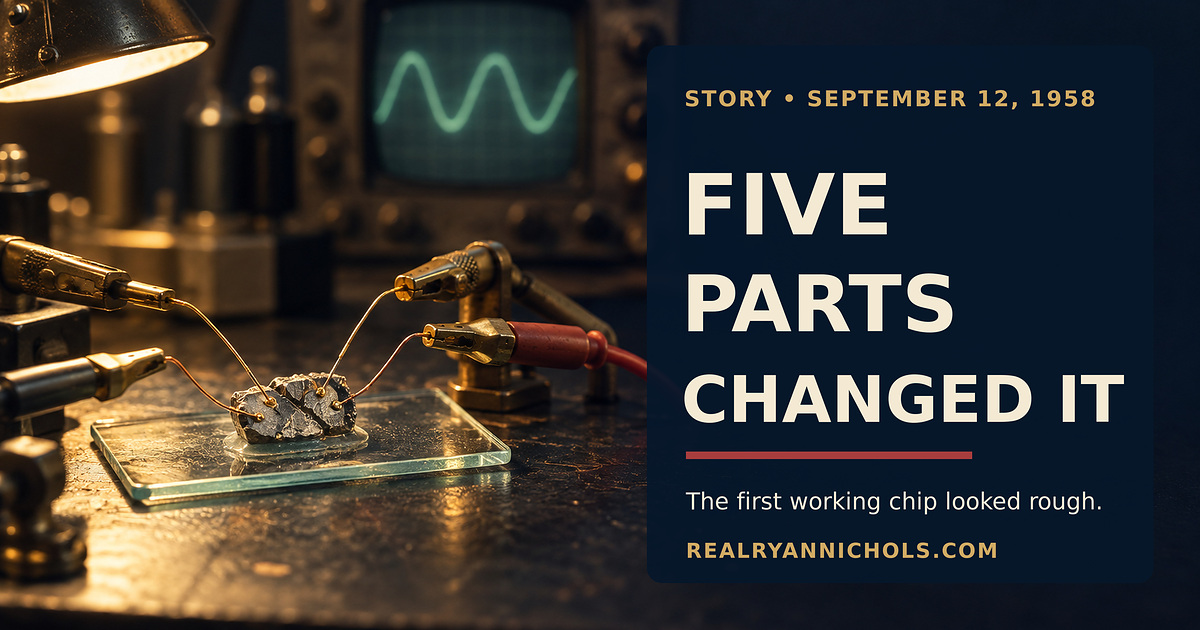 \n\nIt did not look like the future.
It looked like a sliver of material with wires hanging off it.
On September 12, 1958, Jack Kilby tested a small circuit at Texas Instruments. The Computer History Museum’s record describes a piece of germanium with five components linked by wires.
The circuit worked.
That rough demonstration helped establish the idea that components that had been assembled separately could be created on one piece of semiconductor material. The integrated circuit would become the foundation beneath computers, phones, medical devices, vehicles, satellites, industrial controls, and ordinary objects nobody in that room could have fully predicted.
The important part of the story is not that the first version looked advanced.
It is that the first version proved the right thing.
The problem was becoming impossible to wire
Early electronic systems grew by connecting individual components. More capability meant more parts, more joints, more wires, more space, and more places for a failure to begin.
Engineers could make components smaller, but assembly itself became a wall. Shrinking each part did not solve the growing burden of connecting everything reliably.
Kilby’s insight was that the active and passive parts of a circuit could be made from semiconductor material and formed together. Instead of treating each component as a separate object that had to be wired into the system, the system could become one manufactured structure.
That sounds obvious after six decades of chips.
It was not obvious before somebody made it work.
The prototype was not the final answer
Kilby’s first integrated circuit used germanium and external wires. It demonstrated the principle, but it was not the exact manufacturing method that would dominate the industry.
Robert Noyce at Fairchild Semiconductor independently developed a silicon approach that addressed interconnection in a more practical way. The Computer History Museum credits Kilby and Noyce together as inventors of the integrated circuit.
That distinction matters.
Innovation stories get flattened into one person, one flash, and one finished object. Real progress is usually messier. One person proves the idea. Another solves the production problem. Other teams improve reliability, scale, packaging, cost, and design. The thing that changes the world is rarely identical to the object that first proved the world could change.
Five parts were enough to cross the line
The prototype’s five components were not impressive because five is a large number.
They were impressive because five working parts on one semiconductor were enough to answer the central question.
Can this idea function?
Yes.
Once the answer changed from theory to evidence, every later argument happened on different ground.
The device did not need to fit in a customer’s pocket. It did not need a polished case. It did not need a supply chain, a brand campaign, or a price tag.
It needed to produce the signal.
Builders often reverse that order. They polish the explanation before the mechanism works. They design the launch before the test is honest. They ask the first version to satisfy customers it does not have yet.
The September 12 lesson is sharper: identify the smallest proof that would change the conversation, then build for that proof.
A rough test can still be disciplined
Rough does not mean careless.
The circuit had to be assembled well enough to test the idea. The test needed a visible result. The people in the room needed to understand what the result meant.
That is a useful standard for any early build.
Before you make the first version bigger, ask four questions:
- What exact claim is this version supposed to prove?
- What result would count as evidence?
- What can be left out without weakening the test?
- Who needs to see the result to decide the next step?
If you cannot answer those questions, you may be building a demonstration of effort instead of a demonstration of truth.
The object was small. The permission was enormous
The successful test did not instantly place billions of transistors on a modern processor.
It gave engineers permission to keep pushing integration.
That is what a good prototype does. It does not pretend the long road is finished. It makes the next mile rational.
The rough object creates a new fact:
This can work.
From there, teams can ask how to make it smaller, cheaper, faster, more reliable, and easier to manufacture. Before that proof, those questions may be speculation. After it, they become engineering.
Build the proof before the monument
There is a temptation to hide an early version because it looks too simple.
Simple can feel embarrassing when the idea in your head is large.
But the world did not need Kilby’s first circuit to look like a smartphone. It needed the circuit to work.
Your first useful proof may be a spreadsheet, a manual service, a landing page, a cardboard model, a short route, or a process performed by hand before software automates it.
Do not confuse the absence of polish with the absence of value.
Also do not confuse polish with proof.
On September 12, 1958, five components and a mess of wires crossed a line that a perfect drawing could not cross.
The signal appeared.
The idea worked.
The future had evidence.
If you like stories about rough first versions that changed what came next, read The First Solar Car Was 15 Inches Long, then follow the next story here.
What is the smallest honest test that would prove your idea deserves another week?
Read next
Fighting Shadows · Pre-order
Early access for $29.99$29.99
Read it first and own a piece of the story — or become a Founding Supporter (limited to 250).
Don't lose this story to an algorithm.
The next chapter gets posted here first — on my own domain, where no platform can throttle it and no one can ban it. Drop your email or number and the update reaches you the moment it's live.
Email gets one confirmation click. Unsubscribe anytime. No spam, no selling your data — ever.
Tap how this hits you — no signup, everyone sees the count
Share this post — get it back in front of people
Comments
Speak here
Create an account to comment.
This is where people can say what gets buried or cancelled elsewhere. Comments are signed-only, moderated, and tied to a real profile so the record stays usable.
No approved comments yet. Create an account and put the first opinion on the record.