
Did Texas Make the School Phone Ban Too Broad?
Texas bars student phone use across the full school day. Here is the strongest case for the rule, the strongest objection, and the question for parents.
By Real Ryan Nichols Editorial Team
- 3 total reach
- 0 reading now•0 active 24h
- 0 shares•0 inbound
- 0 comments
By Real Ryan Nichols Editorial Team\n\n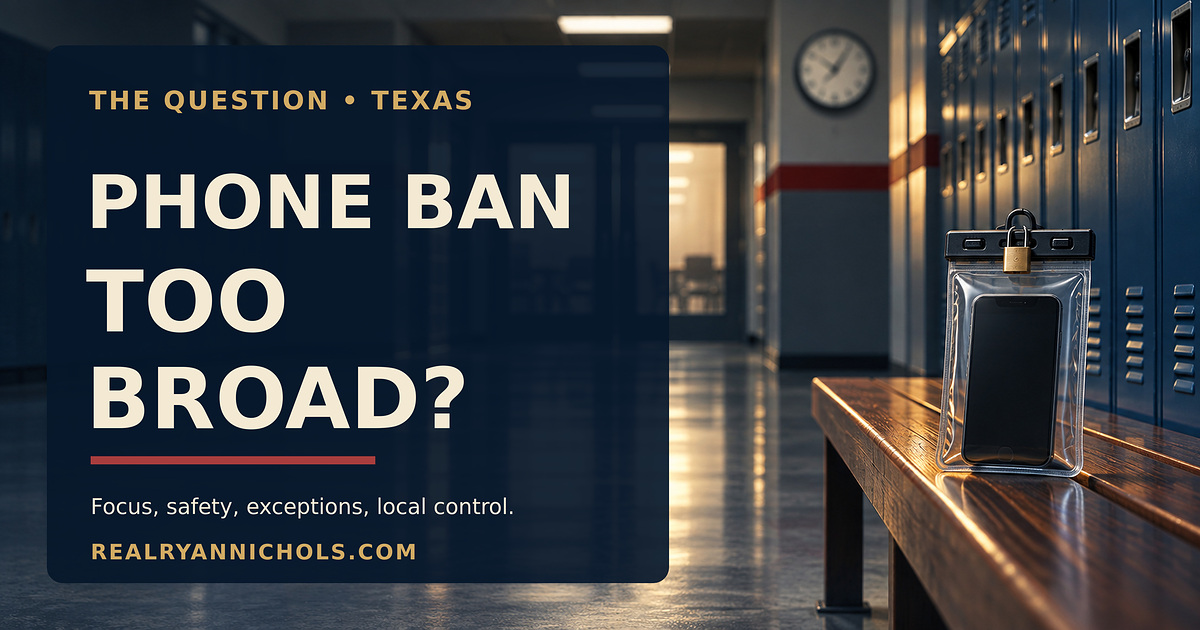 \n\nTexas did not tell public schools to ask students to use phones less.
It told districts and open-enrollment charter schools to adopt written policies that prohibit student use of personal communication devices during the school day.
The rule comes from House Bill 1481, passed by the Legislature in 2025. The law reaches more than phones. It defines personal communication devices to include items such as smart watches, tablets, radios, and other devices capable of telecommunication or digital communication. District-issued devices are treated differently.
The Texas Education Agency’s implementation guidance explains that school systems had to adopt compliant policies and gives room for listed exceptions, including uses required by an individualized education program, a Section 504 plan, a documented medical need, or a health and safety requirement.
The argument is no longer whether phones distract students. Almost everybody agrees they can.
The harder question is whether Texas drew the line in the right place.
The strongest case for the statewide rule
A classroom rule that changes from teacher to teacher is hard to enforce.
One teacher collects phones. Another allows them after the lesson. Another tries to police notifications while teaching. Students learn which rooms have a real rule and which rooms have a suggestion.
A statewide floor makes the expectation easier to understand: the school day is for school.
Supporters can also make a fairness argument. Teachers should not have to negotiate with thirty students every period about whether a glowing screen is urgent. A student without the newest phone should not be the only one looking up while everyone else is scrolling. A child trying to step away from group chats should not have to do it alone.
The broad rule also covers passing periods and lunch if those periods are part of the school day under the policy. That may be the point. If devices return every forty-five minutes, the social pressure and notification loop return with them.
The strongest version of this argument is not “phones are evil.” It is that a school cannot protect sustained attention with a rule full of hourly escape hatches.
The strongest case against the breadth
Parents do not experience a phone only as entertainment.
For many families, it is the direct line to a child during transportation changes, work-schedule changes, health concerns, severe weather, or a campus emergency. Telling a parent to trust the official communication system is reasonable when that system is fast, accurate, and available. It feels different when information is delayed or when a family has lived through a failure.
There is also a local-control argument.
An elementary campus, a rural high school, and a large urban campus do not operate under identical conditions. A district may want different storage rules, consequences, lunch policies, or emergency procedures based on its community. A statewide prohibition can flatten those differences.
Exceptions matter too. The law allows important accommodations, but an exception that exists on paper can still be slow, embarrassing, or inconsistently understood in practice. Students should not have to publicly explain a private medical or disability-related need every time a substitute teacher sees a device.
The strongest objection is not “students should scroll in class.” It is that Texas may have solved a real problem with a rule broader than every campus needs.
What the law leaves to districts
The state sets the prohibition, but local policies still do important work.
Districts decide how devices are stored, what happens after a violation, how a confiscated device is returned, and how exceptions are documented and communicated. The law permits a district to dispose of a confiscated device in some circumstances after notice, and it authorizes an administrative fee before return.
That means two students in different Texas districts can live under the same statewide ban but face very different enforcement.
This is where parents should look beyond the headline. Ask for the actual local policy.
- Does “stored” mean powered off in a backpack, placed in a pouch, or surrendered at the door?
- Can a parent reach a student through the front office without a long delay?
- What is the emergency communication plan?
- How are medical and disability exceptions protected from unnecessary disclosure?
- What happens on the first violation?
- Is there a fee to recover the device?
Those answers tell you how the rule works in real life.
Ryan’s Take
The state was right to stop pretending every teacher could solve this alone.
A rule that only applies during lectures would be weak. The device does not stop shaping attention just because the bell rang. Schools need a clean baseline, and students deserve hours of the day that are not governed by notifications.
But a clean baseline is not an excuse for lazy implementation.
Every district should publish a one-page family version of its policy. It should explain storage, consequences, exceptions, and emergency contact procedures in plain language. The district should test the contact path, not merely list a phone number. It should train substitutes on accommodations. It should report what changed after the first semester, including discipline patterns and exception problems, without exposing students.
If the state keeps the broad rule, the public should get broad accountability with it.
The reasonable middle is not secret phone use and it is not blind trust. It is a firm school-day boundary with a tested family contact system and humane exceptions that work the first time.
The question
Read your district’s actual policy before answering.
Then say where you would draw the line.
Should Texas keep the full school-day phone prohibition, or should local districts be allowed to permit devices during lunch and passing periods?
Read next
Fighting Shadows · Pre-order
Early access for $29.99$29.99
Read it first and own a piece of the story — or become a Founding Supporter (limited to 250).
Don't lose this story to an algorithm.
The next chapter gets posted here first — on my own domain, where no platform can throttle it and no one can ban it. Drop your email or number and the update reaches you the moment it's live.
Email gets one confirmation click. Unsubscribe anytime. No spam, no selling your data — ever.
Tap how this hits you — no signup, everyone sees the count
Share this post — get it back in front of people
Comments
Speak here
Create an account to comment.
This is where people can say what gets buried or cancelled elsewhere. Comments are signed-only, moderated, and tied to a real profile so the record stays usable.
No approved comments yet. Create an account and put the first opinion on the record.