
Should Texas Stop Changing the Clocks Twice a Year?
Texas voted for year-round daylight saving time, but federal law still requires seasonal clock changes. Here are the strongest arguments for each choice.
By Ryan Nichols
- 178 total reach
- 0 reading now•0 active 24h
- 0 shares•0 inbound
- 0 comments
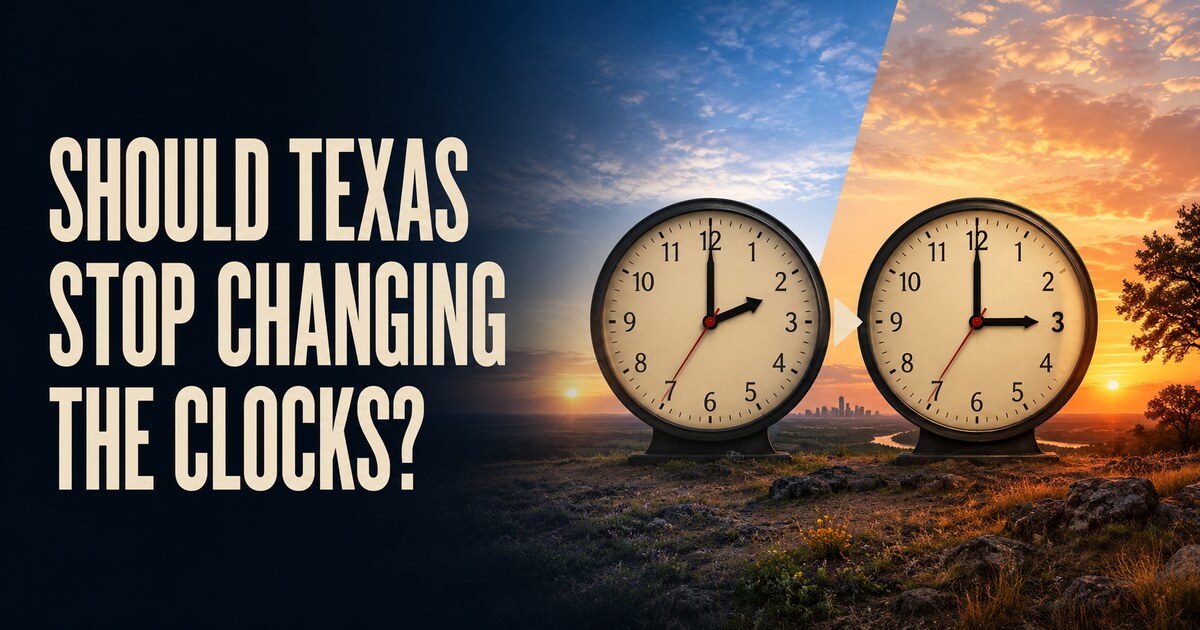
Texas lawmakers have already said what they want: stop changing the clocks and keep daylight saving time all year.
The clocks still change.
That is not because the Texas law disappeared. It is because the state wrote a condition into it that only Congress can satisfy. The result is a useful policy argument hiding inside a simple complaint about losing or gaining an hour.
Should Texas stop the twice-yearly switch? If so, should the state keep the brighter evenings of daylight saving time or the earlier morning light of standard time?
The verified facts
As verified on August 26, 2026, Texas H.B. 1393 says the state shall observe daylight saving time year-round and call it “Texas Time.” The House passed the bill 133 to 11 in April 2025. The Senate passed it 26 to 5 in May.
But the enacted bill also says it takes effect only if Congress passes a law authorizing Texas to remain on daylight saving time year-round.
The current U.S. Department of Transportation explanation of the Uniform Time Act, updated July 15, 2026, says states may exempt themselves from daylight saving time and remain on standard time. States do not have authority to choose permanent daylight saving time. States that observe daylight saving time must use the federally mandated start and end dates.
The National Institute of Standards and Technology says the switch back to standard time occurs on the first Sunday in November at 2 a.m. local time. In 2026, that means the next scheduled clock change is November 1.
So Texas has expressed a preference, but the legal trigger for year-round daylight saving time has not been met.
{{< poll id="texas-time-1" question="What bothers you most about changing the clocks?" options="Sleep disruption|Dark winter evenings|Dark winter mornings|It does not bother me" >}}
The strongest case for ending the switch
The clearest argument is simplicity.
Twice a year, households, schools, workplaces, transportation systems, and software schedules have to absorb an artificial one-hour change. Many devices update themselves, but human bodies do not switch as cleanly.
The CDC's workplace safety guidance says changes in light and time can influence the circadian system and disrupt sleep. It notes evidence of shortened sleep and adverse health and safety effects after the transition to daylight saving time.
Ending the switch would remove that recurring disruption. Parents would not have to reset young children's schedules twice a year. Shift workers would not have to navigate the repeated or missing hour. Businesses operating across locations would face one fewer calendar complication.
There is also a trust argument. Texas legislators took a lopsided vote in favor of a fixed clock. People can reasonably ask why a state decision about local time must wait on Washington.
The strongest case for keeping seasonal time
The strongest defense of the current system is that it moves daylight toward the part of the day when more people can use it.
Summer daylight saving time creates later evening light for travel, recreation, shopping, and outdoor work after the normal business day. Winter standard time moves light back toward the morning, when students commute and many workers begin their day.
A single fixed clock cannot create more daylight. It only decides where the darkness falls.
Permanent daylight saving time would mean darker winter mornings. Permanent standard time would mean earlier summer sunsets by the clock. The seasonal switch is an attempt to split the difference, even if the transition itself is inconvenient.
There is also a coordination problem. Time zones are shared infrastructure. A Texas-only approach could affect transportation, broadcasting, national business, and people who cross state lines. Uniform federal rules reduce a different kind of friction.
The same tension appears in the debate over later school start times in Texas. The clock is not just a number. Morning light, sleep, transportation, family schedules, and local control all collide in the same decision.
{{< poll id="texas-time-2" question="If the clock had to stay fixed, which would you choose?" options="Permanent daylight time|Permanent standard time|Keep seasonal changes|I need more evidence" >}}
Ryan's Take: end the switch, but name the tradeoff
Editorial analysis: Texas should stop changing the clocks twice a year, but “stop changing” is not a complete policy.
The state chose permanent daylight saving time because later evening light is popular and economically useful. That preference is understandable. It also carries a real cost in winter morning darkness. Supporters should say that plainly.
Permanent standard time has a cleaner path under existing federal law and aligns morning light more closely with the body's clock. It also gives up late summer light by the clock. Supporters of that option should say that plainly too.
The wrong way to settle this is to promise that one fixed time improves every part of the year for everybody. It cannot.
The right question is which cost Texas would rather carry: two annual disruptions, darker winter mornings, or earlier summer evenings.
Good policy begins when the tradeoff is visible. That is also the lesson in Protect the First Hour Before the World Claims It. Time cannot be expanded. It can only be assigned on purpose.
What should happen next
Congress could authorize states to select permanent daylight saving time, which would activate the choice Texas already made. Texas could also reconsider permanent standard time, a choice current federal law allows states to make.
Either path should include a clear implementation date, coordination with neighboring states and major transportation systems, and enough lead time for schools, hospitals, employers, and software providers to adjust.
The public deserves something more precise than “keep more sunshine.” No law moves the sun. A law only moves the clock.
{{< poll id="texas-time-3" question="Which cost should Texas accept?" options="Two clock changes|Darker winter mornings|Earlier summer evenings|Let local regions choose" >}}
Should Texas keep waiting for Congress to permit year-round daylight saving time, switch to permanent standard time under current law, or leave the twice-yearly change alone?
{{< share >}}
Verification note: Current legal claims were checked against enrolled Texas H.B. 1393, the U.S. Department of Transportation, NIST, and CDC guidance on August 26, 2026. This article is editorial analysis, not legal or medical advice.
Editorial visual disclosure: The header image is an original AI-assisted conceptual illustration. It does not depict a real location, government action, or document.
You made it to the end
Most people quit at the headline. You didn’t.
So don’t stop here. Pick one.
Read the book
Fighting Shadows is the whole story in my own words: the road into January 6, the D.C. jail, and the fight to get the record out.See the book
Follow the case
The record is still being written. Get one email when something new drops on it.
Hire Ryan
I built this site. Want one that brings your business real leads? Start with a free 30-minute call.See the services



Tap how this hits you — no signup, everyone sees the count
Share this post — get it back in front of people
Comments
Speak here
Create an account to comment.
This is where people can say what gets buried or cancelled elsewhere. Comments are signed-only, moderated, and tied to a real profile so the record stays usable.
No approved comments yet. Create an account and put the first opinion on the record.