
Mother's Day at My Church. The Story Being Told In Public Isn't What Happened.
Ryan Nichols' first-hand account of the Mother's Day 2026 church-parking-lot incident in East Texas — and the blanket social-media gag order he says is unconstitutional and is challenging.
By Ryan Nichols
- 3.2K total reach
- 0 reading now•0 active 24h
- 0 shares•78 inbound
- 0 comments
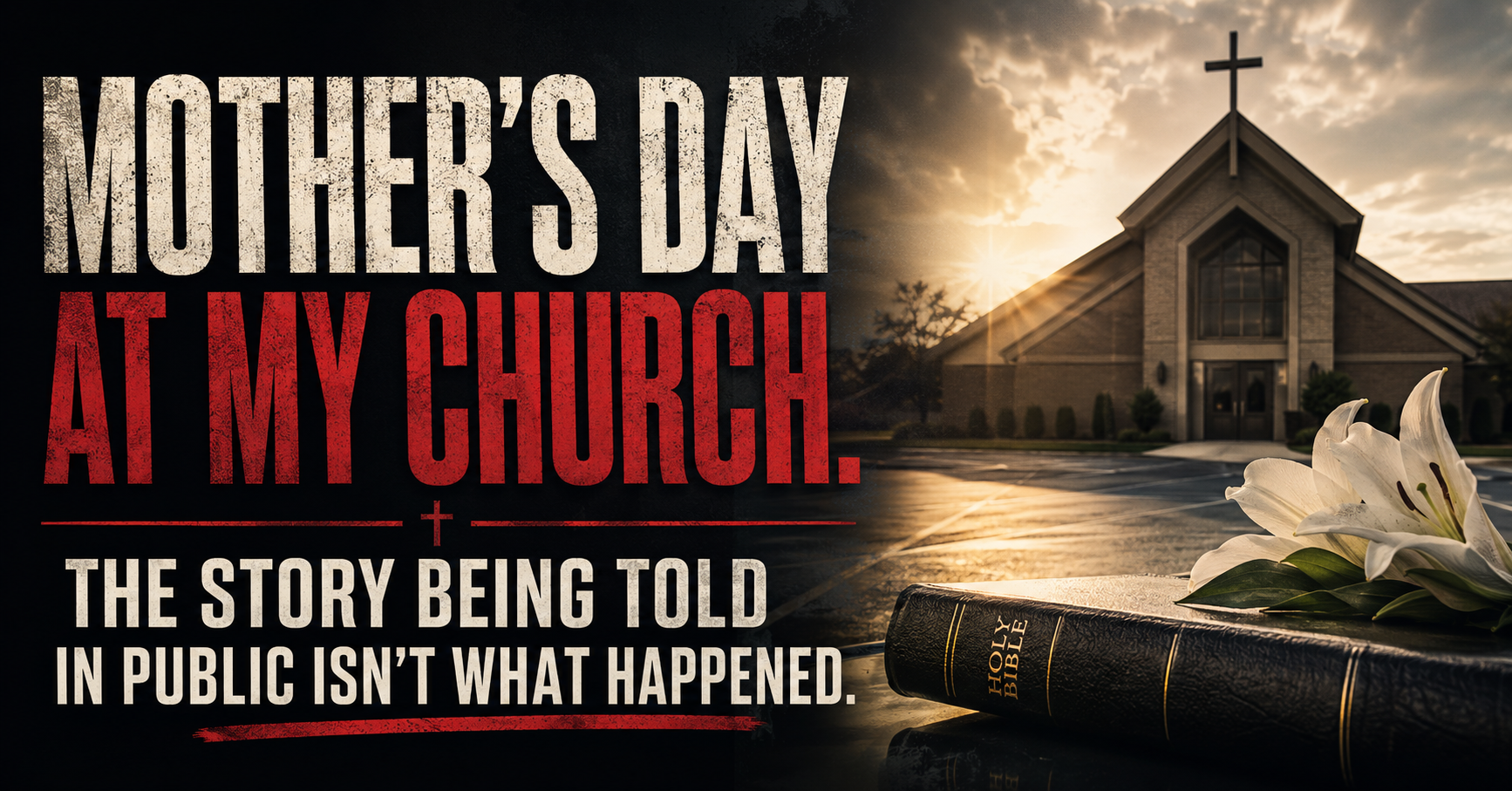
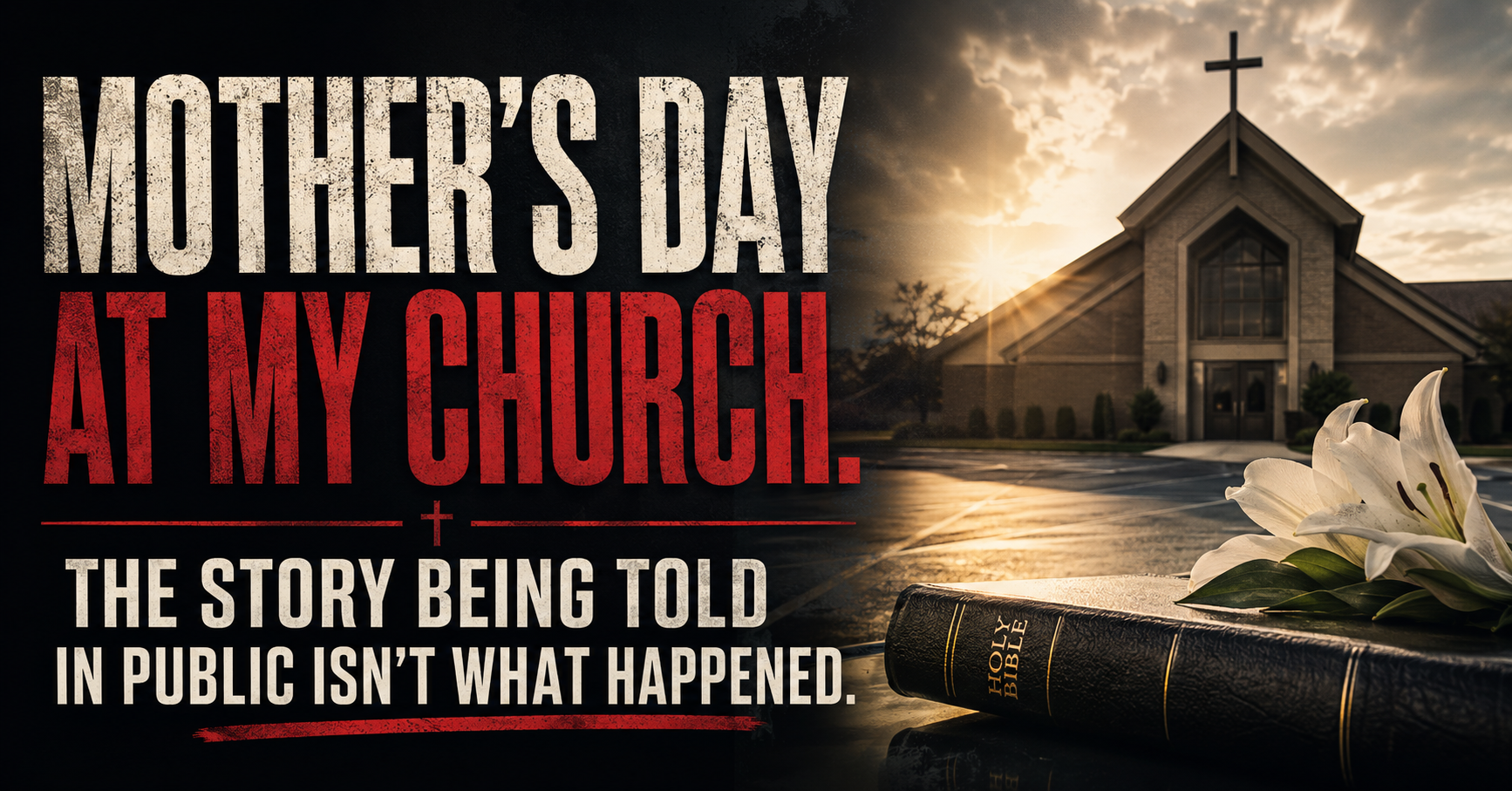
This is an account from an active matter. I am the named subject of accusations arising from an incident at my church on Mother's Day 2026. I am writing in my capacity as an independent investigative journalist about my own case — which I am allowed to do under the modified conditions of my release, and which I have a First Amendment right to do regardless of what any local court tried to tell me at booking. I have intentionally omitted every identifying name. The legal file lives in the legal file. This is what I can say in public — and it is mine to say.
I went to church on Mother's Day.
I sat with my mother. I sat with the people I love. I helped clean up after breakfast like I do every Sunday. I have served at that church — security, gutters, yard work, the kitchen — for months. My father preached there on Sunday nights. We were members.
After breakfast cleanup, I walked out of the church to my car. A family I had known for some time walked out of the same door at the same time, right in front of me, headed in the same direction to the same row of cars. We did not speak. I had no reason to speak to them, and they had no reason to speak to me. I started to pass them on the left.
Their youngest son — a five- or six-year-old boy — said hello to me as I went by. I turned and said hello back. Polite, brief, the way you greet any little kid in a church parking lot. Then I kept walking. Eight to ten more steps. That same little boy called out for me a second time.
When I turned to acknowledge him, this is what I saw: the two adults snarling at their own child, fingers in his face, telling him to stop talking to me.
The boy is five or six years old. He doesn't understand any of this. He was just being a kid greeting a grown-up he recognized from church. What I saw on those adults' faces — directed at their own small child for the crime of saying hello to me — is the moment that tells you everything you need to know about how this incident actually started. Not from me. From them. In front of their own kid. On Mother's Day. In a church parking lot.
I kept walking to my car. I didn't say a word. The family then peeled away from me to put their kids in their own car. That is the moment — when they had broken away to go to their vehicle and there was no one in between us — that I turned around to the father and asked, calmly and openly:
"Would you like to talk?"
That was the entire substance of what I said. Six words. An invitation.
What followed was an escalation that I did not start, in front of children, in front of God, on church property, with cameras pointed at it from eight different angles. A third man — not from either family — stepped between us. He understood what was happening. There are witnesses to that.
When the adult on the other side put his Bible down and lunged at me, I did one thing. I took a single step backward, lifted the hem of my shirt, and put my hand over my pistol. I did not draw it. I did not raise it. I did not point it. I did not threaten anyone with it. Then I did the other thing I should have done — I called the police myself.
That is the story.
The story being told publicly is not that story.
I am the one who called 911 first. The official account of the incident, as it has now spread across social media and local news, is the opposite of what happened on the ground. The first version — told to officers at the scene — was relatively consistent with what I said. Over the next ten, fifteen, twenty minutes, then over the next twelve days, the story changed in public.
I am not the one telling you that the story changed. The record is telling you the story changed. Same speaker, same incident, different versions on different days to different audiences. That's what investigative journalists look for. That's what I'm trained to look for. The fact that the changing story happens to be about me does not change the rules of how you read it.
I have already prepared, for my attorney, a side-by-side chronological catalog of every public statement on the record — same-day video posted to social media, audio captured at the police station, what was said the next morning in private, what was put on Facebook nearly two weeks later. The catalog speaks for itself. I will not be litigating it here.
What I'm asking — and what I'm not
I'm not asking you to believe me because I'm me. I'm asking you to do what I do for a living: look at the public record over time and notice when it stops matching itself.
I'm also going to ask you, plainly, for support — because I am financing this defense myself.
Within hours, they took my guns and tried to take my voice
Within hours of being booked, I lost the firearms I legally owned. Over a misdemeanor.
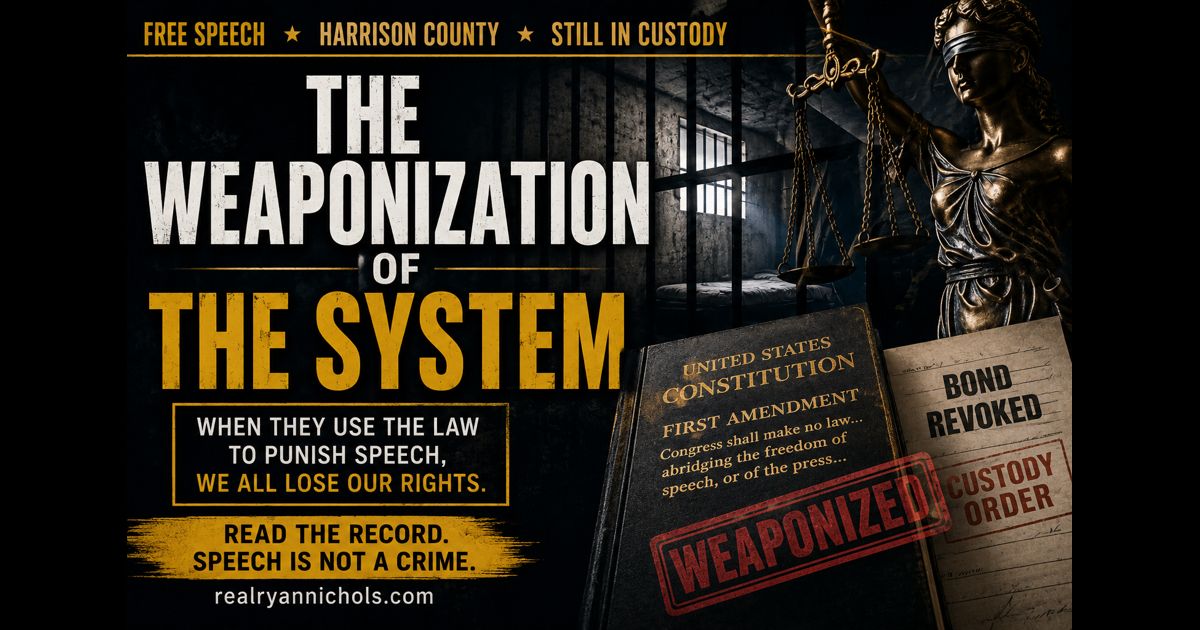
Then, on the record, at the bond hearing, I was told I could not post on social media at all — period. Blanket. Total. As a condition of release.
I told the judge directly that I make my living on the internet as an independent investigative journalist — that I have for fifteen years — and that he could not gag me from doing my job. The answer back was "see you on there, you're going back to jail."
I went to Pre-Trial Services and worked out a modification: I can post for work. I cannot post about the victims. I cannot post personally. I am operating inside that modification — strictly — because that is the order on the record while the underlying condition is challenged. This post is inside the line. I am working. I am not posting personally. I am not posting about the victims. I am doing the job I have done for fifteen years, in a matter where I happen to also be the named subject.
So I built this. This website. RealRyanNichols.com. My own platform, on my own land, under my own First Amendment rights, where my work lives independent of the algorithms that wanted me silent.
The law on this is already settled
I am not making a novel argument. I am citing settled Supreme Court precedent. The blanket social-media gag a Justice of the Peace imposed on me at booking is unconstitutional on its face. Three lines of cases say so:
1. Social media is the modern public square — and social media speech is fully protected, even for convicts.
In Packingham v. North Carolina, 582 U.S. 98 (2017), the United States Supreme Court struck down a North Carolina statute that barred convicted sex offenders from accessing social media. Writing for the Court, Justice Kennedy held that social media is "the modern public square" and "one of the most important places" in modern life for the exchange of views, and that government cannot "foreclose access to social media altogether" without violating the First Amendment. If a convicted sex offender cannot constitutionally be banned from social media, a citizen charged with a misdemeanor — and presumed innocent — cannot lawfully be banned either. That is not a close call. That is a settled call.
The Supreme Court has reaffirmed this framework in two 2024 decisions:
- Moody v. NetChoice, LLC, 603 U.S. ___ (2024) — Unanimous. Justice Kagan re-cited Packingham and described social media platforms as "integral to debates about issues both societal and political." The Court treated social media's central role in public discourse as settled doctrine.
- Lindke v. Freed, 601 U.S. ___ (2024) — Justice Barrett. Reinforces that social media is a constitutionally significant forum for public discourse and applies traditional public-forum and state-action analysis to it.
And Justice Thomas, writing separately in Biden v. Knight First Amendment Institute, 141 S. Ct. 1220 (2021) (Thomas, J., concurring in denial of certiorari), observed that digital platforms function as a modern "public square" — language widely cited even though, as a concurrence in cert denial, it is persuasive rather than binding. The doctrinal direction across these cases is clear: social media is where the First Amendment lives now, and the courts know it.
2. Prior restraints on speech are presumptively unconstitutional.
A bond condition that forbids speech before it happens is the textbook definition of a prior restraint, and the Supreme Court has rejected prior restraints in case after case:
- Near v. Minnesota, 283 U.S. 697 (1931) — government efforts to restrain publication in advance are presumptively unconstitutional and carry "a heavy presumption" against them.
- Nebraska Press Association v. Stuart, 427 U.S. 539 (1976) — even in the middle of a criminal trial, where the State has its strongest interest in protecting the proceedings, prior restraints on speech require the State to satisfy "an exceedingly heavy burden." A blanket social-media gag on a misdemeanor defendant does not come within a country mile of that burden.
3. Bond conditions exist to secure trial appearance — not to punish, and not to silence.
- Stack v. Boyle, 342 U.S. 1 (1951) — the conditions of release exist to assure the defendant's appearance at trial, period.
- United States v. Salerno, 481 U.S. 739 (1987) — pretrial conditions cannot be "punitive" and cannot reach beyond the regulatory purpose they serve.
A blanket "no social media" condition on a misdemeanor has nothing to do with my appearance at trial. It has nothing to do with public safety. It is a punishment imposed before any trial has taken place — on a defendant who is, under the Constitution, presumed innocent.
4. The Texas Constitution is in places even broader than the First Amendment.
This case is in Texas, and Texas law on free speech is not weaker than federal law. The Texas Supreme Court has said clearly that Article I § 8 of the Texas Constitution can be broader than the First Amendment in some applications. Davenport v. Garcia, 834 S.W.2d 4 (Tex. 1992). Texans get two shields — the federal First Amendment and the Texas free-speech clause — and the local court that tried to gag me did not even reckon with either one.
This is what the constitutional argument looks like in plain language: they were wrong. The law is on my side. The motions are being prepared. The challenge is coming. And while it is being litigated, I am operating inside the modified condition Pre-Trial Services agreed to — because that is the right way to challenge an unconstitutional order: comply with the modified version on the record while you litigate the underlying restriction. You do not pretend an unconstitutional order is enforceable. You build the case that proves it isn't.
What's next
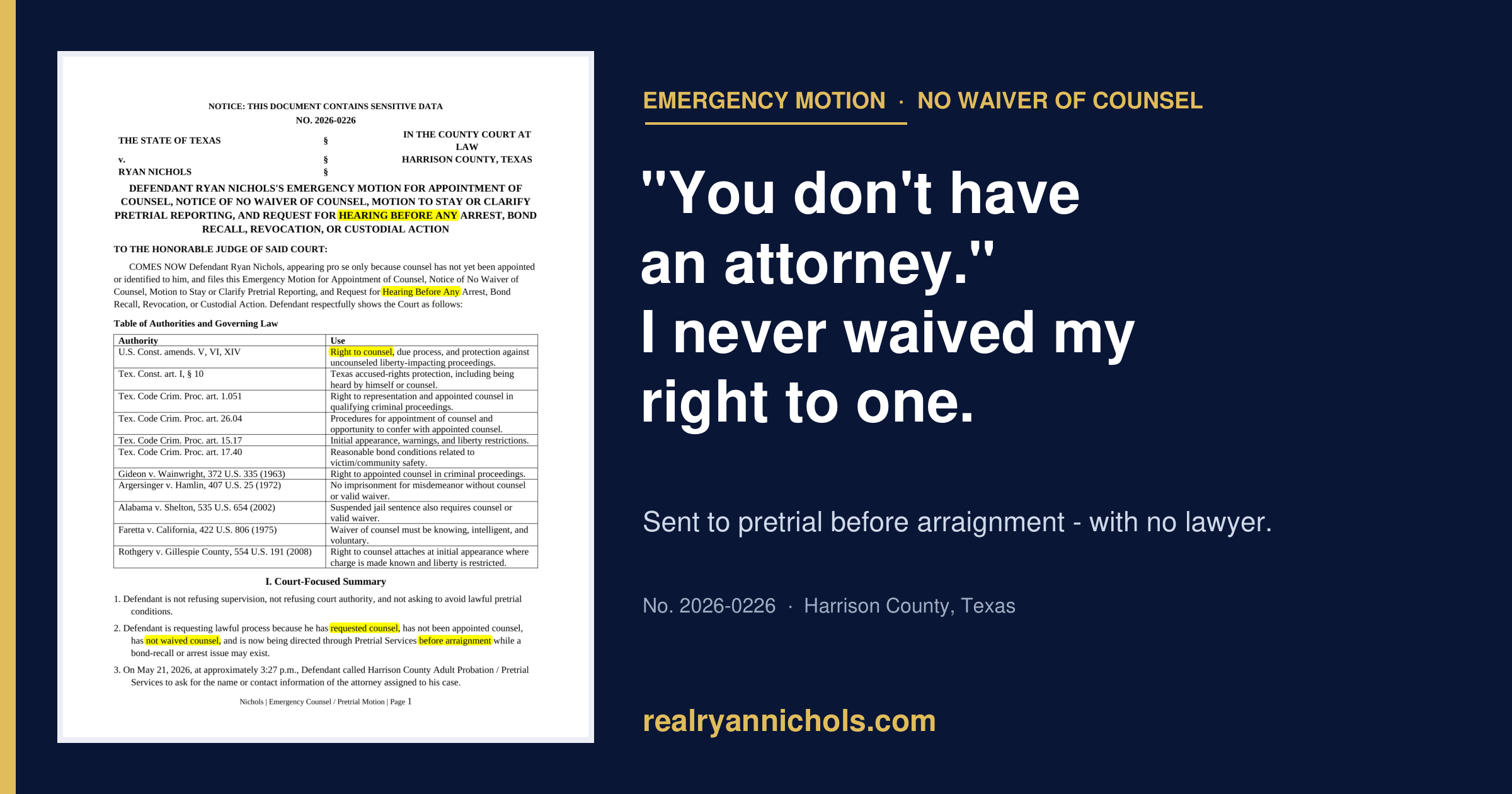
I am preparing the litigation file myself, pro se, until counsel comes on. The motions are coming. The First Amendment challenge to the blanket social-media ban is coming. The Second Amendment challenge to the misdemeanor gun-removal is coming. The preservation letters to the people who hold evidence are going out. The body cam, the church cameras, the dispatch audio — all of it.
I will tell you what I can, when I can, on this site, where I am not at the mercy of someone else's takedown queue and not subject to anyone else's idea of what I am or am not allowed to say about the law of the United States.
Genesis 50:20
"You intended to harm me, but God intended it for good, to accomplish what is now being done, the saving of many lives." — Genesis 50:20
This verse has been my anchor through everything that's been thrown at me. The cell was real. The traps were real. The lies were real. The damage to my family, my reputation, my business — all real. And God is still using it.
I am not going to be silenced by a misdemeanor.
I am not going to be silenced by anyone.
I am going to keep telling the truth, in my own words, on my own land, in a way that no one can erase.
Stand with the work
If this matters to you, the most useful things you can do are:
1. Share this post. Send it to one person who needs to read it. Algorithms throttle me on mainstream platforms. One share is ten people who hear it.
2. Support the rebuild. I am pro se right now. I am paying bond, paying legal-prep costs, and feeding my family with the work I do on this site. Every dollar keeps the lights on, the motions filed, and this website running independent of the platforms that wanted me gone.
➡️ Stand with this work on the support page
3. Become a verified Supporter ($997, one-time). For people who want to lock in. Same link, scroll down to "Become a verified Supporter."
4. No money? You're still in this. Pray. Sign up for updates. Send the link to one person you trust. That is real currency.
➡️ Sign up so the next update comes straight to you
My pledge
This site doesn't take donations — I sell what I build: the book, the builds, the store. That is a pledge in writing. I am not here to milk my own story. I am here to leave the cell — the real one and the one built around me afterwards — and walk back out into the daylight with God and the people who refused to count me out.
Genesis 50:20.
— Ryan
You made it to the end
Most people quit at the headline. You didn’t.
So don’t stop here. Pick one.
Read the book
Fighting Shadows is the whole story in my own words: the road into January 6, the D.C. jail, and the fight to get the record out.See the book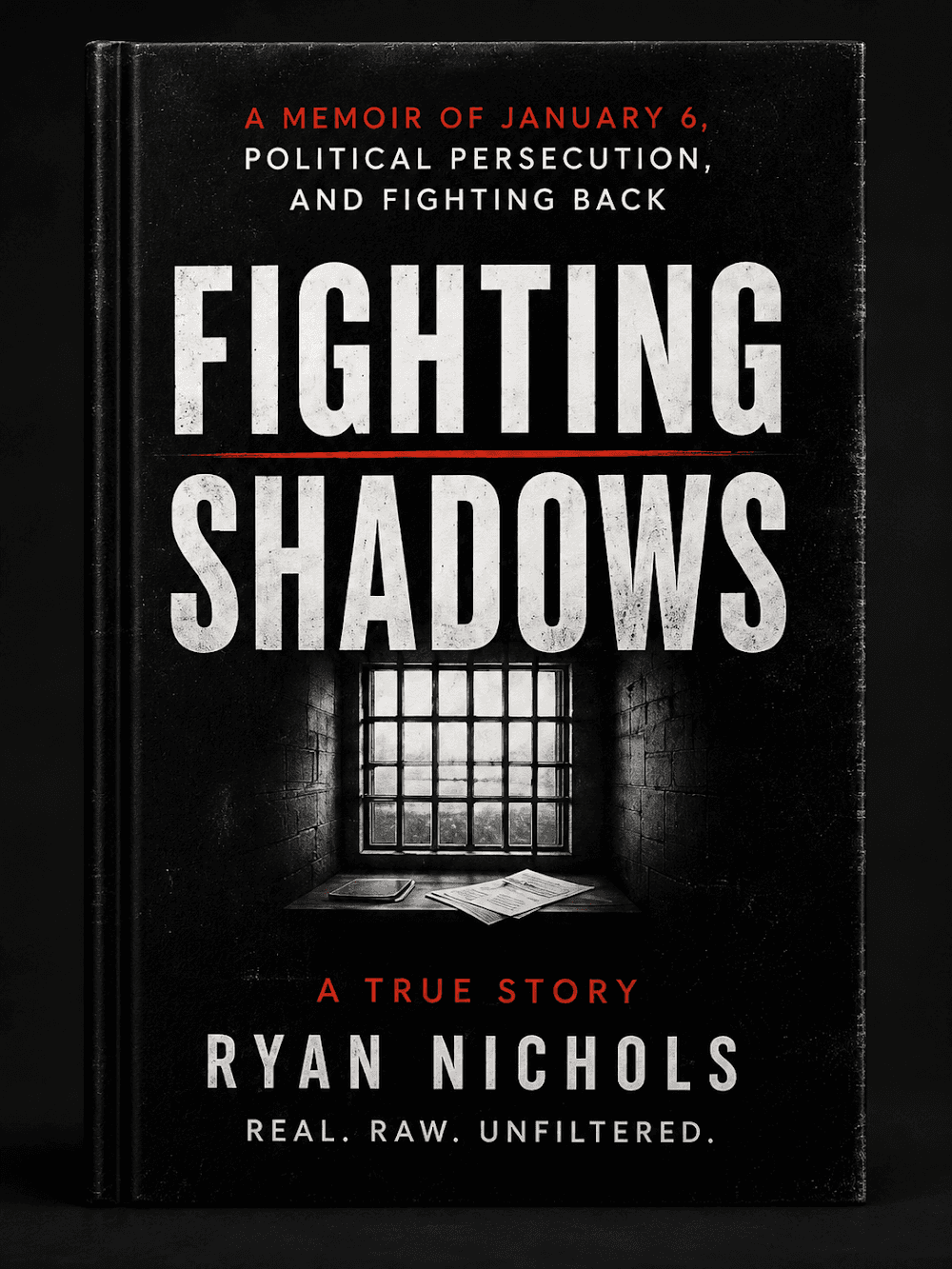
Follow the case
The record is still being written. Get one email when something new drops on it.
Hire Ryan
I built this site. Want one that brings your business real leads? Start with a free 30-minute call.See the services

Tap how this hits you — no signup, everyone sees the count
Share this post — get it back in front of people
Comments
Speak here
Create an account to comment.
This is where people can say what gets buried or cancelled elsewhere. Comments are signed-only, moderated, and tied to a real profile so the record stays usable.
No approved comments yet. Create an account and put the first opinion on the record.